

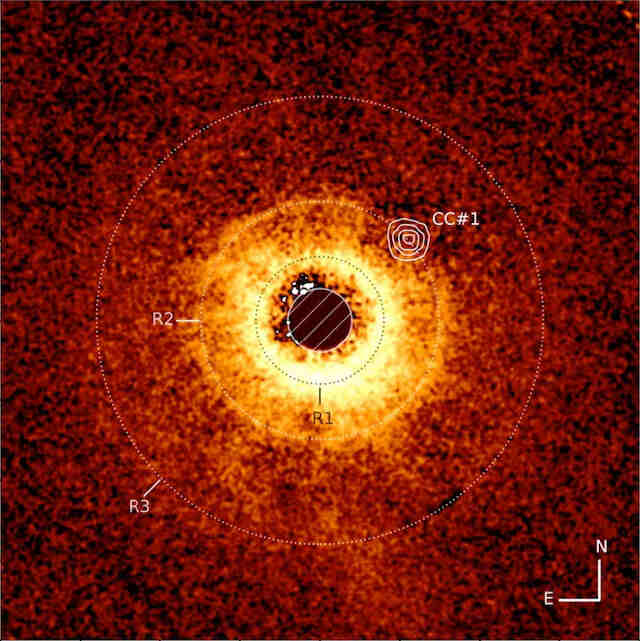
The James Webb Space Telescope (JWST) has made a groundbreaking discovery: it has directly imaged a new exoplanet, TWA 7 b. This is the first time a planet has been directly imaged by JWST since its launch in 2021.
The planet TWA 7 b is about 110 light-years away in the constellation Antlia and is a Saturn-sized gas giant. It is also the least massive exoplanet ever directly imaged, at about 0.3 Jupiter or 100 Earth masses, a feat made possible by Webb’s Mid-Infrared Instrument (MIRI) and its French-built coronagraph.
TWA 7 b orbits a young star that is only 6 million years old. The star is located 52 AU (astronomical units) away from TWA 7 b, which is within a dusty debris disk composed of concentric rings.
Deep learning models are being used to help researchers understand the data that JWST has collected. These models can be trained on large datasets of exoplanet observations, which allows them to make predictions about the exoplanets. Deep learning models can also analyze the data, which helps researchers determine which exoplanets are most likely to support life.
The JWST has opened up a new frontier for exoplanet exploration. It is capable of finding smaller, colder, and more distant exoplanets than were previously detectable. The JWST and deep learning models are powerful tools for exploring our universe.
The JWST discovery of the exoplanet TWA 7 b is the result of the convergence of deep learning and Webb's telescope observations. This convergence shows the potential for discovery that is unlocked when we combine powerful tools with human curiosity and ingenuity.
Orbiting a mere 6‑million-year-old star at ~52 AU, TWA 7 b resides within a dusty debris disk composed of concentric rings, potentially shepherded by yet-unseen companions.
With less than 2% of known exoplanets directly imaged, Webb’s leap marks a breakthrough in discovering colder, more distant, and lower-mass worlds.
“Webb opens a new window—in terms of mass and the distance of a planet to the star of exoplanets that had not been accessible to observations so far,” said Anne‑Marie Lagrange.
Though worlds apart in scale, both stories share a theme: seeing the unseen, whether it's particles dancing in a supercomputer or a newborn planet hidden in starlight.
- Supercomputer modeling provides the theoretical scaffolding that guides experimental design and interpretation what conditions to recreate, what signals to seek.
- On the other end, Webb’s discovery offers empirical validation real-world snapshots of cosmic phenomena that can inform simulation parameters or even inspire new models.
Combined, they show how virtual and observational science are converging each advances the other. Simulations refine telescope targets; telescope images validate and challenge simulations. Step by step, we’re decoding nature’s most elusive puzzles from the wildest weather patterns on Earth to the birth of worlds in distant star systems.
Looking Ahead
- For simulations: Future goals include smarter algorithms that maintain precision but eat far less power unlocking even more complex virtual experiments.
- For exoplanet exploration: Webb’s coronagraphic success is just the beginning, the hunt is now on for smaller, colder worlds, moving ever closer to those that could, someday, harbor life.
In a thrilling week for science, supercomputers and telescopes alike are expanding humanity's gaze be it into the microscopic mechanics of Earth, or the swirling rings and fledgling giants of other star systems. Two very different journeys, but united by one curiosity: to uncover the secrets hidden in the unseen.