

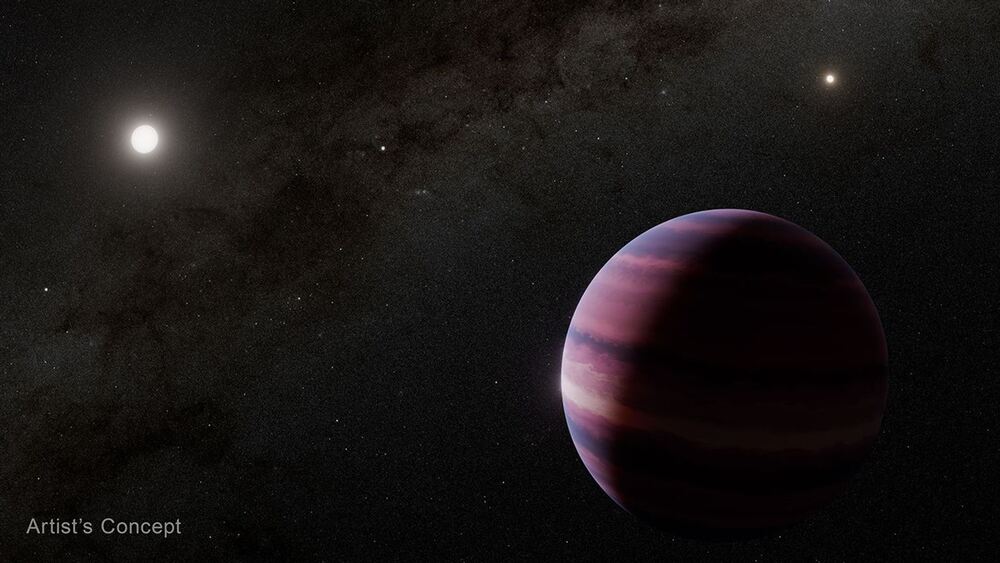
Astronomers have revealed exciting new evidence of a Saturn-mass planet orbiting Alpha Centauri A, the nearest Sun-like star to Earth, thanks to the advanced capabilities of NASA's James Webb Space Telescope and the analytical prowess of supercomputer simulations.
The planet candidate, concealed amidst the brilliance of two glowing suns, was detected using Webb's Mid-Infrared Instrument (MIRI) with a coronagraphic mask to block out starlight. Researchers then painstakingly extracted the planet's signal through advanced image processing and modeling. However, capturing the light is just part of the story, supercomputers provided the essential support.
Simulations: Illuminating an Invisible World
After Webb’s initial observation identified a source more than 10,000 times fainter than Alpha Centauri A, subsequent images were unable to recreate the detection. To understand why, scientists turned to high-powered simulations, digital models that trace hypothetical orbits, analyze light behavior around bright stars, and interpret the optical signatures left by a planet that is too faint to be seen clearly.
These simulations, conducted on supercomputers designed to handle massive datasets, enabled researchers to rule out artifacts, confirm that the signal was consistent with that of a planet, and explain why it might disappear from view in subsequent observations. Such modeling is critical; by virtually recreating the interplay of light, shadow, and movement around the star, researchers could confidently support their candidate's existence.
The Promise of What Lies Ahead
This combination of Webb’s observational power and supercomputer modeling expands our horizons. If confirmed, this gas giant orbiting within the habitable zone of one of our nearest stellar neighbors would represent a significant advancement, achieved through the synergy of cutting-edge engineering and computational capabilities.
As Caltech graduate student Aniket Sanghi notes, confirming this discovery would signify “a new milestone for exoplanet imaging,” driven not only by Webb’s observations but also by the powerful computational tools that bring clarity to complex data.
In an era where every pixel presents a puzzle and every faint dot may represent a new world, it is the collaboration between telescopes and supercomputers that lights our path forward.