

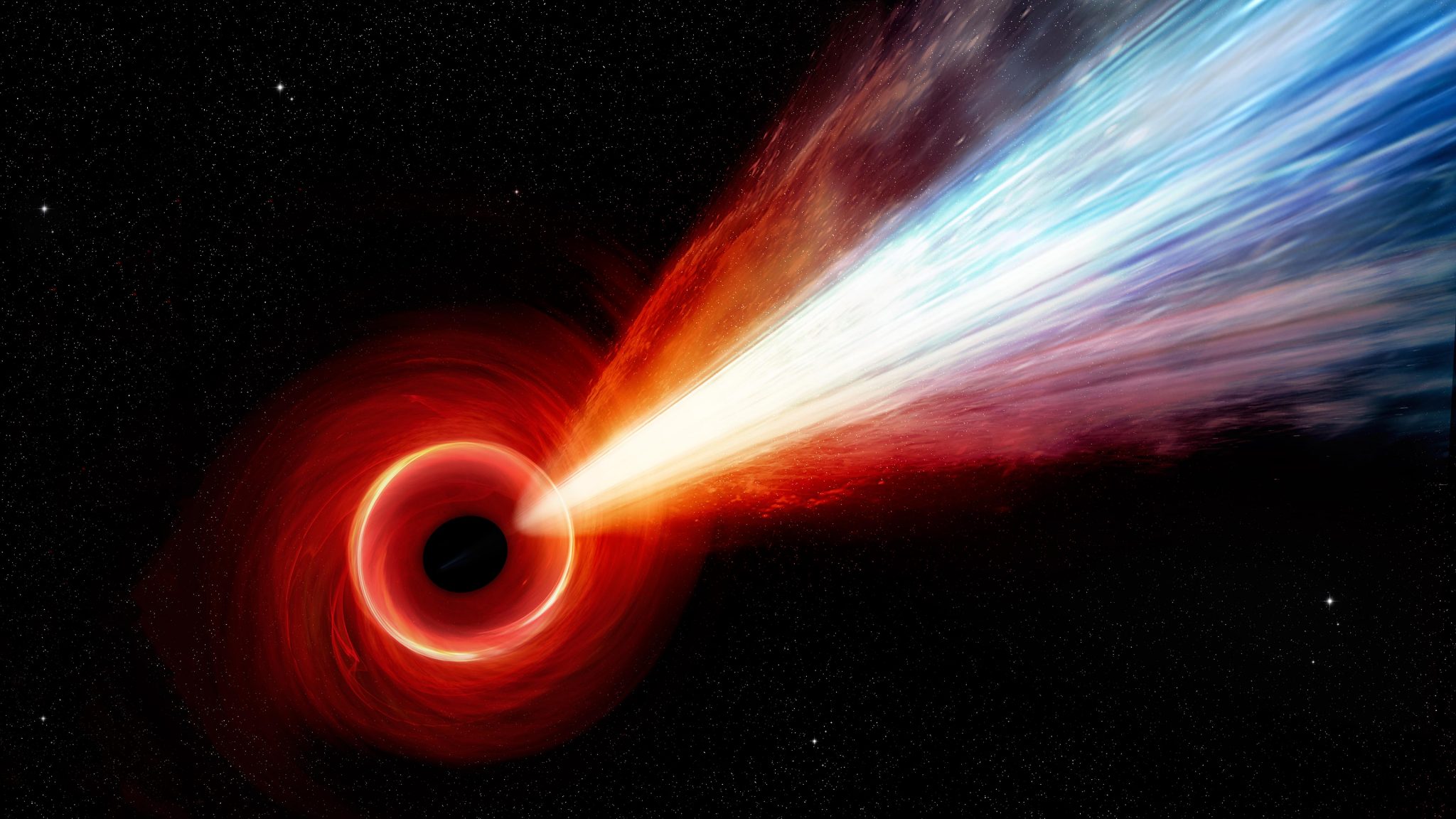
Within the vast, silent expanse of the universe, black holes remain concealed yet omnipresent. Despite their invisibility, their gravitational influence is undeniable, as they consume matter and distort the fabric of spacetime. Paradoxically, these celestial entities also fuel some of the universe's most remarkable phenomena: relativistic jets, powerful beams of matter and energy that propagate outwards at speeds approaching the speed of light. The mechanisms driving these cosmic jets have long been a subject of intense investigation within the physics community. Now, a research team at Goethe University Frankfurt posits a breakthrough in understanding this phenomenon, employing supercomputing technology rather than traditional telescopes to unravel the mystery.
A Century-Old Mystery, Revisited
The galaxy Messier 87 (M87) has long captivated astronomers. At its heart lies a supermassive black hole, M87*, estimated to weigh six and a half billion Suns. From this inky core, a jet erupts, carrying plasma outward across thousands of light-years. Despite decades of observation, the precise mechanism by which a black hole converts its rotational energy into a directed, powerful jet has remained elusive.
The Frankfurt team, led by Professor Luciano Rezzolla, has developed a new computational framework—the FPIC (Frankfurt particle-in-cell) code—that simulates the interaction of charged particles, electromagnetic fields, and gravity near a spinning black hole in extreme detail. Their findings point to a two-fold mechanism: the well-known Blandford–Znajek process, which extracts energy via magnetic fields anchored in the black hole’s spin, and a newly highlighted role for magnetic reconnection. In this latter process, magnetic field lines break and rejoin, releasing energy, accelerating particles, and feeding into the jet itself.
Supercomputers as Modern Alchemists
Simulating these scenes—where gravity, electromagnetism, and plasma physics converge—demands computational power of immense scale. The Goethe team leveraged the "Goethe" supercomputer and Stuttgart's "Hawk," consuming millions of CPU hours to execute their models. The code simultaneously solves Maxwell's equations (governing electromagnetic fields), the equations of motion for electrons and positrons, and aspects of general relativity, all within a curved spacetime. It creates a virtual environment where plasmoids (bubbles of plasma) emerge on the equatorial plane, are propelled outward, and ultimately funnel into jets aligned with the black hole's rotational axis.
The simulations' remarkable accuracy in mirroring observational data—matching temperature estimates, densities, magnetic field strengths, and even radio emissions—bolsters confidence in both the computational method and the physical model it elucidates.
A New Narrative for Jet Power
This work's most inspirational aspect is its expansion of our theoretical toolkit. While the Blandford–Znajek mechanism has long been the leading explanation for how rotating black holes launch jets, the Frankfurt simulations suggest that magnetic reconnection plays a significant, and perhaps indispensable, supporting role. Plasmoids created by reconnection may tap into the black hole’s energy reservoir, spawn regions of negative energy, and seed the jet structure itself. This layered mechanism helps explain how jets maintain their power over thousands of light-years and remain stable, even in the chaotic environment near a black hole. It paints black holes not as mere consumers of matter, but as cosmic engines—engines that convert spin into focused, blazing outflows.
Inspiration from Codes and Crystals of Light
Beyond the physics itself lies a deeper message: the universe responds to our curiosity, if only we dare to ask with enough fidelity and boldness. These simulations don’t just approximate reality; they become mini-universes, where fields, particles, and forces dance under our command (at least in code). Supercomputers serve as the telescopes of the theoretical world. It is no small feat to translate equations into digital matter, to make each photon, electron, and magnetic line part of a symphony. The researchers behind FPIC have demonstrated the extent of human ingenuity, building tools that convert abstract mathematics into images and predictions that reflect the real cosmos.
Into the Future: Open Questions & Wider Horizons
While the Frankfurt simulation marks a significant step, it's not the final answer. Real black holes are fed by complex accretion disks that experience magnetic turbulence, instabilities, and misalignments. How do these local environments—warped disks, feeding flows, and external field structures—influence jet morphology and stability across galactic scales?
The team aims to expand FPIC to more realistic scenarios, including varied spin rates, tilted disks, and uneven magnetic environments. They also plan to directly compare their findings with upcoming high-resolution observations, such as those from next-generation radio interferometers.
One thing is certain: when minds, mathematics, and machines align, the universe reveals itself to us in beautiful, unexpected ways. From the silent entropy of black holes to the blazing pillars of relativistic jets, we are learning that even the darkest regions can shine when viewed through the lens of human curiosity and supercomputing power.
In a data center, supercomputers hum. In their memory, replicas of black hole environments evolve. Magnetic fields twist, plasmas erupt, jets hurtle outward. And in our world, these simulations bring us closer to understanding how the universe’s deadliest monsters light up the cosmos. If that isn't inspiring, what is?