

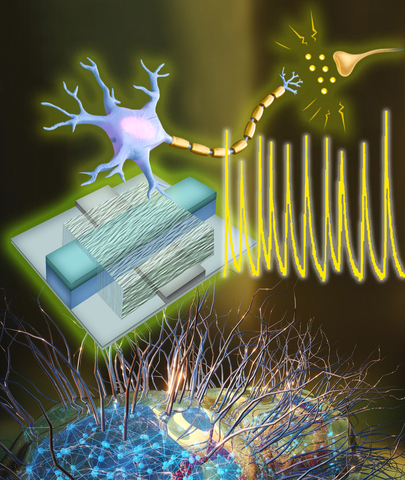
In a lab buzzing with microscopes and circuits, engineers at the University of Massachusetts Amherst have achieved something extraordinary: they’ve built artificial neurons that can communicate directly with living cells, using the same quiet, low-voltage language of biology. This is not science fiction; it’s reality, and it’s here now.
How It Works: Biology Meets Engineering
At the heart of the breakthrough is a clever trick: The team used protein nanowires, grown by bacteria (specifically Geobacter sulfurreducens), to create circuits that mimic biological neurons.
These nanowires serve as bridges for electrical and ionic signals in wet, biological environments where ordinary electronics typically fail.
Ordinary artificial neurons tend to "shout" – they use voltages ten times higher and consume 100 times more power than real neurons. The UMass design, by contrast, "speaks" in subtler terms: It operates at just ~0.1 volts, the same ballpark as biological neurons, enabling direct cell-to-device communication without overwhelming living cells.
They wrapped this around a memristor (a resistor with memory) architecture: When a signal from a biological cell grows strong enough, ions in the nanowire filament bridge a gap, triggering an electrical response; afterward, the filament dissolves, resetting the device, much like the refractory period of a neuron.
In experiments, the team connected their synthetic neuron to heart-tissue cells. When the cells were stimulated chemically to increase their contractions, the artificial neuron fired only in response to that change, proving it can sense and respond to living electrical signals.
Why This Matters: Toward Bio-Inspired Computing & Seamless Interfaces
This is more than a novelty. This engineering feat opens doors into new tech frontiers:
- Energy efficiency: The human brain is astoundingly efficient; it can process vast data with only ~20 watts of power. The new artificial neuron begins to approach that regime, whereas conventional electronics operate far less efficiently.
- Wearables & implants without amplification: Most bioelectronic devices need bulky amplifiers to “listen” to biological signals. These amplifiers consume power and complicate design. A neuron that naturally operates at biological voltages sidesteps that need.
- Future neural interfaces, including prosthetics, brain–machine interfaces, and sensory devices, may all benefit if electronics can truly “speak” the language of cells.
- Greener, biodegradable electronics: Because the core materials are microbial and biologically compatible, disposal or integration into living environments become more plausible and less toxic.
Challenges Ahead & What’s Next
No revolution is without hurdles:
- Scaling material production: Currently, the lab produces only micrograms of nanowire material far from what’s needed for mass manufacturing.
- Uniform fabrication: Making consistent nanowire films over large silicon wafers is technically demanding. Variations in thickness or coverage could break functionality.
- Long-term stability: Biological environments are messy, moisture, ions, proteins, enzymes. The synthetic neurons need to endure and remain functional over time. Future work will test durability.
- Ethics & safety: As we edge closer to electronics merging with living systems, questions of privacy, control, neurological side effects, and unintended consequences arise.
Jun Yao, one of the lead researchers, acknowledges these challenges but remains optimistic: he envisions hybrid chips combining biological adaptability with electronic precision not to replace silicon, but to complement it.
A Vision: Merging Life With Logic
Imagine a future where implanted devices gently monitor brain activity without the need for cumbersome wires or energy-intensive amplifiers. Envision wearable sensors powered by your own bioelectrical currents. Picture biohybrid computers that can grow, adapt, and heal. This UMass breakthrough represents a significant step forward. It demonstrates that electronics and life can communicate not through forceful signals, but through subtle ones. The boundary between biology and technology has shifted, and a new language is emerging.