

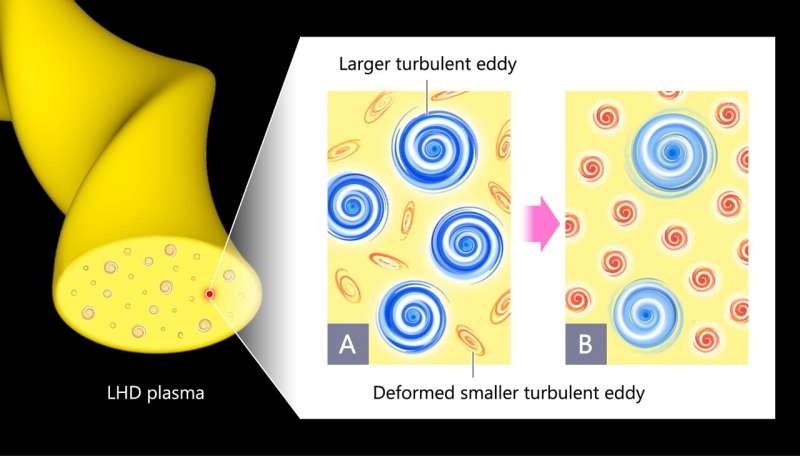
In a significant advance for fusion energy research, Japanese scientists are using supercomputer simulations to investigate turbulence in high-temperature plasma, a complex phenomenon. A new study reveals how turbulence at different scales interacts, transforms, and bifurcates in magnetized plasmas, mirroring conditions within next-generation fusion devices.
Unveiling the Invisible Dance
Plasma is the fourth state of matter, permeates the universe, from the heart of stars to the confined cores of fusion experiments. Within magnetically-confined plasma, turbulence reigns: swirls of charged particles and eddies of electric and magnetic fields operate on scales ranging from centimeters (ion gyroradius) down to millimeters or less (electron gyroradius). This new research shows that these disparate scales are not isolated but locked in a dynamic interplay. The team experimentally observed, and simulations backed this up, a bifurcation in the turbulence regime: as the ion-scale (“micro-scale”) turbulence was suppressed, the “hyper-fine” (HF) scale turbulence at the scale of the electron gyroradius abruptly rose. Simultaneously, the patterns of turbulence shifted from being highly anisotropic (stretched in particular directions) to much more isotropic.
This is not just a curiosity; understanding and controlling turbulence is vital to improving plasma confinement, which in turn is key to realizing fusion as a viable energy source.
Simulations at the Heart: Supercomputers Make the Invisible Visible
While experiments provide direct insight, the real revelation comes from the power of supercomputer simulations to model multi-scale turbulence. Previous work (e.g., Maeyama et al., 2022) used the Japanese flagship supercomputer “Fugaku” to span ion- and electron-scale turbulence in fusion-relevant conditions. These simulations solved the gyrokinetic equations across vastly different length and time scales, a monumental computational challenge. By resolving both the large swirling eddies (ion scale) and the fine ripples (electron scale), they uncovered how small-scale turbulence can suppress large-scale fluctuations, and vice versa, shaping the overall transport of heat and particles in the plasma. In the current work, though primarily experimental, the authors situate their results within the context of these simulation-based predictions: that cross-scale interactions matter and may trigger abrupt transitions (bifurcations) in turbulence behavior. The inspiring takeaway: by harnessing supercomputers, researchers are no longer passively observing turbulence, they are actively modeling, predicting, and beginning to control it.
Why It Matters: Towards Better Plasma Confinement
Turbulence in fusion plasmas acts like an “energy leak” mixing hot and cold zones, allowing heat to escape, and undermining confinement. Taming or steering this turbulence results in a hotter, denser plasma, which enables fusion reactions.
The discovery of a bifurcation between scales suggests new strategies: Suppressing one scale while triggering another to dominate, or vice versa, could steer the turbulence towards a more favorable regime. This path leads to improved confinement, reduced energy losses, and more efficient fusion performance.
Supercomputer simulations provide a blueprint, demonstrating how small-scale electron gyroradius turbulence influences larger ion gyroradius turbulence, thereby altering energy transport. Armed with this blueprint, experimentalists can test and refine control strategies.
Looking Ahead: The Future of Turbulence Modeling
This promising work sets the stage for the next generation of research:
- Expanding simulations: Develop more high-fidelity simulations to capture wider scale separations and complex magnetic geometries.
- Coupling simulation and experiment: Use simulation predictions to guide experiments in real time and refine simulation models with experimental data.
- Active turbulence control: With a better understanding of the mechanisms, future devices could incorporate active control of turbulence scales, using magnetic fields, heating profiles, or other methods to steer the plasma into optimal regimes.
In short: Supercomputer-powered simulations are transforming turbulence from an unruly foe into a potential ally.
A New Chapter in Fusion Science
This research marks a turning point. Turbulence, once chaotic and inscrutable, is now understood as multi-scale, coupled, and bifurcating. The supercomputer is our microscope and our compass. As one author states, studying cross-scale nonlinear interactions “is essential … to understand the physics of high-temperature nuclear fusion plasmas.”
Imagine the roar of swirling plasma inside a confinement device, the invisible eddies twisting and untwisting. Now, imagine scientists using petaflops machines to model, predict, and tame that roar. That is fusion’s future, turbulence, no longer a barrier, but a path forward.
In summary: By combining cutting-edge experiments and supercomputer simulations, plasma physicists are making strides in mastering turbulence within fusion devices. The new study by Tokuzawa et al. underscores how multi-scale interactions and abrupt transitions shape turbulence behavior, offering potential to harness this knowledge for a cleaner, limitless energy future.