

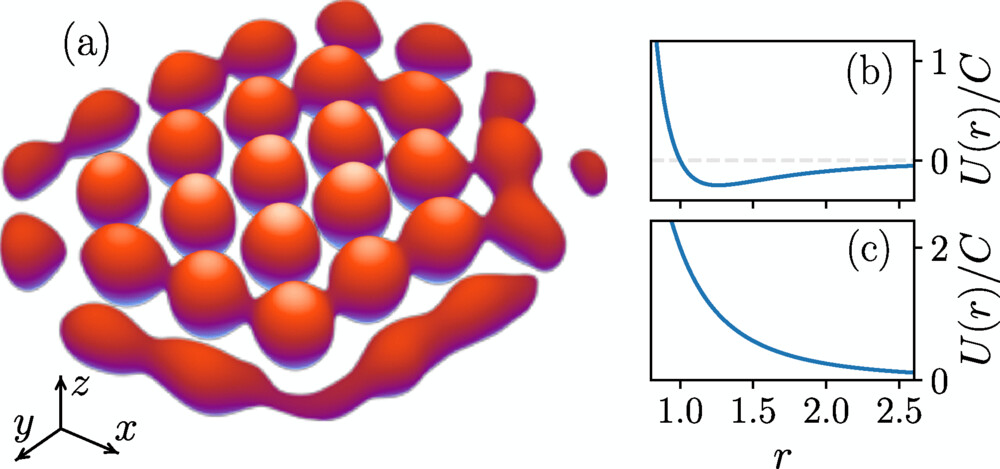
A team of theorists from TU Wien (Vienna) has shed light on one of the most intriguing phenomena in contemporary atomic physics: the spontaneous formation of self-bound superfluid membranes and monolayer crystals composed of ultracold polar molecules. Their findings, recently published in Physical Review Letters ("Self-Bound Superfluid Membranes and Monolayer Crystals of Ultracold Polar Molecules") by Matteo Ciardi, Kasper Rønning Pedersen, Tim Langen, and Thomas Pohl, present exciting prospects for quantum matter research and the advancement of computational simulations.
🧊 From 3D Quantum Gas to 2D Superfluid Membrane
Within this seminal investigation, the research team employed path-integral quantum Monte Carlo simulations, a high-fidelity computational approach adept at capturing quantum fluctuations and correlations, to delineate the complete phase diagram of ultracold dipolar molecules, encompassing a spectrum from weak to strong interactions and ranging from small to mesoscopic particle numbers. The findings are remarkable: under specific conditions, a three-dimensional cloud of interacting dipolar molecules can coalesce into a self-bound droplet, capable of maintaining its structure without external constraints. As the strength of these interactions increases, this droplet transforms into a two-dimensional sheet, forming a superfluid membrane of a single molecular layer. Further intensification of these interactions causes the system to "freeze," resulting in a self-bound crystalline monolayer, a crystalline sheet of molecules suspended in free space.
🚀 Supercomputing + Path Integral Monte Carlo: The Machine of Discovery
To obtain these findings, the research team made extensive use of supercomputing resources and the path-integral Monte Carlo (PIMC) method. PIMC is particularly well-suited for systems where quantum effects are dominant, such as superfluidity, strong correlations, and quantum phase transitions. By representing quantum particles as "paths" in imaginary time and sampling configurations of these paths, PIMC provides access to quantum many-body behavior that goes beyond simpler approximations. The complexity of modeling numerous interacting polar molecules, with anisotropic dipole-dipole interactions and quantum fluctuations, is substantial. The supercomputers employed in this research enabled the team to vary particle number, interaction strength, and geometry, allowing for an in-depth exploration of the emergence of self-bound states and transitions. The outcome is a comprehensive phase diagram that predicts novel forms of matter, which could potentially be experimentally verified in the near future.
🌌 Why It Matters: Quantum Matter, Quantum Engineering
This research represents more than just a computational achievement; it serves as a source of inspiration for future advancements in quantum science. Specifically, the capability to predict the existence of self-bound superfluid membranes and monolayer crystals composed of ultracold polar molecules opens avenues for: New platforms for investigating superfluidity within low-dimensional, strongly correlated systems; Opportunities for the development of engineered quantum materials, including molecular sheets, quantum simulations of crystals, and potentially novel devices; and Experimental targets, as the authors highlight that the predicted transitions occur at interaction strengths that do not lead to two-body bound states, thus allowing for observation in ongoing experiments without limitations from three-body recombination.
In summary, we are witnessing the emergence of novel quantum phases, facilitated by simulation and enabled by advanced computational resources.
🎯 The Takeaway
The research conducted by Ciardi, Pedersen, Langen, and Pohl represents a significant advancement in theoretical quantum physics. Employing path-integral Monte Carlo simulations and large-scale computational resources, they have explored previously uncharted areas, ranging from gaseous dipolar ensembles to self-bound droplets, ultrathin superfluid membranes, and crystalline monolayers. Their findings offer valuable guidance for experimental investigations and suggest that the realm of quantum materials may be more complex and accessible than previously understood. As computational capabilities and quantum technologies continue to evolve, it is evident that the convergence of simulation, theory, and experimentation propels the advancement of scientific understanding. This study serves as compelling evidence that the future of quantum matter is being shaped through computational modeling, advanced hardware, and experimental exploration.