

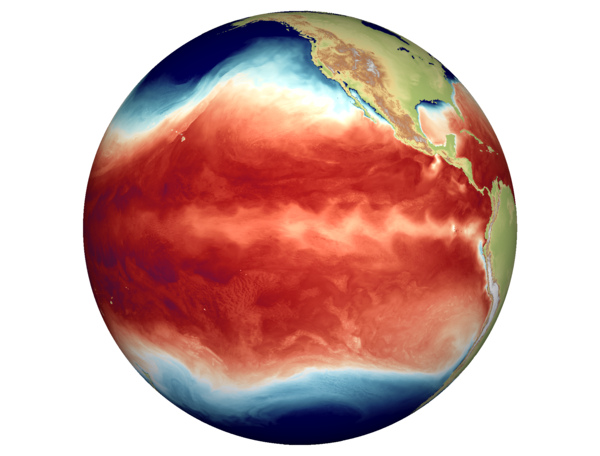
Recent research conducted by the Institute for Basic Science (IBS), a Korean government-funded research institute, and its collaborators has raised significant concerns regarding the behavior of the global climate system in the forthcoming decades. The study indicates that the fluctuations within the recurring cycles of the El Niño–Southern Oscillation (ENSO) may intensify in amplitude and become more regular and interconnected with other significant climate patterns. The implications of these high-resolution supercomputer simulation outcomes are noteworthy, suggesting a transition from irregular, loosely linked climate oscillations to a more synchronized and amplified system. This shift represents not merely an increase in extreme weather events but a fundamental alteration of the climate patterns to which humanity has become accustomed.
What the simulations show
The research team employed a state-of-the-art climate model (AWI‑CM3) with a horizontal resolution of approximately 31 km in the atmosphere and 4-25 km in the ocean. Under a high-greenhouse-gas scenario, the model projected that by around mid-century (2060s), the ENSO cycle will undergo an abrupt transition: The amplitude of sea-surface temperature fluctuations in the tropical eastern Pacific will increase markedly.
The cycles will become more regular instead of erratic, in effect, the “irregular rhythm” of El Niño/La Niña will give way to a more predictable but much stronger oscillation. Other major climate modes, such as the Indian Ocean Dipole (IOD), the North Atlantic Oscillation (NAO), and the tropical North Atlantic mode (TNA), are projected to synchronize their behavior with ENSO, a kind of "resonance" between climate subsystems.
In simple terms, the study suggests a potential shift towards a climate regime in which the tropical Pacific, Indian Ocean, and Atlantic oscillations all begin to ‘swing in step,’ amplifying rainfall and temperature extremes in connected regions around the world.
Why we should worry:
The shift projected by the simulations is not merely academic. The researchers highlight that this amplified and synchronized behavior could create “hydroclimate whiplash,” rapid transitions between flood and drought, intense storms followed by extended dry spells in vulnerable regions such as Southern California and the Iberian Peninsula. Such whiplash events challenge existing adaptation/confidence strategies, infrastructure planning, agriculture, and water resource management.
The study’s authors emphasize that while a more regular oscillation might, in principle, facilitate forecasting, the magnitude of the impacts will demand far more robust preparedness.
Key takeaway: a scientific red flag
The distinguishing characteristic of this research lies in the clarity and specificity of its supercomputer simulation outcomes. These findings represent a departure from general end-of-century projections, as the model indicates an impending shift occurring within the next few decades. The authors characterize this change as an "abrupt transition." Consequently, rather than a gradual deterioration, we may be confronted with a tipping-point scenario: transitioning from a period of moderate, irregular ENSO fluctuations to one characterized by robust, regular, synchronized oscillations and heightened impacts.
Immediate action is required from policymakers and infrastructure planners, given the prospect of increasingly extreme and predictable climate fluctuations. Adaptation strategies must evolve from addressing isolated extreme events to proactively anticipating a fundamentally altered climatic pattern. International collaboration is paramount, as the synchronization of these climate modes will result in global repercussions, extending beyond regional impacts. Furthermore, sustained high-resolution modeling is essential to enhance predictive accuracy, particularly concerning regional effects. The study itself acknowledges ongoing advancements in high-resolution simulations at IBS's supercomputing facility.
In conclusion, the simulations presented by IBS and its collaborators introduce a concerning possibility: a transformation of the Earth's climate system into a new "swing mode," characterized by accelerated, more frequent, and synchronized extreme variations across ocean basins. The window for preparedness is diminishing. Should the model's projections materialize, the world will confront not merely intensified weather events, but a fundamentally altered tempo of climate variability, representing a challenge of potentially unprecedented magnitude.