

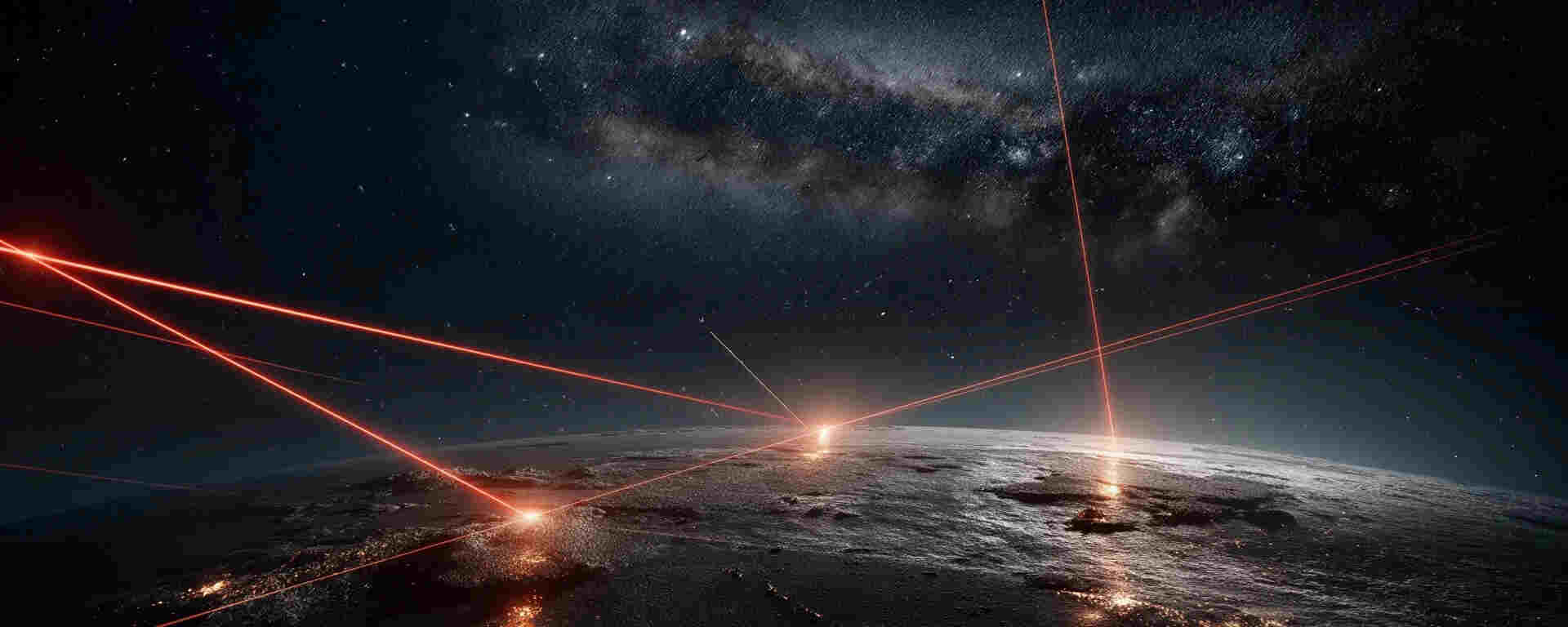
The frontier of quantum communication just flipped; instead of just downlinking from space to Earth, scientists at the University of Technology Sydney (UTS) say we’re now beaming up. A new study reveals it’s feasible to send quantum-entangled particles from Earth up to satellites, a reversal of the usual satellite-to-ground model.
Here’s what’s going on and why it matters.
What did they do?
In the study titled “Quantum entanglement distribution via uplink satellite channels,” led by Simon Devitt and Alexander Solntsev, the UTS team ran detailed modeling of the Earth-to-space path of entangled photons. They accounted for real-world complications, including atmospheric scattering, moonlight reflections, ground station optics misalignment, and satellites moving at approximately 20,000 km/h, around 500 km above Earth.
Until now, quantum satellites primarily created entangled photon pairs on board and then sent one photon to each of two ground stations (a “downlink” model). The UTS team proposes instead that two ground stations emit entangled photons upward simultaneously to a satellite, where they meet and interfere properly, thus maintaining entanglement.
Their findings indicate that this approach is feasible.
The uplink path, which had previously been dismissed as too lossy or noisy, can be engineered to function effectively.
Why does this matter?
- More power on the ground. Ground stations can host stronger photon sources, better maintenance, upgrades satellites are constrained by size/weight/power. Uplink shifts the heavy lifting downward.
- Higher bandwidth for a quantum internet. The team suggests that for building a true quantum internet (rather than just ultra-secure keys), you need many photons and strong links. Uplink helps enable that.
- Cost and scalability. Satellites become simpler: instead of needing bulky quantum-hardware, they may only need a compact optical unit to detect interference. That lowers cost and increases scalability.
What about China & global context?
Yes, China has been a leader in quantum satellite communications. Back in 2016, they launched the Micius satellite, the first to demonstrate space-based quantum key distribution. More recently (2025), a Chinese micro-satellite (Jinan-1) achieved a 12,900 km quantum link between China and South Africa.
So, UTS isn’t starting from scratch, but they are innovating the direction of the link (uplink vs downlink). It shows the global quantum race is maturing: China has the early wins, but Australia and other players are pushing the next phases.
What’s next & caveats
The research is currently based on modeling, not full-space experiments. While simulating the uplink channel is one thing, real-mission conditions present challenges such as atmospheric turbulence, moving satellites, and alignment drift. UTS suggests near-term experiments using balloons or drones.
Furthermore, transitioning from quantum key distribution (QKD), which focuses on secure key sharing, to a full quantum internet, involving quantum computers and sensing, presents numerous engineering hurdles. Uplink technology is just one piece of this complex puzzle.
Bottom line
This development is a significant shift. The idea of firing quantum signals up to space opens new architectures for a quantum internet. It lowers the satellite burden and boosts ground-station capability. If experiments verify the model, the next decade could bring more scalable, global quantum networks than we thought possible.
And yes, China’s earlier quantum satellite milestones provide a strong foundation, but this new direction shows the field is evolving beyond “who launched the first quantum satellite” to “how do we build global quantum infrastructure.”