

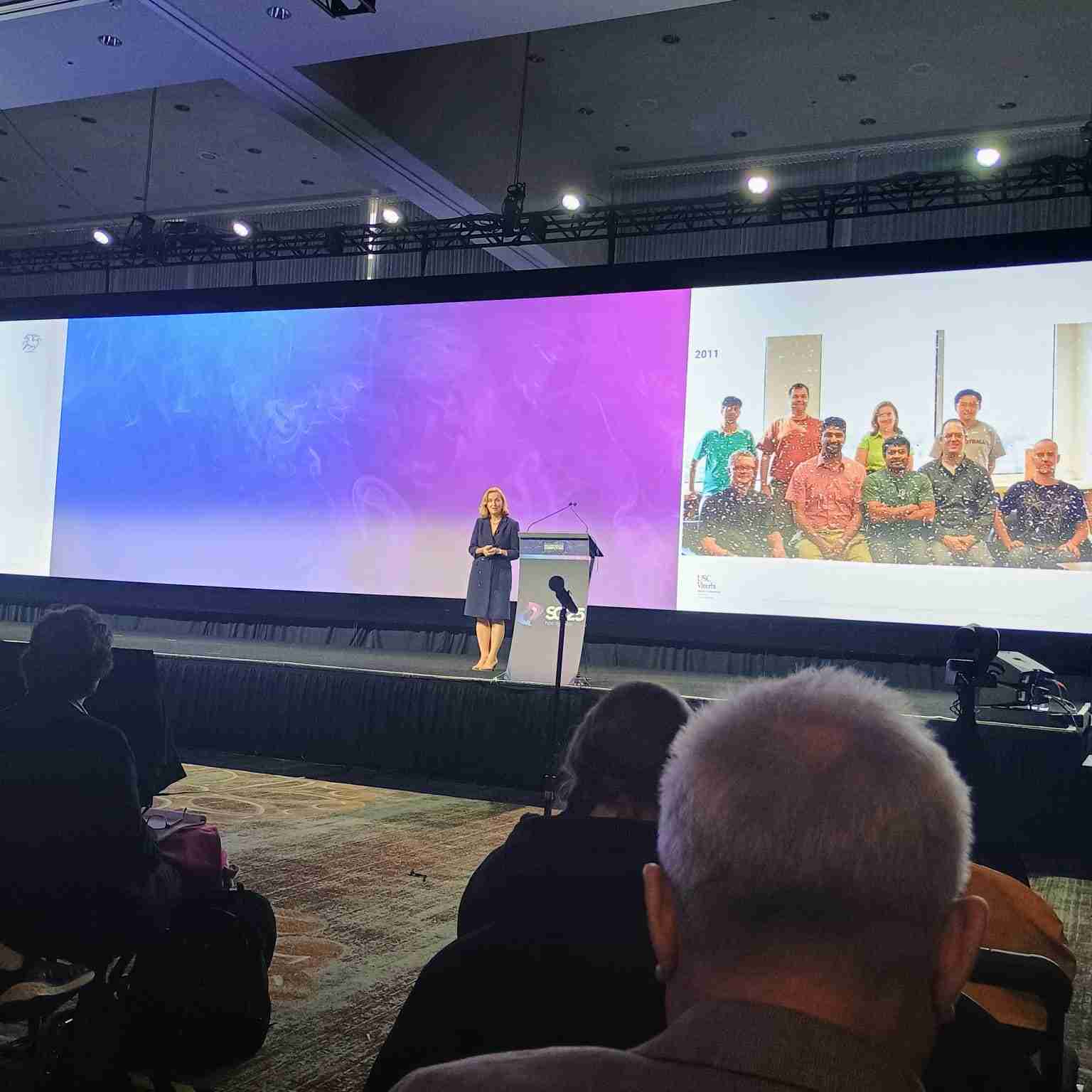
At the SC25 show, the ACM and IEEE-CS Award Presentations provided more than recognition; they reflected on the past and future of scientific computing. The keynote, "Abstraction and Automation: From Workflows to Intelligent Systems and the Future of Scientific Discovery," was delivered by Ewa Deelman of the University of Southern California, a pioneer known for leading the development of the Pegasus Workflow Management System.
From Code to Workflows: Making Complexity Human-Scale
Deelman traced the layered evolution of scientific computing. Initially, researchers worked with machine code and manually scheduled tasks. Subsequently, scripts, batch systems, and workflow engines emerged, serving not as mere conveniences but as tools to preserve scientific intent while managing complexity.
Pegasus emerged from this philosophy. Rather than requiring scientists to think like system schedulers, Pegasus translated high-level scientific descriptions into reliable execution across diverse environments, ranging from high-performance supercomputers to distributed grids. The aim was not automation alone, but rather reproducibility, transparency, and trust.
Automation Arrives, And Changes the Scientific Lifecycle
Deelman shifted to the present, where automation has moved far beyond workflow execution. With artificial intelligence now embedded throughout the research pipeline, systems are:
- assisting with hypothesis generation
- optimizing and adapting workflows
- monitoring results in real time
- and supporting interpretation and publication
In her words, systems are no longer just running science; they are reasoning about it. For fields where data volumes exceed human capacity, cognitive automation has become essential rather than optional.
Transparency, Trust, and the Human Role
The rise of intelligent automation brings new responsibilities. Deelman raised questions that resonated across the SC25 audience:
- How do we ensure transparency when systems make autonomous choices?
- What does scientific accountability look like when recommendations come from models, not humans?
- Where must human judgment remain non-negotiable?
Rather than replacing scientists, Deelman argued, automation amplifies the need for critical thinking and creativity. Scientific skepticism becomes more, not less, important when systems can produce convincing results without explanation.
Design Principles That Endure Through Change
Despite shifting technologies, Deelman highlighted the principles that have sustained Pegasus for decades:
- abstraction that clarifies rather than conceals
- automation that supports scientific intent, not overrides it
- reproducibility as a foundation, not a feature
These values, she emphasized, must guide the next generation of intelligent systems.
Looking Forward: Machines as Partners in Discovery
Deelman closed with optimism grounded in realism. Intelligent systems will soon help explore parameter spaces unreachable by human reasoning alone, uncover patterns hidden in massive datasets, and accelerate breakthroughs that once took decades.
But progress requires discipline: transparent algorithms, accountable design, and a scientific culture that refuses to outsource curiosity.
The applause that followed made clear that the supercomputing community understood the moment. At SC25, the message was unmistakable: scientific computing is entering a new era. Not one defined by machines replacing thought, but by machines expanding what thought can reach.