

How Ramanujan’s formulae for π fuel modern high-energy physics and supercomputational frontiers
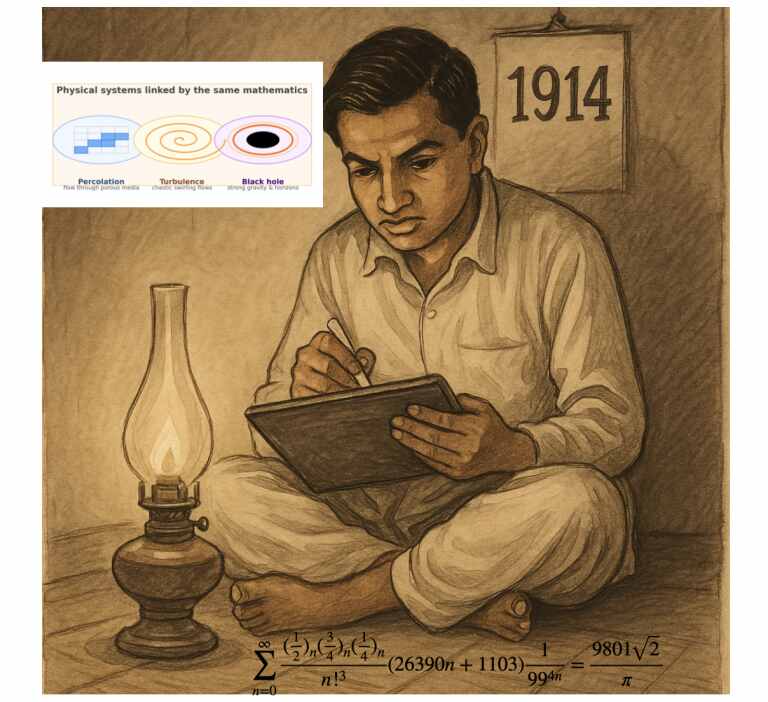
When Srinivasa Ramanujan penned his remarkable series for the constant π more than a century ago, he could hardly have imagined that his deep mathematical insights would one day illuminate some of the most baffling questions in physics. Yet a new study, published this December in Physical Review Letters, reveals that structures Ramanujan discovered in 1914 are not mere curiosities of pure mathematics, but lie at the heart of modern high-energy physics and advanced computational methods.
Ramanujan’s enigmatic infinite series for 1/π compact formulas that accelerate calculations with astonishing efficiency were originally formulated in the early 20th century with no apparent connection to the physical world. In recent years, they have become the basis for modern algorithms that compute π to staggering precision, exceeding 200 trillion digits.
Yet the real surprise comes from interdisciplinary exploration at the Centre for High Energy Physics (CHEP) at the Indian Institute of Science (IISc), where Professors Aninda Sinha and Faizan Bhat asked an audacious question: Why do Ramanujan’s formulas work so brilliantly, and could they be pointing to more than arithmetic beauty?
Their answer bridges mathematics and physics in an unprecedented way. The team discovered that Ramanujan’s formulas naturally arise from logarithmic conformal field theories (LCFTs), sophisticated theoretical frameworks used to describe systems with scale invariance, where phenomena appear the same at every magnification. These theories are central to understanding critical physical processes, such as fluid turbulence, percolation (the process by which substances spread through media), and aspects of black hole physics.
In essence, the formulas Ramanujan discovered as elegant mathematical identities are now showing up as powerful computational tools in physical models. Specifically, the underlying structure of his 1/π series mirrors the mathematics governing two-dimensional LCFTs, models that appear across diverse physical contexts, from polymer physics to quantum Hall effects.
What makes this discovery especially profound for supercomputing and high-energy physics is the computational leverage it offers. By exploiting the shared mathematical architecture between Ramanujan’s series and LCFTs, researchers can compute key quantities in these theories with greater efficiency, much as Ramanujan originally harnessed compact formulas to leapfrog slower π approximations a century ago. This reflects a deep and inspiring symmetry between mathematical ingenuity and physical law.
“We wanted to see whether the starting point of his formulas fits naturally into some physics,” said Sinha, underscoring that the aim was not merely computational optimization but understanding why such formulas exist at all.
Indeed, logarithmic conformal field theories, once thought of as abstract mathematical playgrounds, have now become a nexus where century-old mathematics meets the frontiers of theoretical physics and advanced computation. These theories describe systems at critical points where small changes can lead to dramatic shifts, including transitions from laminar to turbulent flows and the exotic behavior near black holes’ event horizons. The fact that Ramanujan’s series resonates within these contexts highlights how pure thought, unfettered by application, can anticipate the structures of nature itself.
For the supercomputing community, this research is more than a historical curiosity. It represents a testament to the enduring power of mathematical ideas to accelerate computing and advance our understanding of the universe. As supercomputers tackle ever more complex simulations, from plasma dynamics to quantum field computations, the legacy of Ramanujan’s pi formulas proves that efficiency and deep structure often go hand in hand.
In an age where computation, mathematics, and theoretical physics intertwine more closely than ever, the resurrection of Ramanujan’s work in high-energy physics stands as a beacon of inspiration, a reminder that the mathematical rhythms discovered in solitude can echo across the cosmos, shaping how we compute, model, and ultimately grasp the universe’s deepest secrets.