

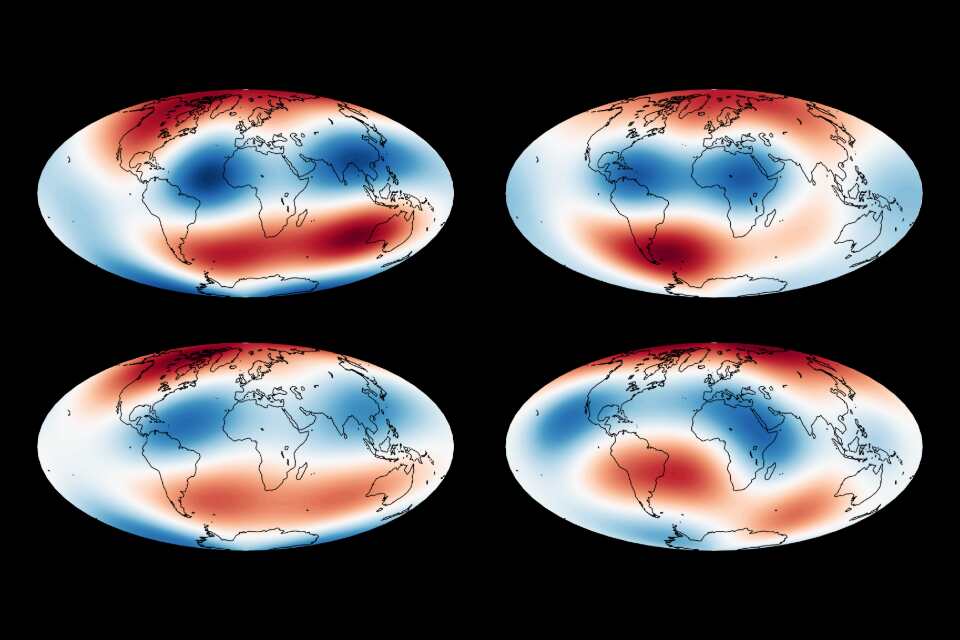
Researchers at the University of Liverpool and their collaborators have achieved a significant advance in understanding Earth's interior, leveraging the capabilities of modern supercomputing. For the first time, they have demonstrated how two massive, ultra-hot formations deep within Earth's mantle affect the creation and long-term dynamics of our planet's magnetic field, using sophisticated numerical models powered by high-performance computing.
The Earth’s magnetic field, the invisible shield that protects life from dangerous solar and cosmic radiation, is generated by the turbulent motion of molten iron in the outer core, a process known as the geodynamo. Understanding what governs the geodynamo’s behavior over millions of years requires not only sophisticated palaeomagnetic measurements from ancient rocks but also large-scale, three-dimensional simulations that test how variations deep within the planet affect core dynamics.
In their study, the research team combined palaeomagnetic datasets, which record changes in the magnetic field over geological time, with supercomputer-based dynamo simulations to reveal the importance of thermal heterogeneity at the core–mantle boundary. Two continent-sized regions of intensely hot rock, located roughly 2,900 km beneath Africa and the Pacific, sit atop Earth’s outer core and create strong, lateral temperature contrasts that profoundly influence the flow of molten iron below.
These “blobs,” known in geophysics as Large Low-Velocity Provinces (LLVPs) because they slow down seismic waves, were already observed by seismic imaging, but their significance for magnetic field generation had been unclear until now. By incorporating the effects of thermal heterogeneity into supercomputer models of the geodynamo, researchers found that these deep mantle structures help explain key features of Earth’s ancient and modern magnetic field, including the persistence of a dominant dipolar structure and subtle longitudinal variations that earlier homogeneous models could not reproduce.
Running these simulations is a remarkable computational feat. The equations that govern the interaction of heat, fluid motion, magnetic induction, and rotation in Earth’s core are exceptionally complex and demand high-performance computing (HPC) clusters with massive parallel processing capability. Even with today’s most powerful machines, exploring how the magnetic field evolves over hundreds of millions of years, and how it responds to boundary conditions set by deep mantle structures, represents an immense computational challenge.
According to Professor Andy Biggin of the University of Liverpool, “strong contrasts in the spatial pattern of core–mantle heat flux … have influenced the geodynamo for at least the last few hundred million years.” This implies that Earth’s magnetic field, while often approximated as a simple bar magnet aligned with the rotation axis, has subtle asymmetries imprinted by deep Earth processes that are only now coming into focus thanks to HPC-enabled modeling.
The implications of this research extend beyond geomagnetism. By demonstrating how deep mantle thermal structures influence core dynamics, these models offer a new framework for understanding the long-term evolution of the planet, including the connections between internal dynamics and surface phenomena such as continental assembly and breakup, climate shifts, and the formation of mineral resources. More accurate reconstructions of Earth’s ancient magnetic field also serve as essential constraints in palaeogeographical studies and plate-tectonic history.
For the supercomputing community, this breakthrough exemplifies how HPC is becoming indispensable to Earth sciences. Supercomputers are not merely accelerators of computation; they are exploratory instruments that allow scientists to build and test virtual Earths, probing regimes that cannot be accessed through direct observation or laboratory experiments. By enabling models that integrate data spanning hundreds of millions of years with high-resolution physics, supercomputers are transforming our understanding of the deep interior of the planet we call home.
With the ongoing growth of computational power, driven by larger HPC systems and improved algorithms, researchers can continue to enhance their models, broaden the range of conditions they examine, and incorporate the latest observational data. These advances will deepen our insights into the geodynamo, Earth’s thermal history, and the intricate connections between our planet’s interior and surface life.
According to the study’s authors, combining palaeomagnetic records with dynamo simulations introduces a “new means to constrain the properties and time evolution of the core–mantle boundary.” This approach provides a clearer perspective on the forces that have safeguarded life on Earth for millions of years. Thanks to supercomputing, we are now seeing a far more dynamic and interconnected Earth than previously imagined.