

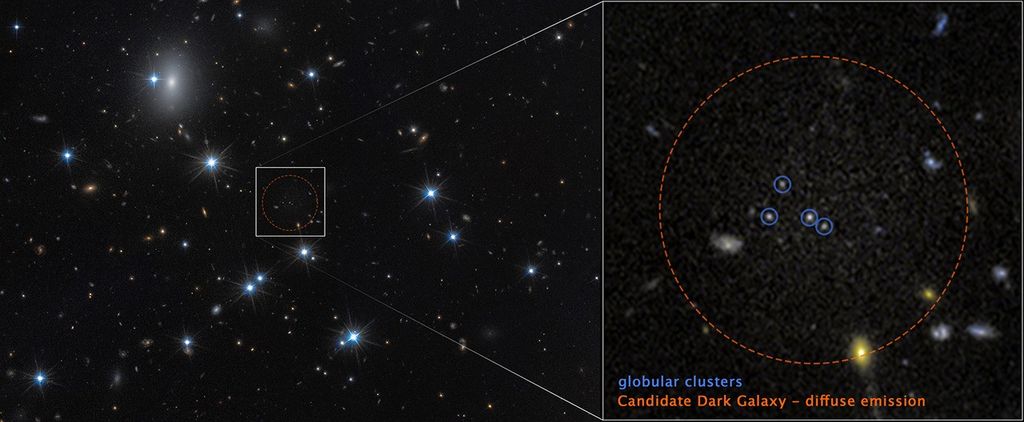
Astronomers have made a discovery that redefines how we think of galaxies, which are often pictured as shining collections of stars. By leveraging cutting-edge space telescopes and state-of-the-art data analysis, scientists have pinpointed one of the dimmest galaxies ever observed, a nearly invisible structure where just a few scattered stars hint at a vast, hidden mass. This achievement, made possible by advanced computational methods, demonstrates how supercomputing and data science are pushing the boundaries of our ability to detect the universe’s faintest and most mysterious objects.
Named Candidate Dark Galaxy-2 (CDG-2), this galaxy lies about 300 million light-years from Earth in the Perseus cluster. Instead of shining with billions of stars like most galaxies, CDG-2 emits barely any light, with a visible brightness equivalent to just six million suns. Even more astonishing, over 99 percent of its mass seems to be made of dark matter, the enigmatic, unseen substance that dominates the universe’s mass but does not emit or absorb light.
What makes this discovery especially groundbreaking is how the galaxy was found. Rather than detecting the galaxy directly by its stars, researchers used globular clusters, densely packed, gravitationally bound spheres of old stars, as cosmic beacons. These compact clusters were identified as unusually tight groupings in survey data, hinting that they might be orbiting an unseen underlying galaxy. Follow-up imaging with NASA’s Hubble Space Telescope confirmed the clusters’ presence, while data from ESA’s Euclid mission and the Subaru Telescope in Hawaii revealed an ultra-faint diffuse glow around them, the first direct evidence of the dark galaxy itself.
This detection would have been impossible without high-performance computing and sophisticated statistical models, which are capable of sifting through vast datasets and isolating subtle signals. Modern astrophysical research increasingly relies on supercomputer-assisted analyses to combine multi-telescope observations, model faint features buried in noise, and test competing interpretations of the observed data. In essence, HPC enables astronomers to digitally construct cosmic systems too faint or distant to examine through direct observation alone.
CDG-2 stands apart from most known systems not just for its dimness, but for what it may reveal about the role of dark matter in galaxy formation and evolution. The prevailing view in cosmology holds that dark matter provides the gravitational scaffolding around which normal matter, gas, and stars accumulate to form galaxies. Yet the extreme case of CDG-2 suggests scenarios in which star formation was suppressed or stripped away, leaving behind a halo rich in dark matter but poor in visible stars. Such galaxies are thought to be exceedingly rare, making this one a crucial testbed for theories of cosmic structure formation.
The supercomputing community should take particular pride in this discovery, as the identification and analysis of CDG-2 depended on algorithms and models developed to handle petabyte-scale datasets from ongoing and upcoming sky surveys. As observatories like the Vera C. Rubin Observatory and the Nancy Grace Roman Space Telescope begin mapping the sky with unprecedented depth and breadth, the role of HPC will only grow, not just in storing and processing data, but in helping astronomers ask new questions about the dark universe and find answers hidden within noise.
Moreover, the methods used to detect CDG-2, effectively letting computational exploration precede direct detection, open a new frontier in observational astronomy. In future surveys, machine learning and other supercomputer-powered techniques may routinely uncover objects too faint or too exotic to be seen by the naked eye of a telescope, blurring the line between observation and inference.
While CDG-2 may be one of the darkest galaxies yet discovered, its detection casts an inspiring light on the future of astrophysics. It reminds us that the universe still holds countless hidden wonders and that with the synergy of powerful telescopes and supercomputing, we are just beginning to uncover them.