

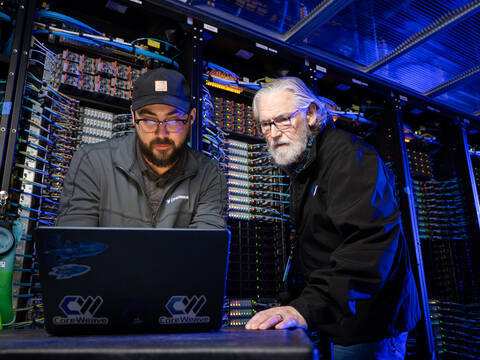
CoreWeave, Inc. has entered a multi-year partnership with Perplexity AI to provide the infrastructure for Perplexity’s next-generation inference workloads via its specialized AI cloud platform. This strategic collaboration demonstrates how advanced HPC-grade architectures, especially GPU clusters optimized for AI inference, are enabling production-scale AI systems with stringent performance, scalability, and reliability demands.
The partnership centers on deploying Perplexity’s inference workloads on CoreWeave’s cloud infrastructure, leveraging dedicated NVIDIA GB200 NVL72-powered clusters to support the high throughput and low latency needed by Perplexity’s Sonar and Search API ecosystem as usage scales.
Inference at Scale: Technical Imperatives
AI inference, serving predictions from pre-trained models in real time, poses unique computational challenges compared with training. While training benefits from large batch sizes and long-duration GPU utilization, inference workloads demand ultra-low latency responses, predictable performance under bursty query patterns, and efficient resource utilization across multi-tenant clusters. For a company like Perplexity, which handles billions of user queries per month, infrastructure that can orchestrate inference workloads at scale with minimal jitter is critical.
CoreWeave’s platform is built on a Kubernetes-orchestrated service layer that abstracts and automates resource allocation across GPU clusters. By pairing container orchestration with dedicated hardware, specifically GB200 NVL72 accelerators, CoreWeave ensures that inference models can be deployed without rigid re-architecture while maintaining consistent latency profiles, even at peak demand. This pattern is particularly important as AI models grow in size and complexity, often requiring substantial GPU memory and bandwidth to serve real-time applications effectively.
From an engineering perspective, this deployment highlights several critical infrastructure considerations:
- Workload specialization: Automated tiering of resources for inference vs. training, recognizing that inference tasks often require different memory and throughput characteristics than model training.
- Latency control: Optimization of GPU-to-network pathways to reduce end-to-end inference time, a key metric for conversational AI and search APIs.
- Scalability: Dynamic scaling mechanisms that transparently add or remove GPU nodes as load fluctuates, coupled with robust orchestration to prevent resource fragmentation.
- Cost predictability: Infrastructure designed to avoid over-provisioning while meeting performance SLAs, aided by load-aware scheduling and GPU utilization monitoring.
Perplexity has already begun running inference workloads on CoreWeave’s platform through its Kubernetes Service and is leveraging tools such as W&B Models to manage models from experimentation to production. This reflects a broader multi-cloud strategy that allows Perplexity to balance resilience, capacity, and vendor flexibility as its AI footprint expands.
Implications for the HPC Community
For supercomputing engineers and architects, this collaboration is emblematic of a broader trend: HPC technologies are transitioning from niche scientific workloads to mainstream AI infrastructure stacks. Traditionally, HPC clusters were associated with physics simulations, climate modeling, and other numerically intensive domains. Increasingly, similar architectures, especially GPU-centric clusters, are now critical for production AI services, requiring operational excellence not just in computational throughput but also in orchestration, fault tolerance, and real-time responsiveness.
Platforms like CoreWeave demonstrate that HPC principles, such as parallelism, memory hierarchy optimization, and workload specialization, are foundational to delivering commercial AI services at a global scale. For inference workloads in particular, engineers must consider not just peak compute, but sustained, predictable performance across thousands of queries per second.
This shift also presents opportunities for HPC professionals to influence how AI infrastructure evolves: from advising on cluster design and interconnect topologies to developing efficiency-aware scheduling policies that reduce energy consumption without sacrificing performance, an increasingly important consideration as production AI systems grow in scale and footprint.
In summary, the CoreWeave, Perplexity alliance exemplifies how cloud platforms purpose-built with HPC knowledge and advanced GPUs are forming the foundation of modern AI services. As inference workloads expand and diversify, platforms that consistently deliver high performance at scale will set themselves apart from general-purpose clouds, reshaping the architecture and deployment of AI applications across industries.