

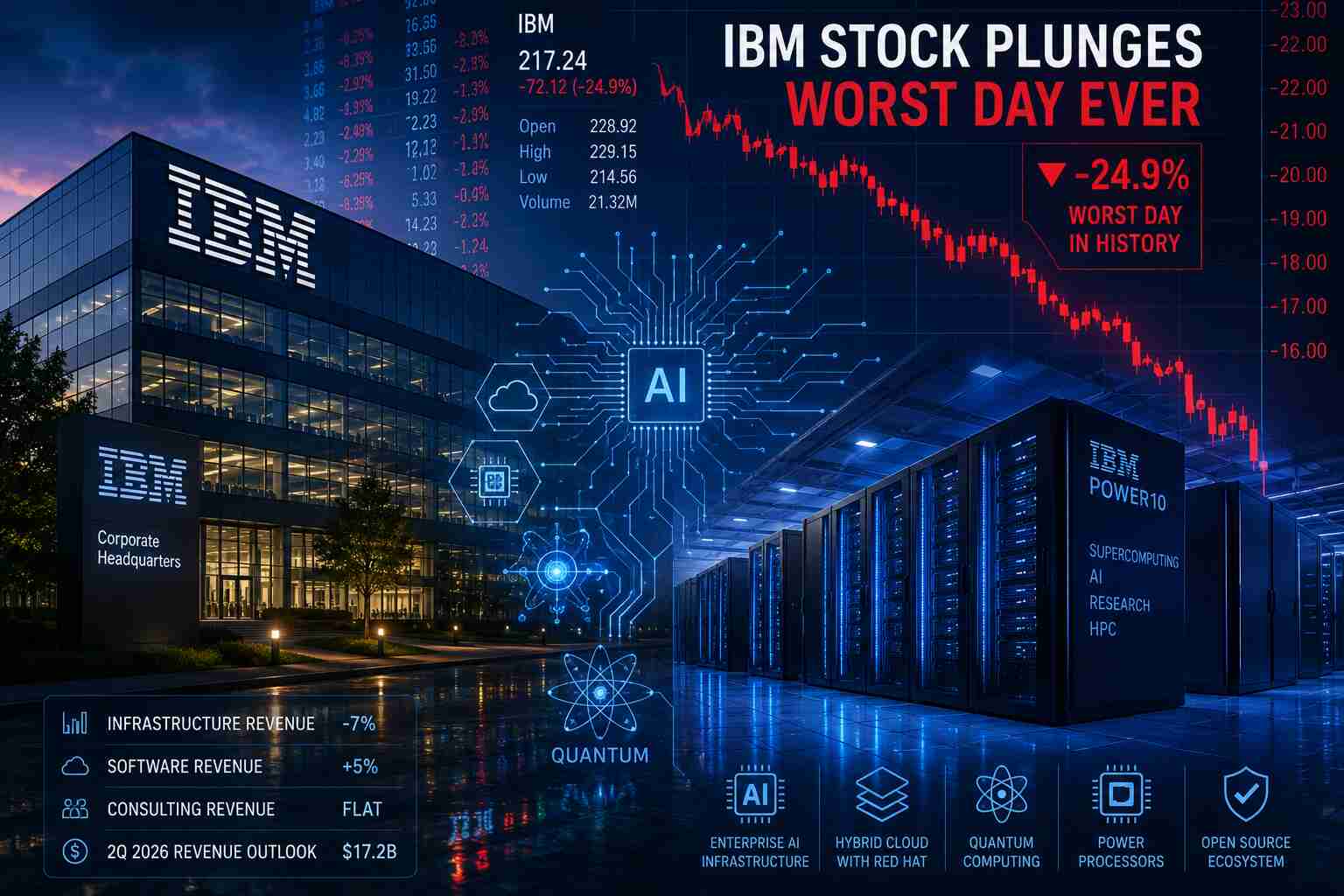
IBM has successfully navigated over a century of technological shifts, spanning from punch cards and mainframes to the current frontiers of cloud computing, artificial intelligence, and quantum research. However, the company faced a historic reckoning on Tuesday when preliminary second-quarter 2026 financial results triggered a 25% plunge in its share price. This sudden decline, which erased over $65 billion in market value, follows a rare earnings miss that snapped a five-year streak of meeting Wall Street expectations.
For those in the high-performance computing (HPC) community, the immediate concern is not the volatility of IBM’s stock, but the potential impact on the company’s long-term commitment to supercomputing, enterprise AI infrastructure, and quantum innovation. A closer look at the data suggests that the reality for IBM’s research-driven future is more complex than the market’s sharp reaction might imply.
The problem was infrastructure, not research
In a letter to investors, IBM Chairman and CEO Arvind Krishna acknowledged that the company "faltered" during the quarter.
IBM expects second-quarter revenue of approximately $17.2 billion, up just 1% year over year but below analyst expectations. Infrastructure revenue declined 7%, while software revenue still increased 5%. Consulting remained essentially flat.
Krishna attributed much of the weakness to disappointing performance in IBM's z17 mainframe rollout and the associated transaction-processing software ecosystem. Customer purchasing patterns also shifted unexpectedly as organizations accelerated spending on servers, storage systems, and memory ahead of anticipated price increases, delaying major software and infrastructure purchases. IBM also acknowledged that several significant enterprise deals failed to close during the quarter.
From an HPC perspective, this distinction matters.
IBM's earnings miss was driven primarily by execution and timing in enterprise infrastructure, not by a collapse in demand for advanced computing technologies.
What this means for IBM's supercomputing business
IBM occupies a unique position in the HPC ecosystem.
Unlike NVIDIA, AMD, or Intel, IBM's supercomputing strategy spans several complementary technologies:
- Enterprise AI infrastructure
- Power processors
- Mainframe computing
- Hybrid cloud through Red Hat
- Quantum computing
- Research partnerships with national laboratories
- AI software platforms
While the disappointing infrastructure results certainly create near-term uncertainty, none directly suggest that IBM is retreating from supercomputing research.
In fact, the opposite appears true.
Even as it announced weaker-than-expected quarterly results, IBM reaffirmed plans to invest more than $10 billion in quantum computing over the next five years, alongside continued investments in AI software, semiconductor manufacturing, and its open-source ecosystem.
That distinction is critical.
Wall Street punished IBM for missing quarterly expectations.
IBM's long-range computational research strategy remains largely intact.
The AI investment paradox
Ironically, artificial intelligence may have contributed indirectly to IBM's disappointing quarter.
Across the technology industry, organizations continue pouring unprecedented amounts of capital into GPU clusters, AI accelerators, networking hardware, memory, and storage infrastructure.
Those investments are enormous.
For many enterprise customers, budgets are finite.
Instead of expanding software spending, many customers appear to be redirecting capital toward building AI-ready infrastructure first.
IBM itself acknowledged that this shift affected customer purchasing behavior during the quarter. Analysts have also pointed to broader market concerns that AI spending is temporarily crowding out traditional enterprise IT investments.
For companies serving enterprise infrastructure, this creates an unusual challenge.
Customers still believe in AI.
They are simply buying different components first.
HPC customers should not panic
Large-scale supercomputing deployments typically operate on multi-year procurement cycles.
National laboratories.
Government agencies.
Universities.
Energy companies.
Pharmaceutical firms.
These customers rarely alter procurement strategies because of one disappointing earnings report.
IBM's participation in advanced computing extends far beyond quarterly financial performance.
Its Power architecture continues supporting numerous enterprise HPC workloads.
Its hybrid-cloud technologies remain deeply embedded throughout research computing.
Its quantum roadmap continues attracting significant government and industrial investment.
None of those initiatives disappear because Wall Street reacted negatively to one quarter.
But investors are sending a message
While IBM's technological roadmap remains compelling, investors clearly expect better operational execution.
Krishna himself acknowledged that IBM underestimated how dramatically customer priorities would shift and admitted the company failed to adapt quickly enough.
That admission is significant.
Today's enterprise computing market evolves faster than ever.
Organizations now make infrastructure decisions based on AI readiness, GPU availability, semiconductor supply chains, cybersecurity concerns, and cloud economics, all simultaneously.
Execution matters just as much as innovation.
Could this affect future HPC investments?
The greatest risk may not be immediate budget reductions but increased scrutiny.
Public companies experiencing sharp stock declines often face pressure to:
- Improve operational efficiency
- Prioritize higher-return investments
- Delay lower-priority initiatives
- Reduce operating costs
- Demonstrate faster returns on capital
Historically, IBM has protected long-term research better than many technology companies during downturns.
The company's continued commitment to quantum computing suggests management still views advanced computational research as a strategic differentiator rather than a discretionary expense.
However, investors will likely expect clearer evidence that these long-term investments translate into stronger commercial performance.
A difficult quarter does not end IBM's HPC leadership
IBM remains one of the few companies simultaneously developing AI software, enterprise infrastructure, quantum computing, advanced processors, hybrid cloud platforms, and large-scale research systems.
That breadth continues to distinguish it from most competitors.
Nevertheless, Tuesday's historic sell-off illustrates an uncomfortable reality.
Technological leadership alone no longer guarantees investor confidence.
Markets increasingly demand both breakthrough innovation and flawless execution.
For the supercomputing sector, IBM’s recent earnings shortfall should be viewed less as an existential crisis for HPC and more as a crucial reminder that even industry stalwarts must demonstrate agility in an AI-dominated market. The coming quarters will clarify whether this sharp market reaction marks a transient setback during a broader technological transition or the catalyst for a fundamental reassessment of IBM’s enterprise infrastructure strategy. While IBM’s research engine remains robust, its quantum ambitions are bold, and its HPC footprint is significant, the company’s immediate challenge lies in proving to investors that these long-term technological strengths can once again be synthesized into consistent, high-value financial performance.