

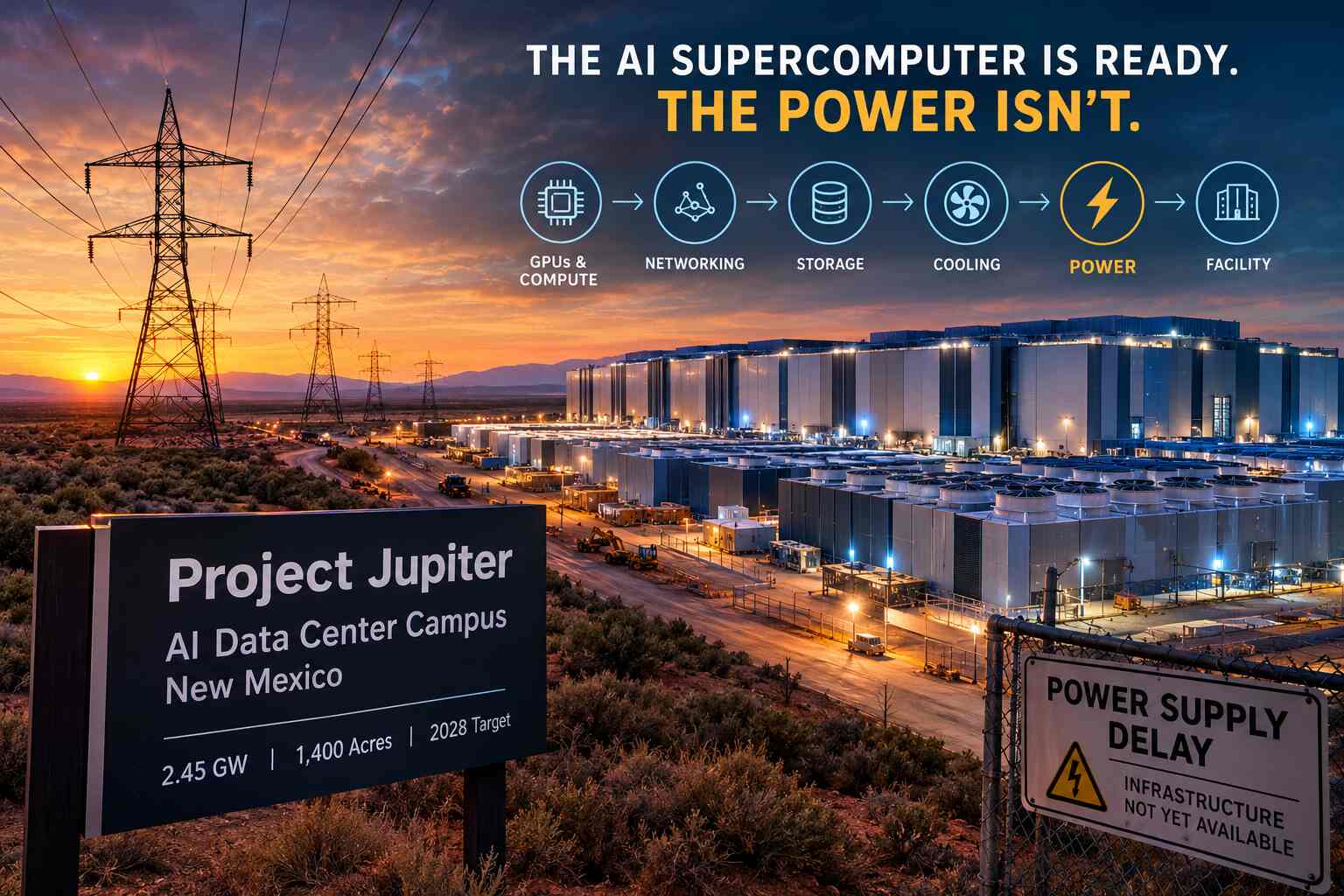
For years, the artificial intelligence industry has focused on a deceptively simple question: how many GPUs can be integrated into a single data center? However, an increasingly critical challenge has emerged that can no longer be ignored: securing the electricity required to power these systems. This question is now fundamentally shaping the future of supercomputing.
The urgency of this issue is highlighted by Oracle’s Project Jupiter in New Mexico, a cornerstone of the collaborative Stargate infrastructure initiative involving Oracle, OpenAI, and SoftBank. Oracle has issued a force-majeure notice to the project’s developer, a unit of Blue Owl Capital, citing potential delays in securing sufficient power. While this notice provides contractual flexibility should the 2028 operational target be missed, Oracle maintains that the project remains on schedule.
The implications for the broader supercomputing industry extend far beyond a single facility or financing arrangement. This situation reveals a fundamental systemic risk within the current AI infrastructure boom: it is becoming significantly easier to acquire computational capacity than to secure the physical infrastructure necessary to power it.
The supercomputer is no longer just a computer
Traditional supercomputing discussions tend to revolve around familiar metrics: FLOPS, accelerator count, memory bandwidth, network bandwidth, storage throughput, and application performance.
Those metrics remain critical.
But an AI supercomputer also has another specification that is becoming just as important: Megawatts.
Modern AI clusters are effectively enormous distributed computing systems. Thousands of accelerators must operate simultaneously, connected by extremely high-bandwidth networks and supported by storage, cooling, and power-conversion infrastructure.
The result is a system whose computational performance is inseparable from its physical infrastructure.
A facility may have the latest accelerators available.
It may have the network fabric.
It may have the cooling system.
It may even have customers waiting for compute capacity.
But if the electrical infrastructure is not ready, the supercomputer does not exist in any meaningful operational sense.
It is simply an expensive collection of hardware waiting for electrons.
Project Jupiter Makes the Problem Concrete
Project Jupiter illustrates the scale of the challenge.
The New Mexico campus is designed as a massive AI computing facility. Recent reporting puts its planned power requirement at roughly 2.45 gigawatts, with the current design centered on Bloom Energy fuel cells operating as an onsite microgrid.
That is not a conventional data-center power requirement.
It is an industrial-scale energy system attached to a computing system.
And the power infrastructure itself has become a critical-path component.
A natural-gas pipeline intended to supply the facility has faced regulatory setbacks and a delay. TechCrunch reports that the pipeline schedule has moved to February 2027, while a separate air-quality permit for the fuel-cell system remains pending.
Oracle’s own June description of the revised design says the company moved away from the previously planned gas-turbine and diesel-generator configuration toward Bloom Energy fuel-cell technology. Oracle says the revised system is intended to reduce water consumption and nitrogen-oxide emissions while providing reliable onsite power.
That engineering evolution is important.
It also demonstrates the uncomfortable reality of AI infrastructure: The power system can become as complicated as the computer system.
When megawatts become a computing specification
Consider what happens inside a large AI cluster.
An accelerator performing a computation consumes electrical power.
Thousands of accelerators multiply that requirement.
Then add CPUs, memory systems, high-speed networking, storage, power-conversion losses, cooling equipment and facility overhead.
The electricity requirement becomes enormous.
And unlike purchasing additional GPUs, increasing electrical capacity is not simply a matter of placing another order.
Power infrastructure requires physical construction.
Transmission capacity may have to be expanded. Substations must be built. Generation resources have to be secured. Fuel infrastructure may be required. Permits have to be obtained. Cooling systems must be engineered. Communities and regulators may have to approve the development.
Those processes operate on very different timescales from the semiconductor industry.
A new accelerator generation can arrive in months.
A major power project can take years.
That mismatch is becoming one of the central infrastructure problems of the AI era.
The GPU supply chain may not be the only bottleneck
The technology industry has spent enormous resources expanding accelerator production.
That effort has created another race: the race to build facilities capable of deploying those accelerators at scale.
This changes the economics of supercomputing.
If a company can acquire 100,000 accelerators but cannot energize the corresponding computing facility, those accelerators do not produce useful AI capacity.
The limiting resource has shifted from silicon alone to the entire infrastructure stack.
Compute availability = accelerators + memory + networking + storage + cooling + power + facility.
Remove any one of those components and the system’s theoretical performance becomes irrelevant.
For AI infrastructure developers, this creates a dangerous possibility: billions of dollars can be committed to computational capacity before the physical infrastructure necessary to operate that capacity is fully secured.
Project Jupiter demonstrates precisely why that matters.
The financing problem follows the power problem
There is another layer to this story.
The AI infrastructure boom is being financed at a scale rarely seen in computing.
Project Jupiter reportedly has approximately $18 billion in loans tied to its development, while Blue Owl has committed roughly $3 billion in equity to the New Mexico project, according to reporting from The Information.
Reuters reported last week that the $18 billion in loans had come under pressure, with portions quoted around 89 to 91 cents on the dollar amid concerns about the project’s regulatory and infrastructure challenges.
That does not mean the project has failed.
It does, however, demonstrate how the physical risks of AI infrastructure can become financial risks.
If a supercomputer takes longer than expected to come online, capital remains tied up.
If power infrastructure is delayed, the facility cannot generate the expected computing capacity.
If construction costs rise, financing requirements increase.
If customer commitments depend upon a particular operational date, delays can ripple through the entire AI infrastructure ecosystem.
The computer may be digital.
The risk is not.
The AI factory has become an energy factory
There is a conceptual shift taking place in the industry.
The next generation of AI facilities should perhaps no longer be thought of simply as data centers.
They are AI factories.
They convert electricity into computation.
Electricity enters the facility.
Accelerators transform that energy into mathematical operations.
Networks move data between processors.
Memory systems feed the calculations.
Storage provides the datasets.
Cooling removes the resulting heat.
The output is computational capacity.
From that perspective, electricity is not merely an operating expense.
It is one of the fundamental raw materials of AI.
That makes the availability of electricity a direct determinant of how much AI computation a company can actually deliver.
Efficiency suddenly matters more
This also changes the meaning of performance optimization.
Historically, HPC engineers have pursued better performance for familiar reasons: finish the simulation sooner, increase throughput, reduce queue times or solve larger problems.
AI adds another dimension: How much computation can be produced per megawatt?
That question could increasingly influence processor architecture, cooling technology, interconnect design, scheduling software, and even algorithms.
A cluster that delivers more useful work per watt can effectively provide more computational capacity without requiring proportional increases in generation and transmission infrastructure.
This is where traditional HPC engineering becomes particularly relevant.
Techniques developed to maximize utilization of supercomputers, workload scheduling, accelerator efficiency, communication optimization, memory locality, precision reduction, and application-specific optimization, suddenly have an infrastructure-level economic consequence.
Every percentage point of efficiency can represent substantial avoided power consumption when multiplied across hundreds of megawatts.
The hidden supercomputer bottleneck
The industry has become accustomed to thinking about AI bottlenecks in terms of GPUs.
Then came high-bandwidth memory.
Then networking.
Then advanced packaging.
Now another bottleneck is becoming increasingly visible: The grid.
Project Jupiter is not proof that the AI industry has run out of electricity.
It is evidence that obtaining enough reliable power, in the right location and on the required schedule, is becoming a major engineering and infrastructure challenge for hyperscale AI.
That distinction matters.
Oracle maintains that Project Jupiter remains on schedule, and the company has invested heavily in a revised onsite power strategy. Oracle also says it will fund the project’s energy infrastructure and electricity costs rather than shifting those costs to local residents.
But the fact that power availability has become important enough to appear in a force majeure notice should get the attention of anyone planning the next generation of AI supercomputers.
The Clock Is Running
There is an uncomfortable mismatch at the heart of the AI boom.
The semiconductor industry is accelerating.
AI models are growing.
Demand for inference is expanding.
Training clusters are becoming larger.
Hyperscalers are announcing increasingly ambitious AI infrastructure programs.
But electrical infrastructure cannot necessarily move at the same speed.
The industry can announce a gigawatt-scale AI campus today.
That does not mean the electrons will be available tomorrow.
And without those electrons, the promised FLOPS remain theoretical.
This is why Project Jupiter deserves attention from the supercomputing community.
The story is not fundamentally about Oracle’s stock price, Blue Owl’s investment or one delayed pipeline.
It is about whether the physical infrastructure of the world’s computing systems can keep pace with the computational ambitions of the AI industry.
The next supercomputing race may be measured in megawatts
For decades, progress in supercomputing was primarily measured in FLOPS. Over time, the industry’s focus expanded to include memory bandwidth, interconnect performance, storage throughput, and energy efficiency. Currently, however, a critical new metric has emerged: available power. The next generation of supercomputing facilities may be constrained not by the density of processors, but by the volume of megawatts that can be reliably delivered to the site. This introduces a significant uncertainty into the trillion-dollar AI infrastructure race.
While the industry may possess sufficient chips, capital, customers, and data, these assets remain dormant without the necessary electricity to power them. Ultimately, the future of artificial intelligence may depend on a fundamental infrastructure challenge: whether we can scale power generation in alignment with our computational ambitions.