

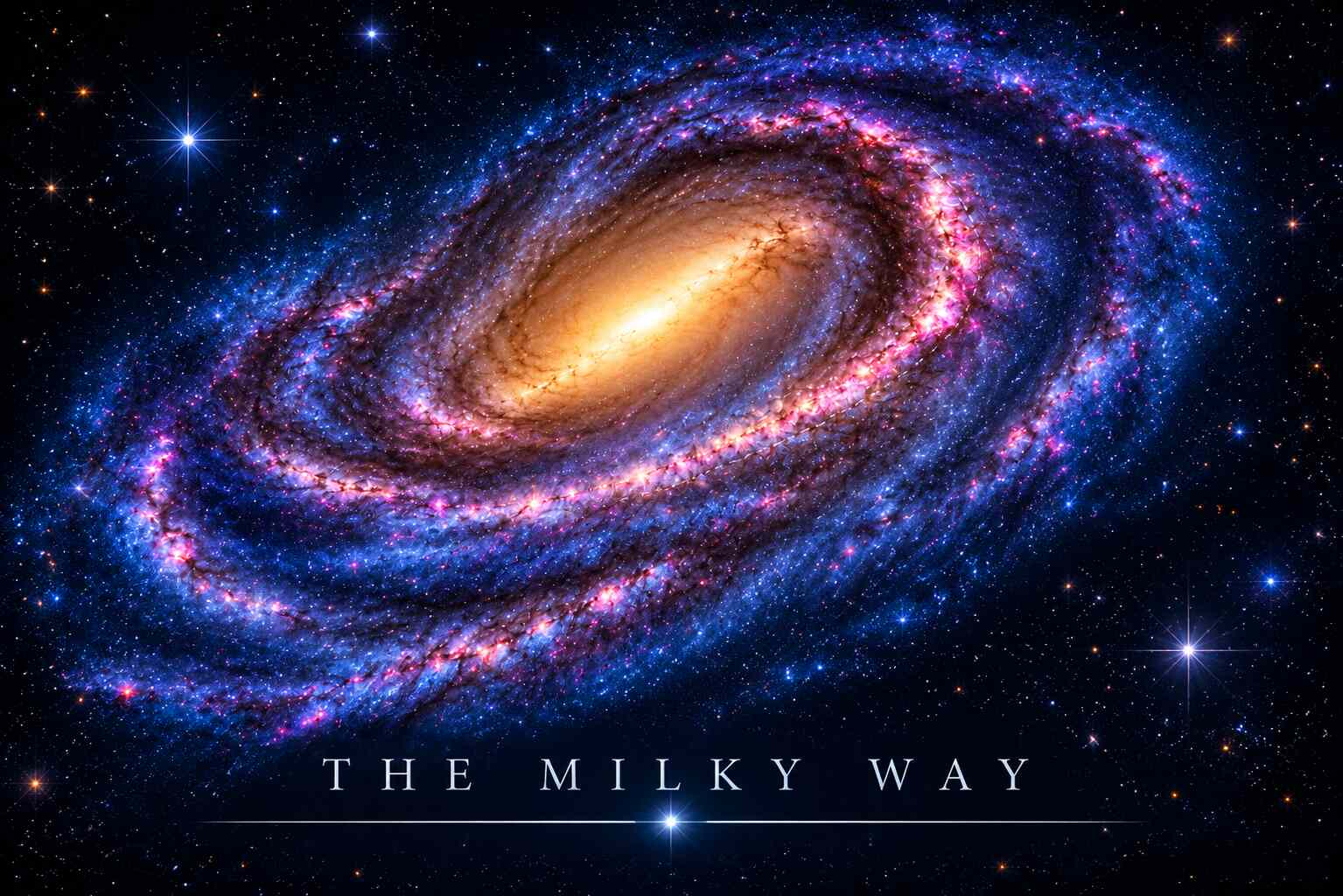
University of Sydney research uses advanced galaxy simulations and astronomical observations to challenge the accepted identity of the Norma spiral arm and provide new insight into the Milky Way’s central bar.
Recent computational research from the University of Sydney suggests that the current understanding of the Milky Way’s structure may require revision. The study posits that a region traditionally identified as the Norma spiral arm may, in fact, be a zone of intense star formation situated along the shock front of the Galaxy’s central stellar bar.
Published on November 20 in Nature Astronomy (https://www.nature.com/articles/s41550-026-03010-5), this discovery offers a new perspective on the distribution of young, massive stars and challenges existing assumptions regarding star formation processes within barred spiral galaxies. The research team utilized a sophisticated methodology that integrates large-scale N-body and hydrodynamic galaxy simulations with astronomical observations. By building computational models to track the evolution of stellar and gaseous structures, the team bypassed limitations inherent in direct observation, such as our position within the Galaxy and interference from interstellar dust.
New research indicates that the Milky Way’s rotating central bar creates shock fronts that compress gas and trigger star formation. This study demonstrates how advanced numerical simulations can reveal galactic structures that are otherwise hidden from direct observation.
A Galactic bar driving shock waves
The Milky Way is classified as a barred spiral galaxy. Its central region contains an elongated concentration of stars known as the Galactic bar, which rotates and exerts gravitational forces on surrounding material.
As gas moves through the bar's gravitational environment, its motion can become highly non-circular. Along the leading edges of the bar, gas can encounter strong compression and form shock fronts. These structures are associated with elongated concentrations of gas and dust commonly called bar dust lanes.
In many nearby barred galaxies, star formation is suppressed along these dust lanes despite the presence of substantial quantities of gas. Strong shocks, turbulence and shear can prevent gas clouds from becoming gravitationally unstable enough to collapse into new stars.
The University of Sydney research presents evidence that the Milky Way may behave differently.
The team argues that young, massive star-forming regions traced by astronomical masers are aligned with a shock front generated by the Galactic bar. This suggests that star formation is taking place along a region where conventional models of barred galaxies would often predict suppression.
The distinction is significant. If the interpretation is correct, the Milky Way provides an important example of how bar-driven gas dynamics can produce conditions favorable to star formation rather than simply disrupting the process.
Simulating billions of years of galactic evolution
The research relies on N-body and hydrodynamic simulations designed to reproduce important characteristics of the Milky Way.
N-body methods calculate the gravitational interactions and collective evolution of large populations of particles representing stars and other galactic components. Hydrodynamic modeling adds the behavior of gas, allowing researchers to investigate how material responds to gravitational forces, develops non-circular motion, becomes compressed and forms dense structures.
The principal Milky Way surrogate model contains four major components: a stellar disk, a central classical stellar bulge, a dark matter halo, and a gaseous disk. The components experience self-gravity and respond to changes in the gravitational potential.
The gas model includes star formation, stellar feedback, radiative heating and cooling, and chemical enrichment. The initial gas particle mass resolution was approximately 1,044 solar masses, with a gravitational softening length of 10 parsecs for the gas.
These details matter because galactic structure cannot be understood simply by calculating where stars are located. The distribution and movement of gas, the gravitational influence of the stellar bar, and the physical processes governing compression and feedback all contribute to the evolution of the system.
The researchers examined a simulation snapshot at approximately 3.95 billion years. They also compared their findings with a second barred-galaxy simulation at approximately 920 million years, providing an additional computational test of the relationship between the simulated shock structures and the observed gas features.
An important aspect of the modeling is its three-dimensional treatment of gas dynamics. The authors explain that two-dimensional simulations can constrain gas to a single plane, limiting its ability to move vertically when encountering spiral-arm shocks. Their three-dimensional models allow gas to move both within and above the galactic plane, producing different non-circular motions and kinematic effects.
That distinction is important when interpreting astronomical observations and estimating the locations of gas clouds.
The Norma arm may not be a spiral arm
The central observational evidence involves astronomical masers.
Masers are naturally occurring sources of concentrated microwave or radio emission. In star-forming regions, they can be associated with young, massive stars and their surrounding molecular gas. Because these objects are very young, they have not had sufficient time to migrate far from the locations where they formed.
Astronomers have used masers to trace portions of the structure traditionally identified as the Norma spiral arm.
The University of Sydney team compared the observed maser positions with the simulated distribution of gas along the Galactic bar. The researchers found that the masers closely align with the predicted shock front in both spatial coordinates and Galactic longitude and line-of-sight velocity measurements.
This correspondence leads to the paper's central conclusion: at least the observed portion of the supposed Norma arm may instead be a star-forming shock front along the leading edge of the Galactic bar.
The researchers also examined carbon monoxide observations, which provide information about molecular gas in the Milky Way. They identified a secondary feature in the observed velocity distribution and connected it to the location where the bar dust lane intersects the tangent-point circle.
The relationship was also found in the second barred-galaxy simulation.
The result does not establish that every structure attributed to the Norma arm is incorrectly identified. Rather, it challenges the interpretation of the observed maser population and raises important questions about how the Galaxy's spiral structure should be mapped.
A longer, slower central bar
The simulations and observational comparisons also provide new constraints on the dimensions and orientation of the Milky Way's central bar.
The researchers estimate a semimajor half-length of approximately 4.3 kiloparsecs, or about 14,000 light-years, and a semiminor half-length of approximately 2.3 kiloparsecs. They estimate an inclination angle of approximately 20 degrees and a bar pattern speed of no more than about 40 kilometers per second per kiloparsec.
These results support a relatively long and slowly rotating Galactic bar, a configuration that has remained debated among astronomers.
The measurements should nevertheless be interpreted with appropriate caution. The researchers matched the simulated shock front to observed maser locations by rotating and scaling the simulation. They acknowledge that some aspects of the bar-length estimation involve visual identification of structural features and that the quoted uncertainties do not capture every possible variation introduced by alternative bar-length measurement methods.
The findings therefore provide additional constraints rather than a final resolution of every disagreement about the Milky Way's central structure.
Computational reproducibility and the research workflow
The research also provides an important computational resource for other astrophysicists.
The authors have made code and precomputed arrays available through a Code Ocean capsule, DOI: https://doi.org/10.24433/CO.6319237.v1. The materials are intended to support reproduction of the paper's principal figures and provide researchers with a way to examine important parts of the analysis.
The disclosure is particularly relevant in an era when computational astrophysics increasingly depends on complex simulation pipelines and extensive data processing. Reproducibility is essential when conclusions depend on matching numerical models with observations that cannot be interpreted through a simple direct measurement.
The paper also explicitly acknowledges the use of ChatGPT, developed by OpenAI, in the research workflow. According to the authors, the tool was used for minor editing of code and writing and for suggestions regarding figure presentation. The authors state that all suggestions were reviewed and verified, and that they retain full responsibility for the final content.
That disclosure illustrates a practical, limited role for generative AI in scientific work. ChatGPT was acknowledged as an assistant for code editing, writing, and presentation. The paper does not credit it with conducting the galaxy simulations, performing the scientific analysis, or producing the discovery.
The distinction is important as AI tools become increasingly common in research environments. Their usefulness in supporting scientific workflows should not be confused with independently establishing scientific results.
AI's larger ambitions in scientific discovery
The broader debate over AI's potential role in mathematics and scientific discovery has also intensified. On November 20, Levent Alpöge, a mathematician at Anthropic, publicly claimed that he and the company's Claude AI model had developed a proof of the Riemann Hypothesis, one of mathematics' most famous unsolved problems. The claim remains subject to independent verification and should not be treated as an established mathematical breakthrough.
The contrast is instructive. In the University of Sydney research, AI assistance is explicitly limited and documented. The much larger claims being made about AI's ability to solve longstanding mathematical problems face a different and considerably more demanding standard of independent scrutiny.
For science, the essential requirement remains the same: computational results, whether produced with conventional simulation software or assisted by AI, must withstand rigorous examination and reproducibility.
National supercomputing infrastructure supports the research
The research was supported by substantial public and institutional investment in scientific computing across Australia and Sweden. The authors report that computations and data storage were enabled by National Computing Infrastructure (NCI) Australia, an NCRIS capability supported by the Australian Government, and LUNARC, the Centre for Scientific and Technical Computing at Lund University, Sweden.
The international collaboration also received funding from the Australian Research Council, the Knut and Alice Wallenberg Foundation, the Swedish Research Council, the Swedish National Space Agency, the LMK Foundation and eSSENCE, a Swedish research initiative.
The authors declared no competing interests.
The acknowledgment of NCI Australia and LUNARC is particularly significant for the computational science behind this research. The simulations required substantial numerical modeling of gravitational dynamics and gas evolution, alongside the storage and analysis of computational data. The named facilities demonstrate the institutional computing infrastructure supporting the work, although the paper does not specify the individual systems, processor configurations, total computing hours or performance benchmarks used.
A new view of our own Galaxy
By employing sophisticated numerical simulations and astronomical findings, University of Sydney scientists suggest that what we perceive as the Milky Way’s Norma arm might actually be a shock front fueled by the galaxy's central bar, where active star formation occurs. This research underscores how computational models can uncover hidden galactic features, potentially overturning conventional theories regarding our galaxy’s physical layout.