SUPERCOMPUTING NEWS SUPERCOMPUTING NEWS
    • MEDIA KIT
    • MOST READ
    • RSS FEED
    • ACADEMIA
    • AEROSPACE
    • APPLICATIONS
    • ASTRONOMY
    • AUTOMOTIVE
    • BIG DATA
    • BIOLOGY
    • CHEMISTRY
    • CLIENTS
    • CLOUD
    • DEFENSE
    • DEVELOPER TOOLS
    • EARTH SCIENCES
    • ECONOMICS
    • ENGINEERING
    • ENTERTAINMENT
    • GAMING
    • GOVERNMENT
    • HEALTH
    • OIL & GAS
    • INDUSTRY
    • INTERCONNECTS
    • MANUFACTURING
    • MIDDLEWARE
    • MOVIES
    • NETWORKS
    • PHYSICS
    • PROCESSORS
    • RETAIL
    • SCIENCE
    • STORAGE
    • SYSTEMS
    • VISUALIZATION
    • AcyMailing subscription form

    • ADD YOUR VIDEOS
    • MANAGE VIDEOS
    • CONVERSATION INBOX
    • SOCIAL ADVERTISER
    • SOCIAL NETWORK VIDEOS
    • SURVEYS
    • GROUPS
    • PAGES
    • MARKETPLACE LISTINGS
    • APPLICATIONS BROWSER
    • PRIVACY CONFIRM REQUEST
    • PRIVACY CREATE REQUEST
    • LEADERBOARD
    • POINTS LISTING
      • BADGES
    • TRADE SHOWS
Sign In
Tyler O'Neal, Staff Editor ACADEMIA May 30, 2022, 2:42 am

UK's leading university launches Future of Work Research Centre

How are artificial intelligence technologies transforming jobs and skills? How does hybrid working affect productivity, teamwork, and value creation? These are some of the critical questions explored by the University of Surrey’s new Future of Work Research Centre launched future of work digital business media df14e

The new Research Centre will focus on people management and job quality in a rapidly changing working environment characterized by rapid technological advancements, economic developments, and societal value changes. These changes have transformed the nature and organization of work, as well as conditions of employment.  eco

Professor Ying Zhou, Director of the Future of Work Research Centre at the University of Surrey, said: 

“With so much uncertainty in our work environment, we’ll be looking at the critical questions facing the future workplace – from analysis of job quality and digital technologies through to the hopes and perils of hybrid working. 

“Artificial intelligence, machine learning, and robotics technologies are changing the nature of jobs, with massive implications for training, skills, and careers. Our new Future of Work Research Centre will draw on world-leading expertise across the University of Surrey, covering artificial intelligence, digital technology, and human resource management, as well as working alongside industry and policy partners. Across our work, we’ll be looking to offer advice on how fairness and justice can be secured in an increasingly diverse workforce.” 

Furthermore, the Research Centre is being established just as the UK Government launches its Future of Work Review headed by MP Matt Warman. 

The launch event will feature Professor Glenn Parry, Head of the Department of Digital Economy, Entrepreneurship and Innovation, Professor Francis Green, Professor of Work and Education Economics at UCL Institute of Education, and Jonny Gifford, Senior Advisor for Organisational Behaviour at the Chartered Institute of Personnel and Development. 

More details on the Future of Work Research Centre can be found here. 

University of Exeter scientists build AI that learns coral reef 'song'

Tyler O'Neal, Staff Editor ACADEMIA May 27, 2022, 3:16 am

Artificial Intelligence (AI) can track the health of coral reefs by learning the "song of the reef," new research shows.

Coral reefs have a complex soundscape – and even experts have to conduct painstaking analyses to measure reef health based on sound recordings. A healthy coral reef in Sulawesi, Indonesia  CREDIT Tim Lamont

In the new study, at the University of Exeter, a public research university in the United Kingdom, scientists have trained a computer algorithm using multiple recordings of healthy and degraded reefs, allowing the machine to learn the difference.

The computer then analyzed a host of new recordings, and successfully identified reef health 92% of the time.

The team used this to track the progress of reef restoration projects.

"Coral reefs are facing multiple threats including climate change, so monitoring their health and the success of conservation projects is vital," said lead author Ben Williams.

"One major difficulty is that visual and acoustic surveys of reefs usually rely on labor-intensive methods.

"Visual surveys are also limited by the fact that many reef creatures conceal themselves, or are active at night, while the complexity of reef sounds has made it difficult to identify reef health using individual recordings.

"Our approach to that problem was to use machine learning – to see whether a computer could learn the song of the reef.

"Our findings show that a computer can pick up patterns that are undetectable to the human ear. It can tell us faster, and more accurately, how the reef is doing."

The fish and other creatures living on coral reefs make a vast range of sounds.

The meaning of many of these calls remains unknown, but the new AI method can distinguish between the overall sounds of healthy and unhealthy reefs.

The recordings used in the study were taken at the Mars Coral Reef Restoration Project, which is restoring heavily damaged reefs in Indonesia.

Co-author Dr. Tim Lamont, from Lancaster University, said the AI method creates major opportunities to improve coral reef monitoring.

"This is a really exciting development. Sound recorders and AI could be used around the world to monitor the health of reefs, and discover whether attempts to protect and restore them are working," Dr. Lamont said.

"In many cases, it's easier and cheaper to deploy an underwater hydrophone on a reef and leave it there than to have expert divers visiting the reef repeatedly to survey it – especially in remote locations."

University of Copenhagen astrophysicists discover stars are heavier than we thought

Tyler O'Neal, Staff Editor ACADEMIA May 25, 2022, 12:46 pm

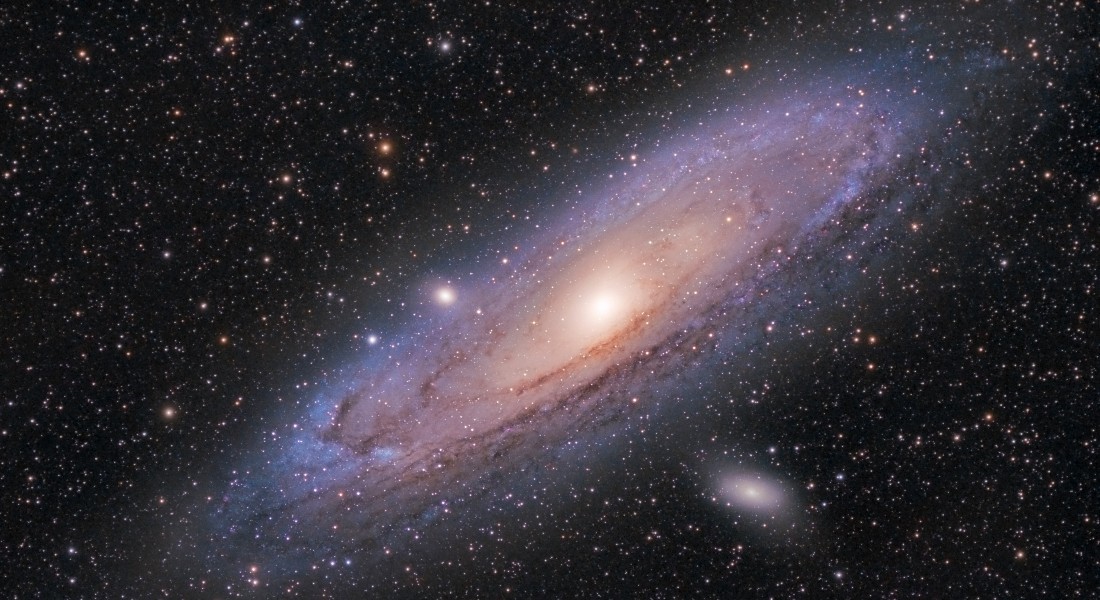
A team of University of Copenhagen astrophysicists has arrived at a major result regarding star populations beyond the Milky Way. The result could change our understanding of a wide range of astronomical phenomena, including the formation of black holes, supernovae, and why galaxies die. The Andromeda galaxy, our Milky Way's closest neighbor, is the most distant object in the sky that you can see with your unaided eye. Photo: Getty
For as long as humans have studied the heavens, how stars look in distant galaxies has been a mystery. In a study published today in The Astrophysical Journal, a team of researchers at the University of Copenhagen’s Niels Bohr Institute is doing away with previous understandings of stars beyond our galaxy.

Since 1955, it has been assumed that the composition of stars in the universe's other galaxies is similar to that of the hundreds of billions of stars within our own – a mixture of massive, medium mass, and low mass stars. But with the help of observations from 140,000 galaxies across the universe and a wide range of advanced models, the team has tested whether the same distribution of stars that appear in the Milky Way applies elsewhere. The answer is no. Stars in distant galaxies are typically more massive than those in our "local neighborhood". The finding has a major impact on what we think we know about the universe.

"The mass of stars tells us, astronomers, a lot. If you change mass, you also change the number of supernovae and black holes that arise out of massive stars. As such, our result means that we’ll have to revise many of the things we once presumed because distant galaxies look quite different from our own," says Albert Sneppen, a graduate student at the Niels Bohr Institute and first author of the study.

Analyzed light from 140.000 galaxies

Researchers assumed that the size and weight of stars in other galaxies were similar to our own for more than fifty years, for the simple reason that they were unable to observe them through a telescope, as they could with the stars of our galaxy.

Distant galaxies are billions of light-years away. As a result, only light from their most powerful stars ever reaches Earth. This has been a headache for researchers around the world for years, as they could never accurately clarify how stars in other galaxies were distributed, an uncertainty that forced them to believe that they were distributed much like the stars in our Milky Way.

"We’ve only been able to see the tip of the iceberg and known for a long time that expecting other galaxies to look like our own was not a particularly good assumption to make. However, no one has ever been able to prove that other galaxies form different populations of stars. This study has allowed us to do just that, which may open the door for a deeper understanding of galaxy formation and evolution," says Associate Professor Charles Steinhardt, a co-author of the study.

In the study, the researchers analyzed light from 140,000 galaxies using the COSMOS catalog, a large international database of more than one million observations of light from other galaxies. These galaxies are distributed from the nearest to farthest reaches of the universe, from which light has traveled a full twelve billion years before being observable on Earth.

Massive galaxies die first

According to the researchers, the discovery will have a wide range of implications. For example, it remains unresolved why galaxies die and stop forming new stars. The new result suggests that this might be explained by a simple trend.

"Now that we are better able to decode the mass of stars, we can see a new pattern; the least massive galaxies continue to form stars, while the more massive galaxies stop birthing new stars, This suggests a remarkably universal trend in the death of galaxies," concludes Albert Sneppen.

The research was conducted at the Cosmic Dawn Center (DAWN), an international basic research center for astronomy supported by the Danish National Research Foundation. DAWN is a collaboration between the Niels Bohr Institute at the University of Copenhagen and DTU Space at the Technical University of Denmark.

The center is dedicated to understanding when and how the first galaxies, stars, and black holes formed and evolved in the early universe, through observations using the largest telescopes along with theoretical work and simulations.


  1. Hubble reaches a new milestone in the mystery of the Universe's expansion rate
  2. Liverpool opens new facility to support innovation

Page 62 of 123

  • 57
  • 58
  • 59
  • 60
  • 61
  • 62
  • 63
  • 64
  • 65
  • 66
POPULAR RIGHT NOW
  • 10,000 AI agents, 130 billion tokens and 88 hours: How OpenAI turned Navier–Stokes into a supercomputing workload
    10,000 AI agents, 130 billion tokens and 88 hours: How OpenAI turned Navier–Stokes into a supercomputing workload
  • Qualcomm enters the supercomputing arena as AWS partnership challenges Nvidia’s AI infrastructure dominance
    Qualcomm enters the supercomputing arena as AWS partnership challenges Nvidia’s AI infrastructure dominance
  • Fugaku goes inside the molecular machine: Supercomputer simulations reveal how kinesin knows which way to step
    Fugaku goes inside the molecular machine: Supercomputer simulations reveal how kinesin knows which way to step
  • From the Tibetan Plateau to California: Supercomputing reveals a hidden source of flood predictability
    From the Tibetan Plateau to California: Supercomputing reveals a hidden source of flood predictability
  • Supercomputing reconstructs the moon Venus may have lost
    Supercomputing reconstructs the moon Venus may have lost
  • Japanese supercomputer recreates the birth of the Universe’s monster black holes
    Visualization of the simulation by ATERUI III showing a rapidly growing black hole surrounded by gas. Red indicates areas of higher temperature. (Credit: Sunmyon Chon, Takaaki Takeda, 4D2U Project, NAOJ)
    Visualization of the simulation by ATERUI III showing a rapidly growing black hole surrounded by gas. Red indicates areas of higher temperature. (Credit: Sunmyon Chon, Takaaki Takeda, 4D2U Project, NAOJ)
  • China’s supercomputing push meets a harder problem: Teaching computers to keep asteroids honest
    China’s supercomputing push meets a harder problem: Teaching computers to keep asteroids honest
  • Alibaba’s superintelligence ambition puts supercomputing at the center of the AI race
    Alibaba’s superintelligence ambition puts supercomputing at the center of the AI race
  • AI’s trillion dollar compute race hits a hard limit: There isn’t enough power
    AI’s trillion dollar compute race hits a hard limit: There isn’t enough power
  • AI agents search 1.9 billion protein clusters, discover a new biological system
    AI agents search 1.9 billion protein clusters, discover a new biological system
THIS YEAR'S MOST READ
  • Wall Street wants to trade supercomputing power like oil
    Wall Street wants to trade supercomputing power like oil
  • Beamforming the future: BeammWave's 6G push signals the rise of orbital-terrestrial wireless networks
    Joakim Axmon
    Joakim Axmon
  • AI breaks conservation barriers: Australia’s Wildlife Observatory leverages supercomputing to protect biodiversity
    AI breaks conservation barriers: Australia’s Wildlife Observatory leverages supercomputing to protect biodiversity
  • Silicon spintronics brings the P-computer closer to reality
    Microscope image of a semiconductor-integrated spintronic test chip developed by researchers at Tohoku University and NIST. The device demonstrates the first silicon-integrated probabilistic bit (p-bit), a key building block for future large-scale probabilistic computers designed for AI and optimization workloads.
    Microscope image of a semiconductor-integrated spintronic test chip developed by researchers at Tohoku University and NIST. The device demonstrates the first silicon-integrated probabilistic bit (p-bit), a key building block for future large-scale probabilistic computers designed for AI and optimization workloads.
  • Hidden order, revealed at scale: Supercomputing, electron ptychography uncover the inner workings of relaxor ferroelectrics
    Hidden order, revealed at scale: Supercomputing, electron ptychography uncover the inner workings of relaxor ferroelectrics
  • Physics-trained ‘Digital Super Brain’ learns from supercomputers to accelerate discovery
    Physics-trained ‘Digital Super Brain’ learns from supercomputers to accelerate discovery
  • Memory has become the new compute: Why Micron, SK Hynix crossing $1 trillion matters to supercomputing
    Memory has become the new compute: Why Micron, SK Hynix crossing $1 trillion matters to supercomputing
  • Cosmic ambition at scale: UK’s supercomputer unlocks a 2.5 petabytes universe
    Cosmic ambition at scale: UK’s supercomputer unlocks a 2.5 petabytes universe
  • Huawei’s Tau Scaling ambition tests the limits of post-Moore semiconductor reality
    He Tingbo from HUAWEI delivered a keynote speech titled "New Semiconductor Path in Practice"
    He Tingbo from HUAWEI delivered a keynote speech titled "New Semiconductor Path in Practice"
  • Intel's Q1 results signal supercomputing surge driving Xeon momentum
    Intel's Q1 results signal supercomputing surge driving Xeon momentum
  • FRONTPAGE
  • LATEST
  • POPULAR
  • REGISTER
  • SOCIAL
  • VIDEO
  • SUBSCRIPTION
  • RSS
  • GUIDELINES
  • PRIVACY
  • TOS
  • ABOUT
  • +1 (816) 799-4488
  • editorial@supercomputingonline.com
© 2001 - 2026 SuperComputingOnline.com, LLC. All rights reserved. This material may not be published, broadcast, rewritten or redistributed without permission.
Sign In
  • FRONT PAGE
  • LATEST
    • MEDIA KIT
    • MOST READ
    • RSS FEED
    • ACADEMIA
    • AEROSPACE
    • APPLICATIONS
    • ASTRONOMY
    • AUTOMOTIVE
    • BIG DATA
    • BIOLOGY
    • CHEMISTRY
    • CLIENTS
    • CLOUD
    • DEFENSE
    • DEVELOPER TOOLS
    • EARTH SCIENCES
    • ECONOMICS
    • ENGINEERING
    • ENTERTAINMENT
    • HEALTH
    • INDUSTRY
    • INTERCONNECTS
    • GAMING
    • GOVERNMENT
    • MANUFACTURING
    • MIDDLEWARE
    • MOVIES
    • NETWORKS
    • OIL & GAS
    • PHYSICS
    • PROCESSORS
    • RETAIL
    • SCIENCE
    • STORAGE
    • SYSTEMS
    • VISUALIZATION
  • VIDEOS
    • ADD YOUR VIDEOS
    • MANAGE VIDEOS
  • COMMUNITY
    • TRADE SHOWS
    • SOCIAL NETWORK VIDEOS
    • SURVEYS
    • APPLICATIONS BROWSER
    • CONVERSATION INBOX
    • SOCIAL ADVERTISER
    • GROUPS
    • MARKETPLACE LISTINGS
    • PAGES
    • LEADERBOARD
    • POINTS LISTING
      • BADGES
    • PRIVACY CONFIRM REQUEST
    • PRIVACY CREATE REQUEST

Hey there! We noticed you’re using an ad blocker.