

University of Liverpool researchers discover a new inorganic material with the lowest thermal conductivity that can lead to lower energy supercomputing

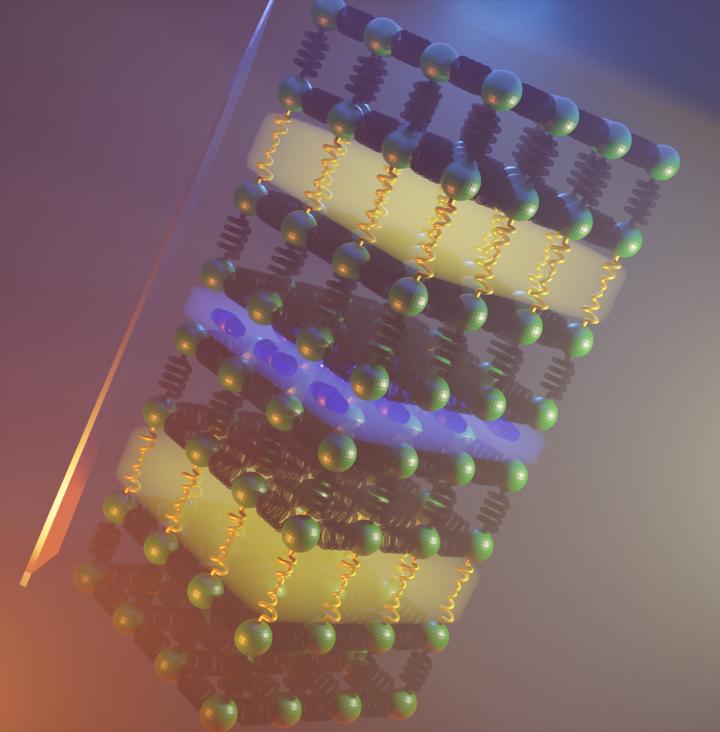
A collaborative research team, led by the University of Liverpool, has discovered a new inorganic material with the lowest thermal conductivity ever reported. This discovery paves the way for the development of new thermoelectric materials that will be critical for a sustainable society. Using the right chemistry, it is possible to combine two different atomic arrangement (yellow and blue slabs) that provide mechanisms to slow down the motion of heat through a solid. This strategy gives the lowest thermal conductivity reported in an inorganic material.
As reported in the journal Science, this discovery represents a breakthrough in the control of heat flow at the atomic scale, achieved by materials design. It offers fundamental new insights into the management of energy. The new understanding will accelerate the development of new materials for converting waste heat to power and for the efficient use of fuels.

The research team, led by Professor Matt Rosseinsky at the University's Department of Chemistry and Materials Innovation Factory and Dr. Jon Alaria at the University's Department of Physics and Stephenson Institute for Renewable Energy, designed and synthesized the new material so that it combined two different arrangements of atoms that were each found to slow down the speed at which heat moves through the structure of a solid.

They identified the mechanisms responsible for the reduced heat transport in each of these two arrangements by measuring and modeling the thermal conductivities of two different structures, each of which contained one of the required arrangements.

Combining these mechanisms in a single material is difficult because the researchers have to control exactly how the atoms are arranged within it. Intuitively, scientists would expect to get an average of the physical properties of the two components. By choosing favorable chemical interfaces between each of these different atomic arrangements, the team experimentally synthesized a material that combines them both (represented as the yellow and blue slabs in the image).

This new material, with two combined arrangements, has a much lower thermal conductivity than either of the parent materials with just one arrangement. This unexpected result shows the synergic effect of the chemical control of atomic locations in the structure and is the reason why the properties of the whole structure are superior to those of the two individual parts.

If we take the thermal conductivity of steel as 1, then a titanium bar is 0.1, water and a construction brick is 0.01, the new material is 0.001 and air is 0.0005.

Approximately 70 percent of all the energy generated in the world is wasted as heat. Low thermal conductivity materials are essential to reduce and harness this waste. The development of new and more efficient thermoelectric materials, which can convert heat into electricity, is considered a key source of clean energy.

Professor Matt Rosseinsky said: "The material we have discovered has the lowest thermal conductivity of any inorganic solid and is nearly as poor a conductor of heat as air itself.

"The implications of this discovery are significant, both for fundamental scientific understanding and for practical applications in thermoelectric devices that harvest waste heat and as thermal barrier coatings for more efficient gas turbines."

Dr. Jon Alaria said: "The exciting finding of this study is that it is possible to enhance the property of a material using complementary physics concepts and appropriate atomistic interfacing. Beyond heat transport, this strategy could be applied to other important fundamental physical properties such as magnetism and superconductivity, leading to lower energy computing and more efficient transport of electricity."

TU Munich prof simulates future forest fires in Yellowstone with artificial intelligence

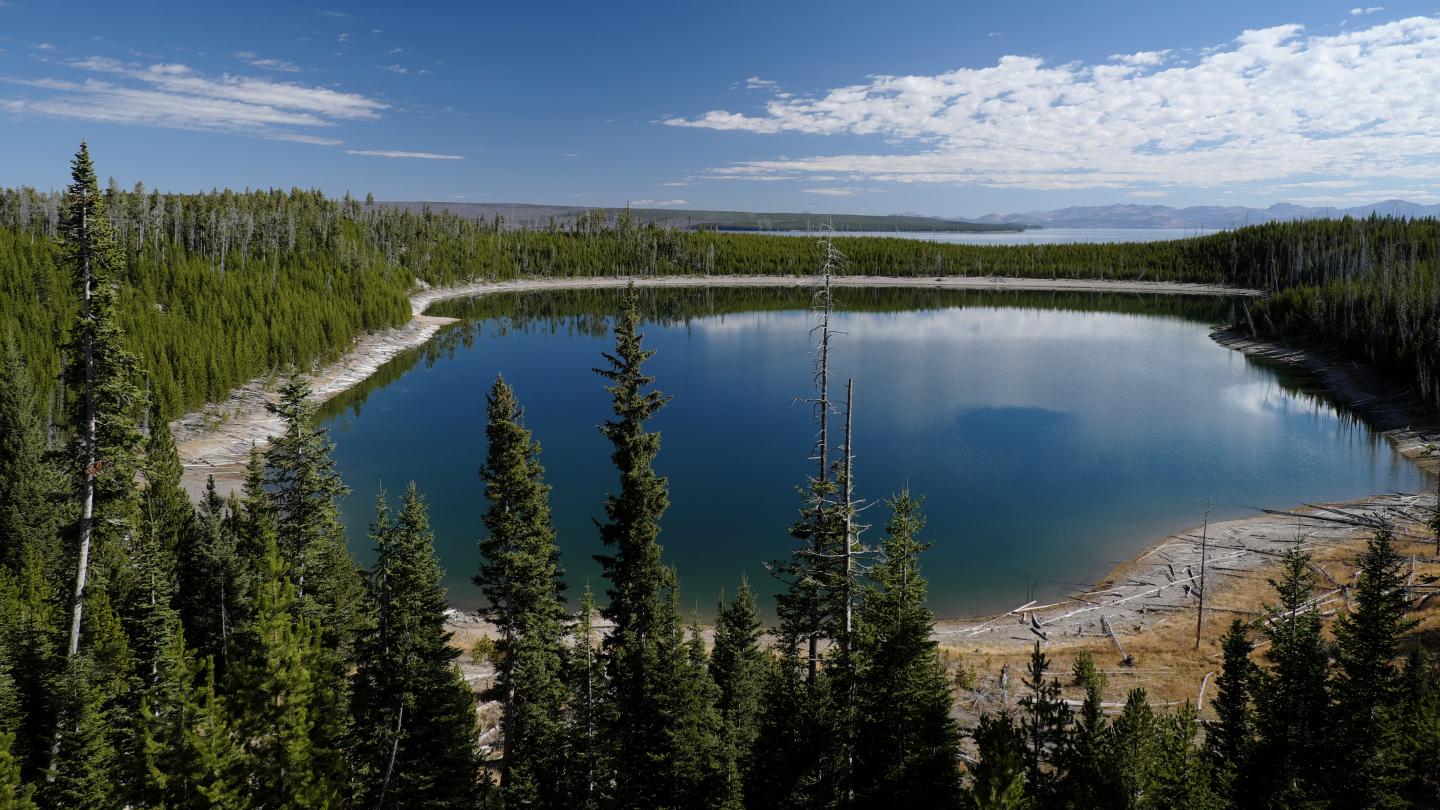
Forest fires are already a global threat. "But considering how climate change is progressing, we are probably only at the beginning of a future that will see more and bigger forest fires," explains Rupert Seidl, Professor of Ecosystem Dynamics and Forest Management in Mountain Landscapes at TUM in Germany. The iconic landscape of Yellowstone National Park is characterized by vast forests that have been untouched by man but are threatened by increasing numbers of forest fires due to climate change.  CREDIT R. Seidl / TUM

In many places, fire is part of the natural environment, and many tree species have become adapted naturally to recurrent fires. These adaptations range from particularly thick bark, which protects the sensitive cambium in the trunk from the fire, to the cones of certain types of pine, which open only due to the heat of a fire, allowing a quick regeneration and recovery of affected woodland.

AI is accelerating ecosystem models

"The interaction between climate, forest fires, and other processes in the forest ecosystem is very complex, and sophisticated process-based simulation models are required to take account of the different interactions appropriately," explains Prof. Seidl. A method developed at TUM is using artificial intelligence to expand the use of these complex models.

This method involves the training of a deep neural network to imitate the behavior of a complex simulation model as effectively as possible. The neural network learns based on how the ecosystem responds to different environmental influences but does so by using only a fraction of the computing power that would otherwise be necessary for large-scale simulation models. "This allows us to carry out spatially high-resolution simulations of areas of forest that stretch across several million hectares," explains scientist Dr. Werner Rammer.

Forecast for the forests in Yellowstone National Park

The simulations completed by the team of scientists include simulations for the "Greater Yellowstone Ecosystem", which has the world-famous Yellowstone National Park at its heart. This area, which is approximately 8 million hectares in size, is situated in the Rocky Mountains and is largely untouched. The researchers at the TUM have worked with American colleagues to determine how different climate scenarios could affect the frequency of forest fires in this region in the 21st century, and which areas of forest cannot regenerate successfully following a forest fire.

Depending on the climate change scenario, the study has found that by the end of the century, the current forest coverage will have disappeared in 28 to 59 percent of the region. Particularly affected were the forests in the sub-alpine zone near the tree line, where the species of tree are naturally less adapted to fire, and the areas on the Yellowstone Plateau, where the relatively flat topography is mostly unable to stop the fire from spreading.

Climate change is causing significant changes to forest ecosystems

The regeneration of the forest in the region under investigation is a threat for several reasons: If the fires get bigger and the distances between the surviving trees also increase, too few seeds will make their way onto the ground. If the climate gets hotter and drier in the future, the vulnerable young trees won't survive, and if there are too many fires, the trees won't reach the age at which they yield seeds.

"By 2100, the Greater Yellowstone Ecosystem is expected to have changed more than it has in the last 10,000 years, and will therefore look significantly different than it does today," explains Rammer. "The loss of today's forest vegetation is leading to a reduction in the carbon which is stored in the ecosystem, and will also have a profound impact on the biodiversity and recreational value of this iconic landscape."

Also, the potential developmental trends identified in the study are intended to help visitors to the national park understand the consequences of climate change and the urgency of the climate protection measures. In the next step, the research team will be using AI to estimate the long-term impact of the problems caused by climate change in the forests of Europe.

Rensselaer physicist wins a half million dollars grant to harness AI to search for new materials with exotic properties

In the periodic table of elements, there are 118 distinct elements, most of which can combine with one or more others to form materials with potentially surprising properties. By one estimate, the number of combinations possibly yielding new materials exceeds the number of atoms in the universe. With all these options, how can we know where to look for materials with the properties we want? CAREER Award supports research that will accelerate materials discovery

With the support of a prestigious $542,813 National Science Foundation Faculty Early Career Development (CAREER) grant, Rensselaer Polytechnic Institute physicist Trevor David Rhone is turning to artificial intelligence to help determine which combination of elements might form new materials with interesting properties for advancing both scientific understanding and technological applications, such as data storage, spintronics, and quantum supercomputing.

Hidden within the astronomically large number of potential materials candidates are yet to be discovered materials with novel properties. Which is the right combination of elements that will produce a material with the desired property? Are there materials with entirely new and surprising behaviors? The accelerated materials discovery approach being developed by Rhone, an assistant professor of physics at Rensselaer Polytechnic Institute, will attempt to address these questions and more. His work has the potential to dramatically speed up the materials discovery process and will identify materials with properties that enable new applications.

"How do you efficiently explore the entire space of possibilities? That's the challenge," Rhone said. "The exploration of materials space could represent a new frontier of scientific discovery, with many challenges but many more opportunities."

Conventionally, the discovery of new material with specialized properties requires a time-consuming effort that often involves first-principles quantum calculations and materials synthesis before characterization and verification of predicted properties with experiments. Alternatively, it may involve a serendipitous observation followed by a painstaking series of systematic experiments and computations.

One property that interests Rhone is magnetism. In simple terms, the magnetism of material is controlled by the so-called spin of its electrons. To visualize spin, it's helpful to imagine the atoms in the material as billiard balls, each with a single arrow projecting from the ball, which represents the direction of the spin of an electron. Magnetism arises when spins align. A random ordering of spins does not give rise to magnetism.

Atomically thin or two-dimensional materials, also called van der Waals materials, can exhibit different properties than their bulk cousins -- like the difference between graphene and graphite. This makes their behavior even harder to study.

Some theories predicted that 2D materials could not exhibit magnetism, but since the discovery of the first magnetic 2D material in 2017, the search for more of them has been intensifying. However, magnetism can manifest in many different ways, and some are more useful than others. For instance, magnetic ordering may only arise below a certain critical temperature. The value of the critical temperature varies from material to material. For real-world applications, it is desirable to have this critical temperature above room temperature. This represents an additional challenge for materials discovery.

Yet another challenge is understanding how the properties of a material are related to the properties of its constituent atoms. There are myriad materials characteristics, such as the chemical composition and atomic position, which may or may not be linked to a target property like magnetism.

"The remarkable thing about computers is that they can find patterns in data comprising a large number of dimensions or characteristics," Rhone said. "My plan is to combine existing databases, in addition to data from in-house simulations and experiments, with AI to search for those 'hidden' patterns that will shed light on a material's behavior."

In a 2020 paper published in Nature Scientific Reports, Rhone tested his approach, calculating the structures of 200 materials (requiring over six months of time on a supercomputer), and then used machine learning to leverage those structures into predictions of more than 4,000 additional structures with a reasonable accuracy (requiring only seconds on a personal computer). His new project will make predictions based on known structures gathered from databases such as those made possible through the government-funded Materials Project, which currently houses open-access entries on more than 130,000 inorganic compounds, as well as the results of additional targeted quantum calculations.

"Given the astronomical number of possible combinations and potential bonding arrangements of atoms, it is reasonable to expect those fascinating new materials with properties that enable new applications and new technologies are waiting to be discovered. Trevor's work will undoubtedly accelerate that process, and we congratulate him on this significant recognition of his groundbreaking work," said Curt Breneman, dean of the Rensselaer School of Science.