Missouri S&T develops first user-friendly software platform to update dynamic networks

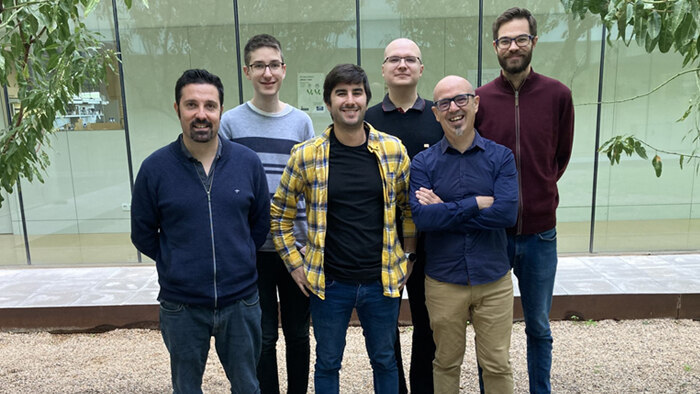
Researchers at Missouri University of Science and Technology are developing a new approach for updating dynamic networks – like those used to track viruses, connect people on social media, and coordinate transportation systems – that they say is the first scalable, expandable and user-friendly solution to analyze who is using the network, where they are, and what information and channels they access. Software programs that analyze static networks are available, but researchers say a lack of cyberinfrastructure hampers innovative research in large-scale, complex, dynamic networks. Dr. Sajal Das reviews work by Missouri S&T computer science graduate students on the Cyberinfrastructure for Accelerating Innovation in Network Dynamics (CANDY) project. Photo by Michael Pierce, Missouri S&T.

Dr. Sajal Das, the Daniel St. Clair Endowed Chair of Computer Science at Missouri S&T, describes dynamic networks modeled as nodes and links. Your cell phone is a node, but unless you make a network connection, there is no link. If you switch off your phone or the battery dies, there is no longer a node. He says nodes and links come and go, making network management complex and challenging.

“The networks change all the time,” Das explains. “Say there’s a disaster or a St. Louis Cardinals game or an accident, and people connect to get information. We don’t know how many people will be on a network at any given time. Similarly, for coronavirus tracing, it’s hard to know how many virus-infected people will come in contact at any given time within proximity.”

Das is collaborating with researchers from the University of Oregon and the University of North Texas on a project titled “Cyberinfrastructure for Accelerating Innovation in Network Dynamics,” or CANDY. The project is funded through a four-year, $2.5 million dollar grant from the National Science Foundation.

Das says they are building the platform to be accessible not only to computer experts but also to intermediate and basic users.

“The networks are so large and changing so fast, we are developing high-performance and parallel computing algorithms,” Das says. “We are also building a cyberinfrastructure tool so that other scientists, engineers, practitioners, and students can develop their own solutions for dynamic networks.”

The Missouri S&T Experimental Mine will be a project case study to analyze the cost-effective operation of complex mining engineering applications such as wireless communications among vehicles, sensor networks, and mining infrastructure. Das says that due to the uncertainty of the infrastructure – which can be affected by terrain, rock or mudslides, and weather conditions – mine-related communications networks may vary dramatically and must be re-established to ensure safety and dependable delivery.

Das says the researchers will work with the government and industry to evaluate the effectiveness of the platform, algorithms, and software tools. They will host workshops and tutorials to educate the research community. Das says the team will also reach out to underrepresented groups by engaging rural communities and high school students in Missouri, Hispanic and Black communities in Texas, First Nation communities in Oregon, and women to train a diverse group of future data scientists in the development of the CANDY platform.

UK mathematicians develop ground-breaking modeling toolkit to predict local COVID-19 impact

A University of Sussex team, including university mathematicians, has created a new modeling toolkit that predicts the impact of COVID-19 at a local level with unprecedented accuracy. The details are published in the International Journal of Epidemiology and are available for other local authorities to use online, just as the UK looks as though it may head into another wave of infections. Output of the compartmental model and comparison with data. The solid line represents the output of the model with the parameters inferred from the data. The shaded region depicts the 95% confidence interval (95% CI) computed from the data, i.e. attributing all the error to measurement error. The dots correspond to observed data. Since all data are collected by manual counting and recording, there is a significant amount of noise. Furthermore, we cannot verify that the counting protocol has not changed during the period. There are between 1 and 5 outliers in each data set, out of a total of 82 data points, but generally the model captures the dynamics of the data and the situation (Colour version online).

The study used the local Sussex hospital and healthcare daily COVID-19 situation reports, including admissions, discharges, bed occupancy, and deaths.

Through the pandemic, the newly-published modeling has been used by local NHS and public health services to predict infection levels so that public services can plan when and how to allocate health resources - and it has been conclusively shown to be accurate. The team is now making their modeling available to other local authorities to use via the Halogen toolkit.

"We undertook this study as a rapid response to the COVID-19 pandemic. Our objective was to provide support and enhance the capability of local NHS and Public Health teams to accurately predict and forecast the impact of local outbreaks to guide healthcare demand and capacity, policymaking, and public health decisions," said Anotida Madzvamuse, professor of mathematical and computational biology within the School of Mathematical and Physical Sciences at the University of Sussex, who led of the study.

"Working with outstanding mathematicians, Dr. James Van Yperen and Dr. Eduard Campillo-Funollet, we formulated an epidemiological model and inferred model parameters by fitting the model to local datasets to allow for short, and medium-term predictions and forecasts of the impact of COVID-19 outbreaks.

"I'm really pleased that our modeling has been of such value to local health services and people. The modeling approach can be used by local authorities to predict the dynamics of other conditions such as winter flu and mental health problems."

Professor Anjum Memon, Chair in Epidemiology and Public Health Medicine at BSMS and co-author of the study, said:

"The world is in the cusp of experiencing local and regional hotspots and spikes of COVID-19 infections. Our epidemiological model, which is based on local data, can be used by all local authorities in the UK and other countries to inform healthcare demand and capacity, emergency planning and response to the supply of medications and oxygen, formulation, tightening or lifting of legal restrictions and implementation of preventive measures."

"The model will also serve as an excellent tool to monitor the situation after the legal COVID-19 restrictions are lifted in England on 19 July, and during winter months with competing respiratory infections."

Kate Gilchrist, Head of Public Health Intelligence at Brighton & Hove City Council and co-author of the study, said:

"This unique piece of work demonstrated that by using local datasets, model predictions and forecasting allowed us to plan adequately the healthcare demand and capacity, as well as policy-making and public health decisions to mitigate the impact of COVID-19 on the local population. Understanding how future COVID-19 spikes and waves could possibly affect the local populations empowers us to ensure that contingency measures are in place and the timely commissioning and organization of services."

Dr. Sue Baxter, Director of Innovations and Business Partnerships at the University of Sussex, said: "The University is delighted that this innovative modeling approach and philosophy has been translated from the mathematical drawing board into a web-based tool-kit called Halogen, which can be used by NHS hospitals, local authorities, and public health departments locally and across the UK to help save lives and improve the capability for hard-pressed public health workers. The successful commercialization of this kind of innovation illustrates just one of the transformational impacts that the Higher Education Innovation Fund can make when applied in a targeted way."

Chinese University of Hong Kong built machine learning accelerates the search for promising Moon sites for energy, mineral resources

A Moon-scanning method that can automatically classify important lunar features from telescope images could significantly improve the efficiency of selecting sites for exploration. Machine learning can be used to rapidly identify and classify craters and rilles on the Moon from telescope images.© 2021 NASA

There is more than meets the eye to picking a landing or exploration site on the Moon. The visible area of the lunar surface is larger than Russia and is pockmarked by thousands of craters and crisscrossed by canyon-like rilles. The choice of future landing and exploration sites may come down to the most promising prospective locations for construction, minerals, or potential energy resources. However, scanning by eye across such a large area, looking for features perhaps a few hundred meters across, is laborious and often inaccurate, which makes it difficult to pick optimal areas for exploration. 

Siyuan Chen, Xin Gao, and Shuyu Sun, along with colleagues from The Chinese University of Hong Kong, have now applied machine learning and artificial intelligence (AI) to automate the identification of prospective lunar landing and exploration areas.

“We are looking for lunar features like craters and rilles, which are thought to be hotspots for energy resources like uranium and helium-3 — a promising resource for nuclear fusion,” says Chen. “Both have been detected in Moon craters and could be useful resources for replenishing spacecraft fuel.”

Machine learning is a very effective technique for training an AI model to look for certain features on its own. The first problem faced by Chen and his colleagues was that there was no labeled dataset for rilles that could be used to train their model.

“We overcame this challenge by constructing our own training dataset with annotations for both craters and rilles,” says Chen. “To do this, we used an approach called transfer learning to pretrain our rille model on a surface crack dataset with some fine-tuning using actual rille masks. Previous approaches require manual annotation for at least part of the input images —our approach does not require human intervention and so allowed us to construct a large-high-quality dataset.”

The next challenge was developing a computational approach that could be used to identify both craters and rilles at the same time, something that had not been done before.

“This is a pixel-to-pixel problem for which we need to accurately mask the craters and rilles in a lunar image,” says Chen. “We solved this problem by constructing a deep learning framework called high-resolution-moon-net, which has two independent networks that share the same network architecture to identify craters and rilles simultaneously.”

The team’s approach achieved precision as high as 83.7 percent, higher than existing state-of-the-art methods for crater detection.