KIST produces simulations for the high-efficiency production of Hydrogen peroxide

Supercomputer simulation-based catalyst development for hydrogen peroxide production with the selectivity of 95%. Development of the platinum-gold alloy catalyst facilitating hydrogen peroxide direct synthesis from hydrogen and oxygen at room temperature and atmo

Hydrogen peroxide is used as a disinfectant, after dilution in water, to treat wounds. It is widely used across the industry as an eco-friendly oxidizing agent for impurity removal from semiconductors, waste treatment, etc. Currently, it is mainly produced by the sequential hydrogenation and oxidation of anthraquinone (AQ). However, this process is not only energy-intensive and requires large-scale facilities, but AQ is also toxic.

As an alternative to the AQ process, hydrogen peroxide direct synthesis from hydrogen (H2) and oxygen (O2) using a palladium (Pd) catalyst were proposed. However, the commercialization of the technology has been challenging because the amount of water (H2O) formed is more than hydrogen peroxide (H2O2) during the process.

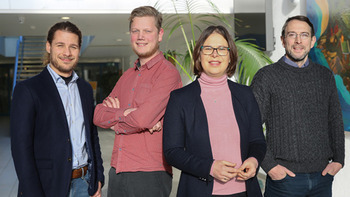
The Korea Institute of Science and Technology (KIST) announced that a joint research team of Dr. Sang Soo Han and Dr. Donghun Kim (Computational Science Research Center), Dr. Seung Yong Lee (Materials Architecture Research Center), and Professor Kwan-Young Lee at Korea University (Korea University, President Jin Taek Chung) developed a platinum-gold alloy catalyst for hydrogen peroxide production based on a computer simulation. Hydrogen peroxide selectivity can be increased to 95% by using this catalyst, compared with only 30-40% for a palladium catalyst, which indicates that mostly hydrogen peroxide on the developed Pt-Au catalyst can be produced with a small amount of water. Dr. Sang Soo Han, Computational Science Research Center, KIST{module INSIDE STORY}

The joint research team between KIST and Korea University developed a new type of Pt-Au alloyed nanoparticle catalyst. Although it is difficult to homogeneously mix Pt and Au to develop an alloyed catalyst due to the intrinsic immiscibility of the metals, the researchers could successfully synthesize nanoparticles in the form of alloys by forcibly reducing precursors of Pt and Au. Also, using this method, the content of each metal particle could be controlled by adjusting the number of precursors of Pt and Au.

Hydrogen peroxide can be produced anywhere without large equipment by simply injecting both hydrogen gas and oxygen gas into an aqueous solution using the catalyst developed by the researchers. Unlike the Pd catalyst, the catalyst developed by the joint researchers can produce hydrogen peroxide up to 95% even at ambient temperature (10 C) and atmospheric pressure (1 atm). In addition, a catalytic reaction can be maintained for longer than 8 h, resulting from the structural stability of the catalyst.

The researchers clearly established the crystal structure of Pt-Au alloy nanoparticles by performing additional supercomputer simulations, which is difficult to solve using general material analysis techniques. Furthermore, the catalytic reaction mechanism via supercomputer simulations was proposed at the atomic level in which the reason why the catalytic performance for hydrogen peroxide production is increased with increasing Au content was also clarified.

Sang-Soo Han, Head of the Center at KIST, said, "it is important that the developed catalysts provide an eco-friendly hydrogen peroxide production option that can be applied without any limitation of manufacturing sites. Therefore, commercialization for the hydrogen peroxide direct synthesis would be greatly accelerated by overcoming the limitation of Pd catalysts with the low selectivity" and "the time and cost for the development of novel catalysts, mainly explored through trial and error, could be considerably reduced through computer simulations." 

The research results were published in the latest issue of the academic journal 'Acta Materialia' in the field of materials science.

Pitt team develops cheap, potent pathway to pandemic therapeutics

By capitalizing on a convergence of chemical, biological, and artificial intelligence advances, the University of Pittsburgh School of Medicine scientists have developed an unusually fast and efficient method for discovering tiny antibody fragments with big potential for development into therapeutics against deadly diseases. 

The technique, published today in the journal Cell Systems, is the same process the Pitt team used to extract tiny SARS-CoV-2 antibody fragments from llamas, which could become an inhalable COVID-19 treatment for humans. This approach has the potential to quickly identify multiple potent nanobodies that target different parts of a pathogen—thwarting variants.

Yi Shi, Ph.D., assistant professor of cell biology, University of Pittsburgh.“Most of the vaccines and treatments against SARS-CoV-2 target the spike protein, but if that part of the virus mutates, which we know it is, those vaccines and treatments may be less effective,” said senior author Yi Shi, Ph.D., assistant professor of cell biology at Pitt. “Our approach is an efficient way to develop therapeutic cocktails consisting of multiple nanobodies that can launch a multipronged attack to neutralize the pathogen.” {module INSIDE STORY} 

{media load=media,id=251,width=350,align=right,display=inline}

Shi and his team specialize in finding nanobodies—which are small, highly specific fragments of antibodies produced by llamas and other camelids. Nanobodies are particularly attractive for development into therapeutics because they are easy to produce and bioengineer. In addition, they feature high stability and solubility, and can be aerosolized and inhaled, rather than administered through intravenous infusions, like traditional antibodies. 

By immunizing a llama with a piece of a pathogen, the animal’s immune system produces a plethora of mature nanobodies in about two months. Then it’s a matter of teasing out which nanobodies are best at neutralizing the pathogen—and most promising for development into therapies for humans. 

That’s where Shi’s “high-throughput proteomics strategy” comes into play. 

“Using this new technique, in a matter of days we’re typically able to identify tens of thousands of distinct, highly potent nanobodies from the immunized llama serum and survey them for certain characteristics, such as where they bind to the pathogen,” Shi said. “Prior to this approach, it has been extremely challenging to identify high-affinity nanobodies.”

After drawing a llama blood sample rich in mature nanobodies, the researchers isolate those nanobodies that bind specifically to the target of interest on the pathogen. The nanobodies are then broken down to release small “fingerprint” peptides that are unique to each nanobody. These fingerprint peptides are placed into a mass spectrometer, which is a machine that measures their mass. By knowing their mass, the scientists can figure out their amino acid sequence—the protein building blocks that determine the nanobody’s structure. Then, from the amino acids, the researchers can work backward to DNA—the directions for building more nanobodies. 

Simultaneously, the amino acid sequence is uploaded to a supercomputer outfitted with artificial intelligence software. By rapidly sifting through mountains of data, the program “learns” which nanobodies bind the tightest to the pathogen and where on the pathogen they bind. In the case of most of the currently available COVID-19 therapeutics, this is the spike protein, but recently it has become clear that some sites on the spike are prone to mutations that change its shape and allow for antibody “escape.” Shi’s approach can select for binding sites on the spike that are evolutionarily stable, and therefore less likely to allow new variants to slip past.

Finally, the directions for building the most potent and diverse nanobodies can then be fed into vats of bacterial cells, which act as mini-factories, churning out orders of magnitude more nanobodies compared to the human cells required to produce traditional antibodies. Bacterial cells double in 10 minutes, effectively doubling the nanobodies with them, whereas human cells take 24 hours to do the same.

“This drastically reduces the cost of producing these therapeutics,” said Shi. 

Shi and his team believe their technology could be beneficial for more than just developing therapeutics against COVID-19—or even the next pandemic. 

Yi Shi, Ph.D., operates his mass spectrometry machine to analyze 10's of millions of nanobodies pulled from llama blood.MassSpecYiShi release“The possible uses of highly potent and specific nanobodies that can be identified quickly and inexpensively are tremendous,” said Shi. “We’re exploring their use in treating cancer and neurodegenerative diseases. Our technique could even be used in personalized medicine, developing specific treatments for mutated superbugs for which every other antibiotic has failed.”

Additional researchers on this publication are Yufei Xiang and Jianquan Xu, Ph.D., both of Pitt; Zhe Sang of Pitt and Carnegie Mellon University; and Lirane Bitton and Dina Schneidman-Duhovny, Ph.D., both of the Hebrew University of Jerusalem.

This research was supported by the UPMC Aging InstituteNational Institutes of Health grant 1R35GM137905-01, Israel Science Foundation grant 1466/18, the Ministry of Science and Technology of Israel, and the Hebrew University of Jerusalem Center for Interdisciplinary Data Science Research. 

Russian scientists discover new physical effects important for the ITER reactor operation

Researchers discovered new effects, which affect the energy flow in the reactor

The energy of the future lies in the area of the controlled thermonuclear fusion. The scientific group from Peter the Great St.Petersburg Polytechnic University (SPbPU), headed by Professor Vladimir Rozhansky, is directly involved in the establishment of the world's largest experimental thermonuclear reactor ITER. Researchers discovered new effects, which affect the energy flow in the reactor. The theoretical predictions were confirmed by the experiments on two tokamaks. The research results were published in the scientific journal "Plasma Physics and Controlled Fusion.Researchers discovered new effects, which affect the energy flow in the reactor.{module INSIDE STORY}

The scientific group of Polytechnic University is engaged in modeling of the edge plasma. The researchers aim to identify how and what types of impurities to enter the reactor, and how the power coming from the central zone to be redistributed, and so on. Scientists of SPbPU developed SOLPS-ITER transport code. Currently it is announced as the official code for calculating the parameters of the edge plasma not only for ITER, but also for all existing installations.

"One of the main issues of thermonuclear fusion is associated with the edge plasma, or rather with the thin scrape-off layer. Understanding how this layer is arranged, knowledge of the physical processes helps to predict the energy flux density on the material surfaces. Generally, it influences the possibility to carry out the controlled thermonuclear fusion, because the reactor divertor plates should withstand huge energy flows , "notes Vladimir Rozhansky, professor at the Higher School of Physics and Engineering at SPbPU.

The researchers investigated the electric currents which flow in the scrape-off layer of the edge plasma. They carried out theoretical calculations, and performed numerical simulations. The calculated data was verified experimentally on two tokamaks. On the tokamak at the Max Planck Institute for Plasma Physics in Germany, and also on the Russian tokamak "Globus-M", which is located at the Ioffe Institute. In the course of studying a new type of current was discovered.

"Due to the simulations and experiments on existing tokamaks, we were able to confirm the theory of the mechanisms of the scrape-off layer formation in the reactor. Experiments on both tokamaks fully confirmed our theoretical calculations. Therefore, we can make predictions and extrapolate these data to the larger object , the ITER reactor, "says Professor Rozhansky.

The scientific group is currently working on modeling the world's largest JET tokamak, with plasma parameters close to ITER.