

Hokkaido University discovers age does not contribute to COVID-19 susceptibility

Scientists have estimated that the age of an individual does not indicate how likely they are to be infected by SARS-CoV-2. However, the development of symptoms, the progression of the disease, and mortality are age-dependent.

There have been a large number of deaths due to the ongoing COVID-19 pandemic, and it has been shown that elderly individuals disproportionately develop severe symptoms and show higher mortality.

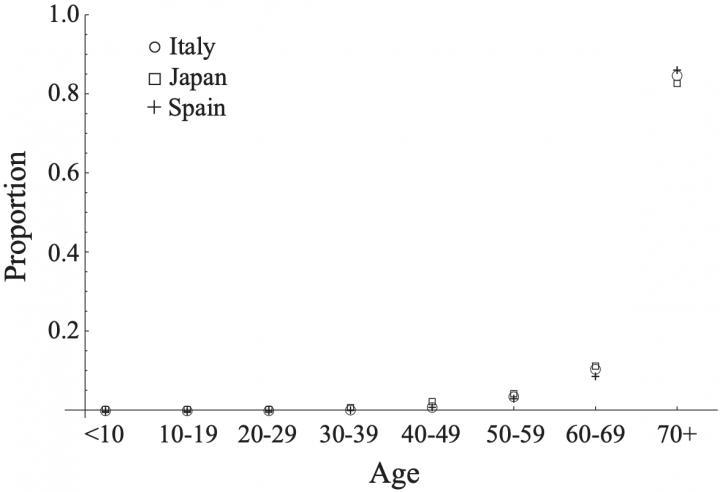
A team of scientists, including Associate Professor Ryosuke Omori from the Research Center for Zoonoses Control at Hokkaido University, have modeled available data from Japan, Spain, and Italy to show that susceptibility to COVID-19 is independent of age, while the occurrence of symptomatic COVID-19, severity, and mortality is likely dependent on age. Their results were published in an academic journal on October 6, 2020. The age distribution of mortality by COVID-19 was similar in Italy (reported on 13th May 2020), Japan (reported on 7th May 2020), and Spain (reported on 12th May 2020).{module INSIDE STORY}
Causes of mortality in elderly individuals may be due to two factors: how likely they are to be infected due to their advanced age (age-dependent susceptibility), which is reflected in the number of cases; and, how likely they will be affected by a severe form of the disease due to their advanced age (age-dependent severity), which is reflected in the mortality rate. These factors are not fully understood for COVID-19.

The scientists chose to analyze data from Italy, Spain, and Japan to determine if any relationship between age, susceptibility, and severity. These three countries were chosen as they have well recorded, publicly available data. As of May 2020, the mortality rate (number of deaths per 100,000) was 382.3 for Italy, 507.2 for Spain, and 13.2 for Japan. However, despite the wide disparity in mortality rates, the age distribution of mortality (the proportional number of deaths per age group) was similar for these countries.

The scientists developed a mathematical model to calculate susceptibility in each age group under different conditions. They also factored in the estimated human-to-human contact level in each age group, as well as varying restriction levels for outside-home activities in the three countries.

The model showed that the susceptibility has to be unrealistically different between age groups if they assume age does not influence severity and mortality. On the other hand, the model indicated the age should not influence susceptibility but should negatively influence severity and mortality, to explain the fact that the age distribution of mortality is similar between the three countries.

Ryosuke Omori, from the Research Center for Zoonoses Control at Hokkaido University, specializes in epidemiological modeling: the use of mathematics and statistics to understand and predict the spread of diseases. Since the outbreak of COVID-19, he has turned his efforts to ascertain the true extent of the spread of the pandemic in Japan and abroad.
Dartmouth wins $12.5 million grant to establish Center for Quantitative Biology

Dartmouth's Geisel School of Medicine has been awarded a 5-year, $12.5 million grant from the National Institutes of Health (NIH) to establish a Center for Quantitative Biology (CQB) that will bring together and enhance initiatives in computational biology, bioinformatics, and experimental genomics across Dartmouth.

The new center will be funded as an Institutional Development Award (IDeA) Center for Biomedical Research Excellence (COBRE) from the NIH's National Institute of General Medical Sciences. The IDeA program builds research capacities in states that historically have had low levels of NIH funding by supporting basic, clinical and translational research; faculty development; and infrastructure improvements.

"This is a very exciting development. With funding from this federal grant, our new Center of Quantitative Biology will coalesce expertise from all corners of our campus to explore questions about the variability of cells in our bodies and how cell-to-cell variation affects the onset and severity of disease and response to treatment," says Duane Compton, PhD, dean of the Geisel School of Medicine. "Under the skilled leadership of Dr. Michael Whitfield, the grant will also assist with the recruitment of new faculty in this rapidly emerging area of biomedical science." {module In-article}

The rapid advancement of high-throughput genomics (genes), proteomics (proteins), metabolomic (nutrients), and immune profiling technologies now provide a breadth and depth of data on individual cells that can be explored to examine basic biological processes, changes in cellular or organismal populations, and the molecular basis of disease.

"The scientific theme of our new Center will focus on these 'omics,' in studies that range from whole organisms and tissue biopsies to the detailed genomic analyses of single cells," explains Michael Whitfield, Ph.D., chair of the Department of Biomedical Data Science at Geisel and principal investigator on the grant.

"Growing this new area of single-cell omics will allow us to not only learn more about individual cells and how they change in response to their environments, but also about the changes that occur in single cells that could result in disease or in therapeutic responses to diseases like cancer," says Whitfield, who is also a professor of biomedical data science and of molecular and systems biology at Geisel.

The CQB will be organized around several major goals: recruiting and developing new faculty with expertise in computational and experimental approaches; accelerating the interdisciplinary and collaborative research projects of junior faculty; further mentoring of junior quantitative biologists; and developing shared services (in single-cell genomics and data analytics) that provide the systems and infrastructure needed to support the merging of advanced quantitative biology and single-cell genomics.

"In essence, what we're trying to do is to make high-level computation available to experimentalists that might not have that in their labs, while also helping people who are excellent computational biologists get access to really good data to analyze--that partnership will be key to our efforts," Whitfield explains.

The CQB will draw upon Dartmouth faculty in Arts & Sciences, the Thayer School of Engineering, and Geisel, as well as colleagues at the University of Vermont Larner College of Medicine. It will recruit and provide a cohesive community for diverse scientists who could have homes in biomedical data science, molecular and systems biology, epidemiology, microbiology and immunology, biochemistry and cell biology, healthcare policy, biological sciences, computer science, and mathematics.

With the awarding of the COBRE grant, Dartmouth has made a substantial commitment to the success and long-term sustainability of the Center, including plans to hire new tenure-track faculty. It will also provide institutional program enrichment funds to help support research infrastructure, scientific exchange, and a pilot project program.

The success of the CQB will benefit the entire Dartmouth community by facilitating data integration and interdisciplinary research at all levels. "It will help us to foster a vibrant intellectual community, recruit and mentor new junior faculty who will become leaders in their own right at Dartmouth and in the region, and enhance the impact and funding competitiveness of all CQB members," says Whitfield.

Through its emphasis on the generation, as well as the analysis, of wet-lab-based "omics big data," the new Center will synergize with ongoing initiatives in the Norris Cotton Cancer Center, other COBREs at Dartmouth, and a number of departments, as well as educational programs such as the Graduate Program in Quantitative Biomedical Sciences (QBS) at Geisel.

"The training we've done with grad students in our QBS program has been very successful in merging different fields," says Whitfield. "The big focus now will be to take that to the faculty level and encourage people to cross disciplines and work together in ways that are really more than the sum of their parts."

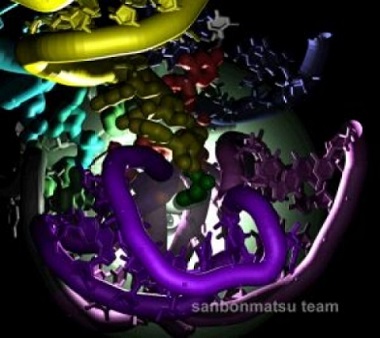
The amino acid (green) slithers into the chemical reaction center, moving through an evolutionarily ancient corridor of the ribosome (purple). The amino acid is delivered to the reaction core by the transfer RNA molecule (yellow).

Largest Computational Biology Simulation Mimics The Ribosome

Researchers at Los Alamos National Laboratory have set a new world's record by performing the first million-atom computer simulation in biology. Using the "Q Machine" supercomputer, Los Alamos computer scientists have created a molecular simulation of the cell's protein-making structure, the ribosome. The project, simulating 2.64 million atoms in motion, is more than six times larger than any biological simulations performed to date. Today, the effort is featured in a paper in the Proceedings of the National Academy of Sciences.

The ribosome is a living factory, the essential element within cells that creates proteins by decoding each protein type's specific recipe that is stored within messenger RNA. Ribosomes are a fundamental model for future nano-machines, producing the protein building blocks of all living tissue. Credit: Los Alamos National Laboratory

The ribosome is the ancient molecular factory responsible for synthesizing proteins in all organisms. Using the new tool, the Los Alamos team led by Kevin Sanbonmatsu is the first to observe the entire ribosome in motion at atomic detail. This first simulation of the ribosome offers a new method for identifying potential antibiotic targets for such diseases as anthrax. Until now, only static, snapshot structures of the ribosome have been available.

Sanbonmatsu posits that this technique offers a powerful new tool for understanding molecular machines and improving the efficacy of antibiotics. Antibiotic drugs are less than one one-thousandth the size of the ribosome and act like a monkey-wrench in the machinery of the cell. Such drugs diffuse into the most critical sites of this molecular machine and grind the inner working of the ribosome to a halt.

"Designing drugs based on only static structures of the ribosome might be akin to intercepting a missile knowing only the launch location and the target location with no radar information. Our simulations enable us to map out the path of the missile's trajectory," Sanbonmatsu said. "The methods and implications lie at the interface between biochemistry, computer science, molecular biology, physics, structural biology and materials science," said Sanbonmatsu. "I believe the results serve as a proof-of-principle for materials scientists, chemists and physicists performing similar simulations of artificial molecular machines in the emerging field of nano-scale information processing. Sanbonmatu's study focuses on decoding, the essential phase during protein synthesis within the cell wherein information transfers from RNA to protein, completing the information flow specified by Francis Crick in 1958 and known as the Central Dogma of Molecular Biology. "The ribosome is, in fact, a nano-scale computer and is very much analogous to the 'CPU' of the cell," he said.

The ribosome is so fundamental to life that many portions of this molecular machine are identical in every organism ever genetically sequenced. In developing the project, the team identified a corridor inside the ribosome that the transfer RNA must pass through for the decoding to occur, and it appears to be constructed almost entirely of universal bases, implying that it is evolutionarily ancient. The corridor represents a new region of the ribosome containing a variety of potential new antibiotic targets. The simulations also reveal that the essential translating molecule, transfer RNA, must be flexible in two places for decoding to occur, furthering the growing belief that transfer RNA is a major player in the machine-like movement of the ribosome. The simulation also sets the stage for future biochemical research into decoding by identifying 20 universally conserved ribosomal bases important for accommodation, as well as a new structural gate, which may act as a control mechanism during transfer RNA selection.

The aminoacyl-transfer-RNA (red) caught in the act of delivering its amino acid to the growing protein hanging off the peptidyl-transfer-RNA (yellow). The ribosome (large subunit in white and small subunit in cyan) uses the transfer RNA molecules to read the genetic information from the messenger RNA (green). Water molecules are shown in blue. For visualization purposes, only 1 of every 10 water molecules are shown and the top portion of the ribosome is cut away so that the transfer RNA molecules are visible. Credit: Los Alamos National Laboratory

The multi-million-atom simulation was run on 768 of the "Q" machine's 8,192 available processors. Sanbonmatsu worked to develop the simulation with Chang-Shung Tung of Los Alamos, as well as Simpson Joseph of the University of California at San Diego. Funding for the research was provided by the National Institutes of Health, Los Alamos National Laboratory's research and development fund, and support from the Laboratory's Institutional Computing Project.