OSU researchers build new prediction tools for wildfire occurrence

 The recent advancement in refining a database to predict the location and timing of wildfires is a significant step forward in wildfire management and preparedness. Researchers have incorporated numerous new factors that impact fire ignition and spread, revolutionizing the assessment and mitigation of wildfire risks.

The Fire Program Analysis Fire-Occurrence Database, developed by the U.S. Forest Service in 2013, has undergone five updates, resulting in a more comprehensive tool providing detailed insights into the various elements contributing to wildfire incidents. In addition to basic data such as ignition points and fire sizes, the revised database now includes environmental, social, and practical attributes that play crucial roles in shaping wildfire dynamics.

According to Erica Fleishman, a distinguished professor at Oregon State University, the enhanced database serves as a valuable resource for wildfire personnel and empowers stakeholders, including power companies and land management agencies, to make informed decisions based on evidence-backed analyses. Integration of environmental factors, social vulnerability indicators, and economic justice metrics highlights a shift toward evidence-based policy-making in wildfire management.

Yavar Pourmohamad, a doctoral student at Boise State University, and Mojtaba Sadegh, an associate professor at Boise State, have been instrumental in leading efforts to expand the database with nearly 270 additional attributes. Covering 2.3 million fire incidents in the United States from 1992 to 2020, this comprehensive dataset offers a nuanced understanding of the complex interplay between various factors influencing wildfires. Pourmohamad emphasizes the database's ability to reveal disparities in wildfire impacts on diverse human populations and ecosystems, informing targeted strategies to address inequities.

The enriched database has potential applications beyond data analysis. As highlighted by Fleishman, integrating this wealth of information into artificial intelligence and machine learning models can facilitate predicting future fire occurrences and understanding the drivers behind past incidents. By harnessing computational capabilities and leveraging vast datasets, stakeholders can extract actionable insights tailored to specific regions, aiding in proactive wildfire prevention and response strategies.

The collaborative effort behind this transformative research, involving experts from various academic institutions and research organizations, underscores the multidisciplinary nature of wildfire research and management. Co-authors from institutions such as the University of California, Merced, USDA Forest Service, and the National Weather Service have contributed to the comprehensive analysis and implications detailed in the recently published paper in the prestigious journal Earth System Science Data.

Supported by the Joint Fire Science Program, a joint initiative of the U.S. Forest Service and the U.S. Department of the Interior, this research initiative not only advances scientific knowledge but also underscores the critical role of collaboration and innovation in addressing complex environmental challenges.

In conclusion, the advancements in prediction tools for wildfire occurrence exemplify a concerted effort to utilize data-driven insights for effective wildfire management. By embracing a holistic approach that considers environmental, social, and practical factors, researchers are paving the way for a more informed and strategic response to wildfire risks, ultimately contributing to enhanced resilience and preparedness in the face of an ever-evolving natural hazard.
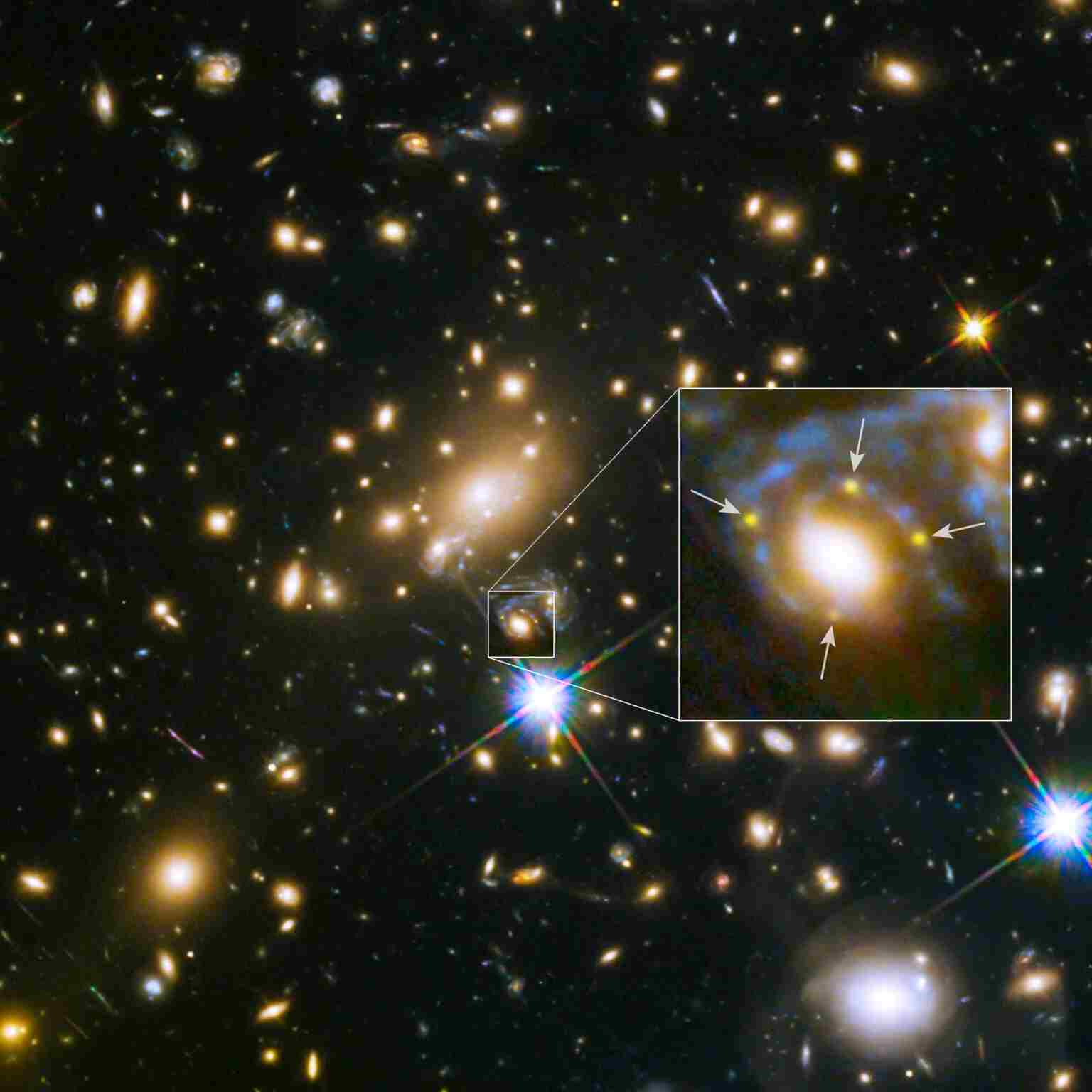
 

This image, captured by the Hubble Space Telescope, displays a galaxy's powerful gravity embedded in a massive cluster of galaxies that forms multiple images of a single distant supernova behind it. The galaxy lies within a large cluster of galaxies called MACS  J1149.6+2223, which is more than 5 billion light-years away from Earth. In the zoomed-in view of the galaxy, the multiple copies of an exploding star named Supernova Refsdal are indicated by arrows. This supernova is located 9.3 billion light-years away from Earth. The image credit goes to NASA, ESA, and S. Rodney (JHU) and the FrontierSN team; T. Treu (UCLA), P. Kelly (UC Berkeley), and the GLASS team; J. Lotz (STScI) and the Frontier Fields team; M. Postman (STScI) and the CLASH team; and Z. Levay (STScI).
This image, captured by the Hubble Space Telescope, displays a galaxy's powerful gravity embedded in a massive cluster of galaxies that forms multiple images of a single distant supernova behind it. The galaxy lies within a large cluster of galaxies called MACS J1149.6+2223, which is more than 5 billion light-years away from Earth. In the zoomed-in view of the galaxy, the multiple copies of an exploding star named Supernova Refsdal are indicated by arrows. This supernova is located 9.3 billion light-years away from Earth. The image credit goes to NASA, ESA, and S. Rodney (JHU) and the FrontierSN team; T. Treu (UCLA), P. Kelly (UC Berkeley), and the GLASS team; J. Lotz (STScI) and the Frontier Fields team; M. Postman (STScI) and the CLASH team; and Z. Levay (STScI).

Unlock the secrets of the Universe with the help of cutting-edge data mining tools designed for use with the Roman Space Telescope

Researchers delving into one of the biggest enigmas of the universe - the speed at which it is expanding - are preparing to tackle this question in a novel manner through NASA's Nancy Grace Roman Space Telescope.

By May 2027, when it launches, astronomers will sift through the vast collection of images from Roman in search of gravitationally lensed supernovae. These observations can then be used to calculate the rate at which the universe is expanding.

Astronomers have various methods to determine the current expansion rate of the universe, which is also known as the Hubble constant. However, these different techniques have resulted in varying values, causing what is referred to as the "Hubble tension."

Roman's main focus will be on studying the enigmatic dark energy and its impact on the expansion of the universe. One of their key techniques for this will involve comparing the inherent brightness of objects such as type Ia supernovae with their observed brightness to calculate their distances. Another approach could be using Roman to analyze gravitationally lensed supernovae, which offers a distinct method for determining the Hubble constant based on geometric methods rather than just brightness comparisons.

According to Lou Strolger from the Space Telescope Science Institute (STScI) in Baltimore, who co-leads the team preparing for Roman's study of gravitationally lensed supernovae, "Roman is the perfect tool to advance our understanding of these objects." These supernovae are not only difficult to find, but also rare. We have had to rely on luck in detecting a few of them early enough. However, with Roman's wide field of view and high-resolution imaging capabilities, these chances will greatly improve."

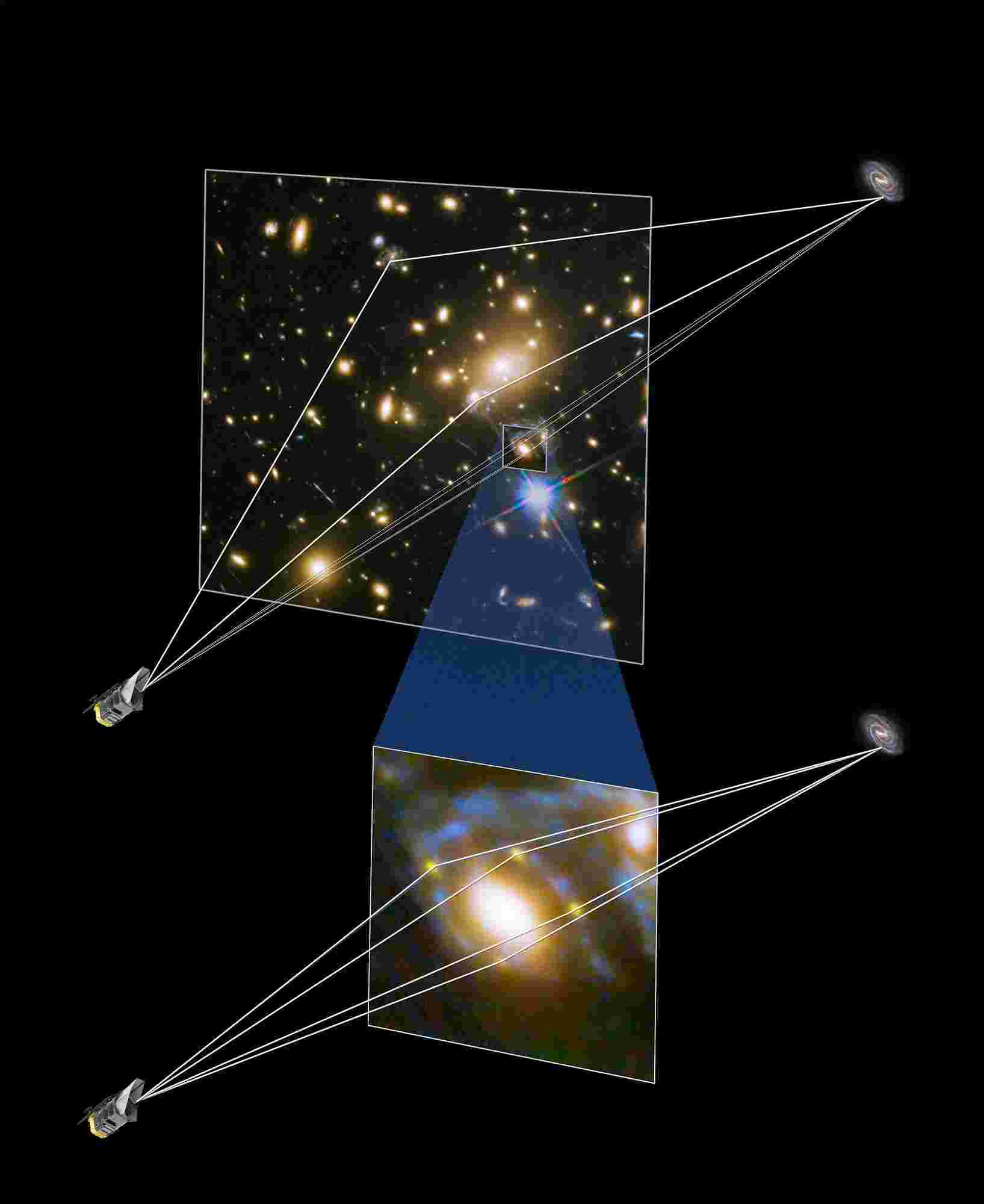
Using advanced tools such as NASA's Hubble Space Telescope and James Webb Space Telescope, scientists have identified a total of only eight supernovae that are gravitationally lensed in the entire universe. However, out of those eight, only two have been suitable for accurately measuring the Hubble constant due to their specific type and the time it takes for their images to reach us. This phenomenon of light being bent by the strong gravitational forces of galaxies or clusters is known as gravitational lensing. This image is created using Hubble Space Telescope pictures of Supernova Refsdal. It shows how the gravity of a massive galaxy cluster, known as MACS J1149.6+2223, bends and focuses the light from the supernova behind it. As a result, multiple images of the exploding star are formed. When the star explodes, its light travels through space and encounters the foreground galaxy cluster. The cluster's gravity bends the light paths, which are then redirected onto new paths that point toward Earth. Astronomers observe multiple images of the exploding star, each corresponding to one of those altered light paths. Each image takes a different route through the cluster and arrives at a different time. The redirected light then passes through a giant elliptical galaxy within the cluster, which adds another layer of lensing. Credit goes to the illustration team consisting of NASA, ESA, A. Fields (STScI), and J. DePasquale (STScI). The science team includes NASA, ESA, S. Rodney (JHU) and the FrontierSN team, T. Treu (UCLA), P. Kelly (UC Berkeley), the GLASS team, J. Lotz (STScI) and the Frontier Fields team, M. Postman (STScI) and the CLASH team, and Z. Levay (STScI).

As the light from the supernova travels along various paths, it creates multiple images of itself in different locations in the sky. Due to differences in these paths, the images may appear delayed by varying amounts of time - anywhere from hours to months, or even years. By precisely measuring these differences in arrival times, we can determine a combination of distances that helps us understand the Hubble constant.

Using this unique method with the same observatory allows us to gain new insights into why different techniques have produced conflicting results, explained Justin Pierel, co-lead on the program alongside Strolger, both of whom are from STScI.

Roman's thorough surveys will accurately map the universe at a much faster rate than Hubble, as the new telescope can capture over 100 times more area in a single image. Instead of taking multiple pictures of individual trees, this advanced technology allows us to view the entire forest in one snapshot, Pierel explained enthusiastically.

Under the High Latitude Time Domain Survey, astronomers will repeatedly observe the same area of the sky, providing unique opportunities to study objects that change over time. This will result in an immense amount of data – more than 5 billion pixels in each observation – which must be carefully analyzed to identify rare events. Dr. Strolger and Dr. Pierel at STScI are leading a team funded by NASA's ROSES program to develop methods for detecting gravitationally lensed supernovae in data collected by the Nancy Grace Roman Space Telescope.

Pierel explained that the full potential of gravitationally lensed supernovae can only be realized with careful preparation. We must have all the necessary tools in place beforehand so that we do not squander valuable time sifting through large amounts of data.

A group of researchers from different NASA centers and universities across the nation will work together to complete this project. The preparation process will consist of multiple phases. First, the team will develop data reduction systems specifically for identifying gravitationally lensed supernovae in images captured by Roman. To effectively train these systems, the researchers will also generate simulated images as there are currently only 10,000 known lenses available for testing, but they require 50,000.

The data reduction pipelines developed by the team led by Strolger and Pierel will supplement existing pipelines designed to research dark energy using Type Ia supernovae. According to Strolger, Roman presents a unique opportunity to create a high-quality collection of gravitationally lensed supernovae. All our preparations leading up to this point will provide us with the necessary components to fully utilize the immense potential for cosmological studies.

The management of the Nancy Grace Roman Space Telescope falls under the responsibility of NASA's Goddard Space Flight Center in Greenbelt, Maryland. Other key players involved include NASA's Jet Propulsion Laboratory and Caltech/IPAC in Southern California, as well as the Space Telescope Science Institute in Baltimore. A team of scientists from different research institutions also contribute to the project. The primary companies involved in its development are Ball Aerospace and Technologies Corporation based in Boulder, Colorado; L3Harris Technologies located in Melbourne, Florida; and Teledyne Scientific & Imaging headquartered in Thousand Oaks, California.

Hubble discovers spiraling stars, providing a window into the early universe

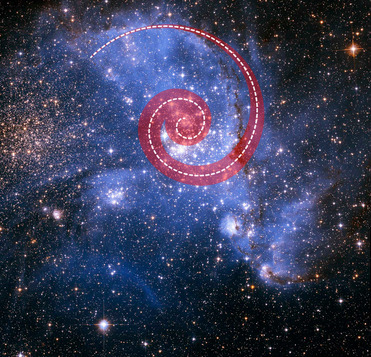
Nature likes spirals – from the whirlpool of a hurricane to pinwheel-shaped protoplanetary disks around newborn stars, to the vast realms of spiral galaxies across our universe. The massive star cluster NGC 346, located in the Small Magellanic Cloud, has long intrigued astronomers with its unusual shape. Now researchers using two separate methods have determined that this shape is partly due to stars and gas spiraling into the center of this cluster in a river-like motion. The red spiral superimposed on NGC 346 traces the movement of stars and gas toward the center. Scientists say this spiraling motion is the most efficient way to feed star formation from the outside toward the center of the cluster. Credits: Illustration: NASA, ESA, Andi James (STScI)

Now astronomers are bemused to find young stars that are spiraling into the center of a massive cluster of stars in the Small Magellanic Cloud, a satellite galaxy of the Milky Way.

The outer arm of the spiral in this huge, oddly shaped stellar nursery called NGC 346 may be feeding star formation in a river-like motion of gas and stars. This is an efficient way to fuel star birth, researchers say.

The Small Magellanic Cloud has a simpler chemical composition than the Milky Way, making it similar to the galaxies found in the younger universe when heavier elements were more scarce. Because of this, the stars in the Small Magellanic Cloud burn hotter and so run out of their fuel faster than in our Milky Way.

Though a proxy for the early universe, at 200,000 light-years away the Small Magellanic Cloud is also one of our closest galactic neighbors.

Learning how stars form in the Small Magellanic Cloud offers a new twist on how a firestorm of star birth may have occurred early in the universe's history when it was undergoing a "baby boom" about 2 to 3 billion years after the big bang (the universe is now 13.8 billion years old).

The new results find that the process of star formation there is similar to that in our own Milky Way.

Only 150 light-years in diameter, NGC 346 boasts the mass of 50,000 Suns. Its intriguing shape and rapid star formation rate have puzzled astronomers. It took the combined power of NASA's Hubble Space Telescope and the European Southern Observatory's Very Large Telescope (VLT) to unravel the behavior of this mysterious-looking stellar nesting ground.

"Stars are the machines that sculpt the universe. We would not have life without stars, and yet we don't fully understand how they form," explained study leader Elena Sabbi of the Space Telescope Science Institute in Baltimore. "We have several models that make predictions, and some of these predictions are contradictory. We want to determine what is regulating the process of star formation because these are the laws that we need to also understand what we see in the early universe."

Researchers determined the motion of the stars in NGC 346 in two different ways. Using Hubble, Sabbi and her team measured the changes in the stars' positions over 11 years. The stars in this region are moving at an average velocity of 2,000 miles per hour, which means that in 11 years they move 200 million miles. This is about 2 times the distance between the Sun and the Earth.

But this cluster is relatively far away, inside a neighboring galaxy. This means the amount of observed motion is very small and therefore difficult to measure. These extraordinarily precise observations were possible only because of Hubble's exquisite resolution and high sensitivity. Also, Hubble's three-decade-long history of observations provides a baseline for astronomers to follow minute celestial motions over time.

The second team, led by Peter Zeidler of AURA/STScI for the European Space Agency, used the ground-based VLT's Multi Unit Spectroscopic Explorer (MUSE) instrument to measure radial velocity, which determines whether an object is approaching or receding from an observer.

"What was really amazing is that we used two completely different methods with different facilities and basically came to the same conclusion, independent of each other," said Zeidler. "With Hubble, you can see the stars, but with MUSE we can also see the gas motion in the third dimension, and it confirms the theory that everything is spiraling inwards."

But why a spiral?

"A spiral is really the good, natural way to feed star formation from the outside toward the center of the cluster," explained Zeidler. "It's the most efficient way that stars and gas fueling more star formation can move towards the center."

Half of the Hubble data for this study of NGC 346 is archival. The first observations were taken 11 years ago. They were recently repeated to trace the motion of the stars over time. Given the telescope's longevity, the Hubble data archive now contains more than 32 years of astronomical data powering unprecedented, long-term studies. 

{media id=287,layout=solo}

"The Hubble archive is really a gold mine," said Sabbi. "There are so many interesting star-forming regions that Hubble has observed over the years. Given that Hubble is performing so well, we can actually repeat these observations. This can really advance our understanding of star formation."

Observations with NASA's James Webb Space Telescope should be able to resolve lower-mass stars in the cluster, giving a more holistic view of the region. Over Webb's lifespan, astronomers will be able to repeat this experiment and measure the motion of the low-mass stars. They could then compare the high-mass stars and the low-mass stars to finally learn the full extent of the dynamics of this nursery.