Japanese university develops method to identify symmetries in data using Bayesian statistics

A Bayesian statistics-based method derives unprecedented exact integral formulas, allowing future applications in various areas, including genetic analysis

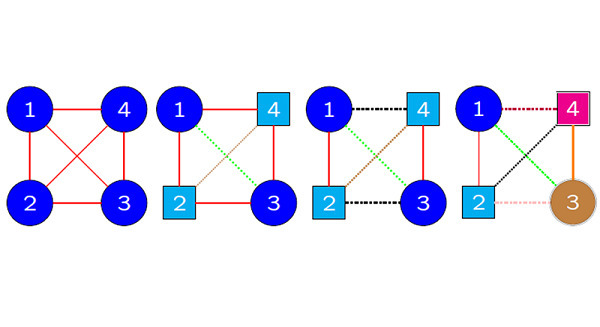
Symmetries in nature make things beautiful; symmetries in data make data handling efficient. However, the complexity of identifying such patterns in data has always bedeviled researchers. Scientists from Osaka Metropolitan University and their colleagues have taken a major step towards detecting symmetries in multi-dimensional data by utilizing Bayesian statistics. Their findings were published in The Annals of StatisticsExamples of colored graphs designating symmetries of four-dimensional data. Vertices and edges of the same color and shape in a graph are mapped to each other by a symmetry permutation preserving the structure of data.

Bayesian statistics has been in the spotlight in recent years due to improvements in computer performance and its potential applications in artificial intelligence. Bayesian statistics is a statistical approach that, even when data are insufficient, derives the probability of an event occurring by first setting a prior probability and then, whenever new information is obtained, calculating a posterior probability—an update to the prior probability—that the event will occur. The calculation of posterior probabilities requires complex calculations of integrals and therefore is often considered an approximation only.

The international team including Professor Hideyuki Ishi from Osaka Metropolitan University, Professor Piotr Graczyk from the University of Angers, Professor Bartosz Kołodziejek from Warsaw University of Technology, and the late Professor Hélène Massam from York University (Toronto) has succeeded in deriving new exact integral formulas, and in developing a method to search for symmetries in multi-dimensional data using Bayesian statistical techniques.

When the amount of data to be handled increases, the optimal pattern must be selected from a vast number of patterns, making it difficult to solve the problem precisely. Addressing this challenge, the team has also developed an efficient algorithm for obtaining an approximate solution even in such cases.

In the words of Professor Ishi, “Symmetries in data are ubiquitous in a wide variety of models. Once symmetries are identified, the number of parameters required to display the structure of the data, and the number of samples required to determine the parameters, can be significantly reduced. In the future, the results of this research are expected to contribute to genetic analysis, discovering chromosomes that have the same function in different locations.”

The study was supported by JSPS KAKENHI Grant Number 16K05174, 20K03657, JST PRESTO, Grant 2016/21/B/ST1/00005 of the National Science Center, Poland, and an NSERC Discovery Grant.

MIT, MGH, Harvard Med build simulation models that project national opioid crisis to worsen before it gets better

SOURCE, a collaboration with the FDA, identifies three strategies that could save the most lives by 2032

A significant challenge in addressing the country’s opioid crisis is that policies based on past patterns of behavior may have unintended consequences because those patterns change over time. Collaborating with the U.S. Food and Drug Administration (FDA)Mohammad Jalali and his research colleagues have created a data-driven simulation model that incorporates key behavioral feedback such as social influence and risk perceptions. Called SOURCE (Simulation of Opioid Use, Response, Consequences, and Effects), the model has projected three key strategies that could save more than 100,000 lives over the next ten years.

Dr. Jalali is an investigator at Massachusetts General Hospital (MGH), an assistant professor at Harvard Medical School, and a senior lecturer at MIT’s Sloan School of Management in the System Dynamics Group. SOURCE is the most operationally detailed national-level model of the opioid crisis to date and provides an integrated framework for policy decision-making.

According to SOURCE’s projections, the opioid crisis will worsen before it gets better and will claim more than a half-million additional lives over the next 10 years. And while the number of people misusing prescription opioids or heroin is already declining, their risk of overdose – particularly for those who use heroin – has increased dramatically since 2013 due to the spread of illicitly manufactured fentanyl.

In response, the researchers used SOURCE to project eleven different strategies and found three with the potential to save more than 100,000 lives during this time period. The three key strategies, which must be implemented together, are: 1) fentanyl harm reduction; 2) naloxone distribution; and 3) recovery support for people in remission from opioid use disorder (OUD), the group at highest risk of overdose. In the short-term, bolstering buprenorphine providers’ capacity to treat more patients with OUD also has a lifesaving effect by helping to overcome the treatment system’s current capacity limitations.

Their article analyzing lifesaving strategies was published today in Science Advances, while SOURCE is described in a research paper recently published in the Proceedings of the National Academy of Sciences.

“This broader perspective is critical to making progress,” says Dr. Jalali. “It’s like playing whack-a-mole. If you don’t look at the whole system and its interconnected parts, then fixing one aspect of the problem can make other aspects worse.”

SOURCE replicates the historical trajectory of the opioid crisis, using 22 years of data on prescription opioid use and misuse, heroin use, overdose deaths, and more. Accounting for these processes allows SOURCE to explain historical shifts in opioid use and overdose trends, as well as how they may evolve in the future. For instance, SOURCE finds that the risks of opioid use are deterring potential new initiates. As a result, the primary source of OUD in the future will be people in remission relapsing. So, recovery support for people in remission to reduce relapse could have a major impact, saving tens of thousands of lives.

SOURCE found that specific strategies to reduce the risk from fentanyl, such as drug-checking services that support people to use drugs more safely, could have a dramatic impact on opioid overdose deaths.

SOURCE also shows that while increased distribution of the overdose reversal drug naloxone has helped mitigate this growing risk, naloxone’s positive effects still lag far behind the growing fentanyl threat. Going forward, model analysis shows naloxone should nonetheless remain a key part of the nation’s overdose deaths prevention strategy.

Because of the decline in OUD, SOURCE projects that opioid overdose deaths will continue to rise in the near future before eventually falling. “Although we expect deaths to peak in the next few years, we’re still talking about over half a million deaths over the next decade. Our projections really underscore the urgency of addressing the substance use and overdose crisis,” says coauthor and MIT Sloan PhD graduate Tse Yang Lim.

Coauthor Erin Stringfellow, a research fellow at MGH and Harvard Medical School agrees: “If we wait for the crisis to peak, it will be too late. We need to use these strategies together, and now, for them to have their maximum impact. These strategies will only become more important if our projections about fentanyl’s penetration of the drug supply turn out to be too optimistic.”

Jalali adds, “SOURCE is a powerful analytical tool for projecting and exploring policy outcomes and testing strategies. There is a lot of exciting work ahead to be done building on this model.”

In addition to Jalali, Lim, and Stringfellow, coauthors hail from Harvard Medical School, MGH, McLean Hospital, the FDA, Stanford University, and Portland State University.


Japanese-built MD simulations, ML, topology reveals a hidden relationship in amorphous silicon

Theoretical scientists have used topological mathematics and machine learning to identify a hidden relationship between nano-scale structures and thermal conductivity in amorphous silicon, a glassy form of the material with no repeating crystalline order.

A study describing their technique appeared in the Journal of Chemical Physics yesterday.

Amorphous solids, such as glass, obsidian, wax, and plastics, have no long-range repeating, or crystalline structure, to the atoms or molecules that they are made out of. This contrasts with crystalline solids, such as salt, most metals, and rocks. As they lack long-range order in their structure, the thermal conductivity of amorphous solids can be far lower than a crystalline solid composed of the same material.

However, there can still be some medium-range order on the scale of nanometers. This medium-range order should affect the propagation and diffusion of atomic vibrations, which carry heat. The heat transport in disordered materials is of special interest to physicists due to its importance in industrial applications. The amorphous form of silicon is used in an enormous range of applications in the modern world, from solar cells to image sensors. For this reason, researchers have intensively investigated the structural signature of the medium-range order in amorphous silicon and how it relates to thermal conductivity.

“For better control over applications that make use of amorphous silicon, controlling its thermal properties is high on engineers' wish list,” said Emi Minamitani, the corresponding author of the study and a theoretical molecular scientist with the Institute for Molecular Science in Okazaki, Japan. “Extracting the nano-scale structural characteristics in amorphous including medium-range order is an important key.”

Unfortunately, researchers have struggled to carry out this task because it is difficult to determine the essential nano-scale features of disordered systems using traditional techniques.

In experiments, the presence of medium-range order has been physically detected using fluctuation electron microscopy, which involves statistical analysis of scattering from nano-scale volumes of a disordered material. At the theoretical level, it has been discussed by considering the distribution of dihedral angles (the angle between two intersecting planes between sets of atoms) or using ‘ring statistics.’ The latter tries to understand the structural characteristics from the connectivity of atoms.

This in turn draws on the field of mathematics known as topology, which investigates properties of an object that do not change—or are ‘invariant’— even when the object is constantly stretched and deformed without being broken (such as shapes written on a rubber sheet). Focusing on this topological invariance is useful for delivering a qualitative description, such as the tendency of the physical properties with respect to the randomness. However, it is demanding to determine the atomic structure corresponding to a medium-range order and predict its physical properties only from simple topological invariants.

So the researchers pivoted to an emerging technique called persistent homology, a type of topological data analysis. Persistent homology has been used elsewhere to analyze complex structures ranging from proteins to amorphous solids. The benefit of this method is in detecting topological features in complicated structures at different spatial scales. This is vital because the medium-range order comprises quasi-repetitive structures at various scales. Using this characteristic, we can extract the medium-range order hidden beneath what otherwise appears as randomness.

The researchers built computational models of amorphous silicon by classical molecular dynamics wherein the temperature of the silicon was increased above the melting point and then gradually cooled (quenching) to room temperature. Differences in structural characteristics were introduced by changing the cooling rate.

Then, the persistent diagram, which is the two-dimensional visualization of persistent homology, was computed for each model. The researchers focused on that the diagrams reflect the structural features of amorphous silicon. Thus, they constructed the numerical representation, called ‘descriptors,’ that could be used in machine learning. The researcher found that the persistent diagram fulfilled the creation of a good descriptor for use in the machine learning procedure, which in turn achieved accurate predictions about the thermal conductivities.

By further analyzing the persistent homology data and machine-learning model, the researchers illustrated the previously hidden relationship between medium-range order in amorphous silicon and its thermal conductivity.

The study should now open an avenue for controlling material characteristics of amorphous silicon and other amorphous solids through the topology of their nanostructures.