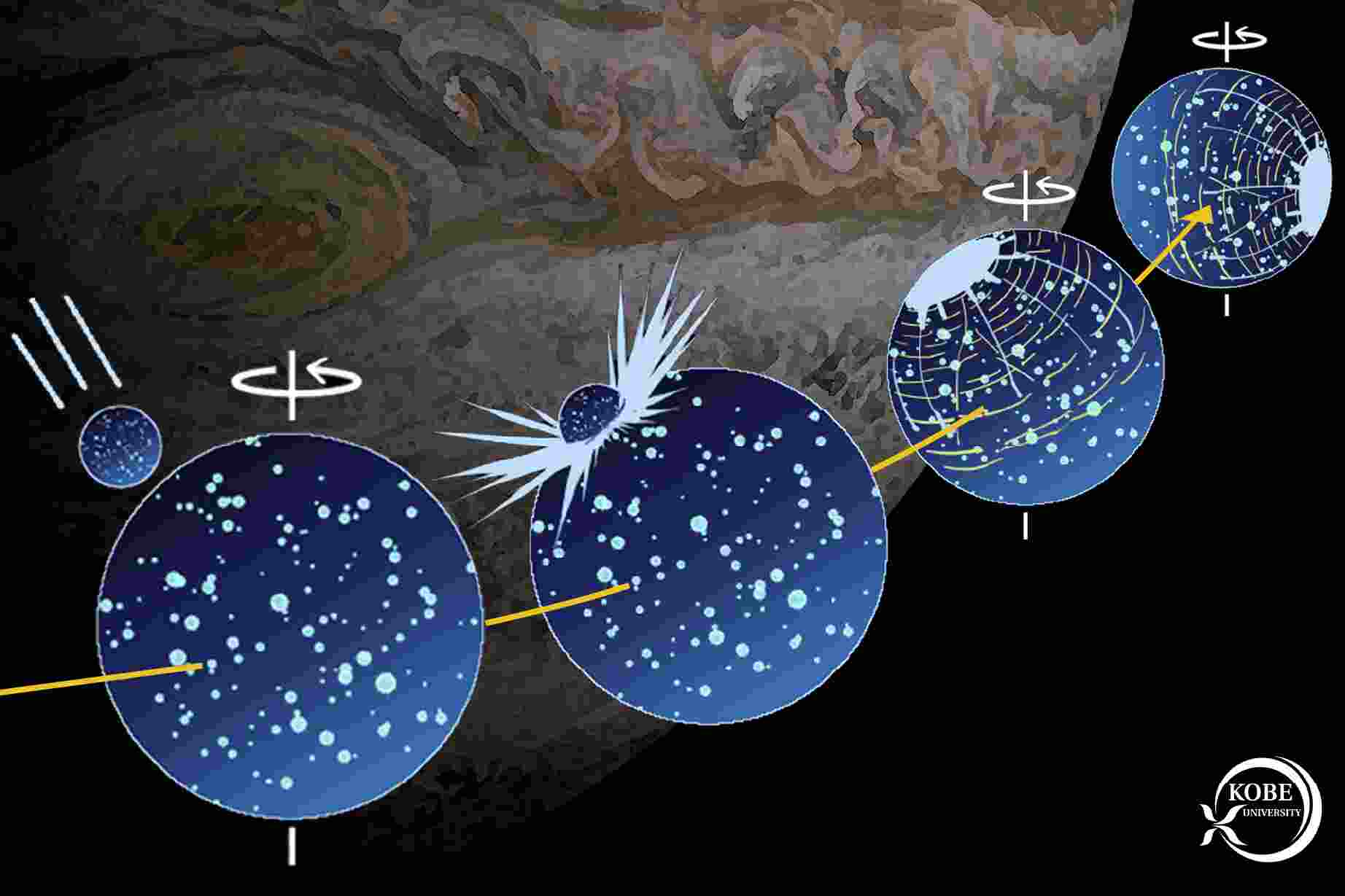
Kobe University's HIRATA Naoyuki was the first to observe that the location of an asteroid impact on Jupiter's moon Ganymede is almost precisely on the meridian farthest away from Jupiter. This suggests that Ganymede may have experienced a reorientation of its rotational axis. As a result, Hirata was able to calculate the type of impact that could have led to this reorientation. This information is courtesy of HIRATA Naoyuki (CC BY).

A colossal asteroid impact altered the orbit of the largest moon in the solar system

A recent study from Kobe University in Japan has provided new insights into the impact event that changed the axis of Jupiter's largest moon, Ganymede. Conducted by researcher Naoyuki Hirata, the study demonstrates the significant effect of a massive asteroid collision on Ganymede. The research relied on advanced supercomputer simulations, emphasizing their importance in planetary studies.

Around 4 billion years ago, a huge asteroid, estimated to be 20 times larger than the one that caused the extinction of the dinosaurs on Earth, collided with Ganymede. This collision caused a major shift in the moon's rotational axis. Through advanced supercomputer simulations, Hirata calculated the type of impact that could have resulted in this celestial phenomenon, marking a significant discovery in planetary science.

The study suggests that the impact was likely caused by an asteroid approximately 300 kilometers in diameter, creating a temporary crater spanning between 1,400 and 1,600 kilometers. These findings, based on comprehensive simulations, offer valuable insights into the effects of large cosmic collisions on planetary bodies, highlighting the crucial role of supercomputer technology in unlocking celestial mysteries.

Hirata, known for simulating impact events on moons and asteroids, aims to further explore the origin and evolution of Ganymede. He emphasizes the need for additional research to understand the long-lasting effects of the asteroid collision on the moon's internal evolution, particularly its subsurface oceans' thermal and structural effects.

This research has implications beyond academia, as it could significantly impact future space exploration endeavors. The forthcoming JUpiter ICy moons Explorer (JUICE) mission by the European Space Agency, scheduled to orbit Ganymede in 2034, is expected to use the data obtained to confirm the findings of Hirata's study. The mission aims to shed light on the structural and thermal evolution of Ganymede, potentially addressing important questions posed by the Kobe University researcher.

Hirata's groundbreaking research was made possible with support from the Japan Society for the Promotion of Science and the Hyogo Science and Technology Association, showcasing collaborative efforts driving planetary science forward.

This study showcases the crucial role of advanced supercomputer simulations in understanding celestial events and shaping our knowledge of planetary evolution.


Using simulations to speed up drug discovery: A promising approach in medical research

In a groundbreaking leap forward, researchers at the University of Cincinnati College of Medicine and Cincinnati Children's Hospital have revealed a revolutionary method to speed up the pace and success of drug discovery. Their study promises to transform the landscape of pharmaceutical research, potentially reducing the drug discovery timeline from years to months.

The approach involves a fusion of data analysis and molecular simulations, offering renewed hope for finding effective therapies at an unprecedented speed. Using a database from the Library of Integrated Network-based Cellular Signatures (LINCS) to screen thousands of small molecules with potential therapeutic effects simultaneously, researchers have harnessed the power of targeted docking simulations to model the interaction between these molecules and their protein targets. This innovative technique has not only expedited the screening process from months to mere minutes but has also significantly increased the efficiency and accuracy of identifying potentially effective compounds.

Dr. Alex Thorman, co-first author of the study, expressed unwavering optimism about the transformative impact of this new method. "The hope is we can speed up the timeline of drug discovery from years to months," he said, emphasizing the potential of this approach to bring new hope to individuals with diseases lacking a cure, such as cancer. Dr. Thorman's enthusiasm is infectious as he underlines the broader scope of its application, including its potential to create more targeted treatment options in precision medicine.

However, the impact of this pioneering research extends far beyond mere expediency. It has the potential to revolutionize our ability to respond to public health crises, as highlighted by Dr. Thorman about the COVID-19 pandemic. The accelerated drug discovery process could serve as a game changer, providing a rapid and effective response to emergent health threats.

Moreover, this research showcases the power of collaboration, with contributions from a diverse array of researchers, including Dr. Jim Reigle and Dr. Somchai Chutipongtanate. The corresponding authors of the study, Dr. Jarek Meller and Dr. Andrew Herr, along with several other co-investigators, have brought together their expertise to steer medical research into a new era of innovation and impact.

Equally inspiring is the funding provided for this transformative research, which includes grants from the National Institutes of Health, a Department of Veterans Affairs merit award, a UC Cancer Center Pilot Project Award, and a Cincinnati Children's Hospital Innovation Fund award. This investment underscores the recognition of the potential of this method to make a profound difference in the field of medicine.

As we stand on the precipice of this new era of drug discovery, the promise of incorporating supercomputer simulations into our research endeavors is nothing short of inspirational. It offers a beacon of hope for those challenged by diseases with no known cure, and it symbolizes a transformative leap forward in our quest for better, more effective therapies. The relentless pursuit of innovation by the researchers at the University of Cincinnati and Cincinnati Children's Hospital has the potential to save lives, transform outcomes, and propel the future in a new and promising direction.

"Innovation Lives Here" is more than just a slogan; it is a testament to the enduring commitment of researchers and institutions to lead the way in driving positive impact and change in the world of medicine. This study is a testament to the unwavering dedication, collaborative spirit, and innovative mindset that define these institutions as pioneers in medical research.

As we celebrate this milestone, we are reminded that our collective pursuit of knowledge and innovation knows no bounds. The future of drug discovery is being shaped today, and it is imbued with the potential to transform the lives of countless individuals. Through the power of molecular simulations and the dedication of visionary researchers, we stand on the cusp of a new frontier in medicine.

AI software revolutionizes plant engineering to combat climate change

At Salk in La Jolla, researchers are collaborating to harness the power of artificial intelligence (AI) to engineer plants that can help combat climate change. They are using a pioneering deep learning software called SLEAP to optimize plant root systems, which will capture and store carbon dioxide from the atmosphere. This innovative research offers a promising solution to mitigate the impacts of global warming.

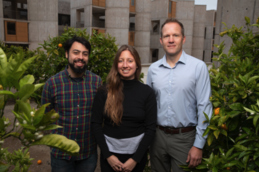
Originally developed for tracking animal movement, SLEAP has been repurposed by Salk Fellow Talmo Pereira and plant scientist Professor Wolfgang Busch to analyze plant root growth with extraordinary precision and efficiency. The scientists have unlocked a sophisticated tool to expedite the design of climate-saving plants by utilizing this state-of-the-art AI software. This is a pivotal endeavor advocated by the Intergovernmental Panel on Climate Change (IPCC) to limit global temperature rise. From left: Talmo Pereira, Elizabeth Berrigan, and Wolfgang Busch.

The study published in Plant Phenomics on April 12, 2024, introduced a new protocol for utilizing SLEAP to analyze various aspects of plant root systems. These include depth, mass, and angle of growth. The painstaking process of manually measuring these physical characteristics posed significant challenges and time constraints to researchers before the advent of SLEAP. The innovative combination of computer vision and deep learning incorporated within SLEAP has revolutionized this paradigm, enabling researchers to achieve accurate and rapid analysis of plant root features without the cumbersome, frame-by-frame manual labor required by previous AI models.

One of the most striking achievements resulting from the application of SLEAP to plants is the development of the most extensive catalog of plant root system phenotypes to date. This invaluable resource facilitates the identification of genes associated with specific root characteristics and elucidates the complex relationships between different root traits, providing crucial insights into the genes most beneficial for optimizing plant designs.

The transformative capabilities of SLEAP were further demonstratedthrough the creation of the sleap-roots toolkit, open-source software that empowers SLEAP to process biological traits of root systems. This toolkit not only expedited the analysis of plant images but also outperformed existing practices by annotating 1.5 times faster, training the AI model 10 times faster, and predicting plant structure on new data 10 times faster, all while maintaining or even improving accuracy.

By seamlessly connecting phenotype and genotype data, SLEAP and the sleap-roots toolkit are poised to revolutionize the efforts of Salk's Harnessing Plants Initiative to engineer plants with enhanced carbon-capturing capabilities and deeper, more robust root systems. These advancements hold the potential to accelerate the development of climate-resilient plants that can significantly mitigate the impacts of climate change.

SLEAP has not only positioned Salk as a trailblazer in plant engineering but has also garnered attention from scientists at NASA, reflecting the global impact and potential of this pioneering technology. With accessibility and reproducibility at the forefront of its design, SLEAP and the sleap-roots toolkit offer an invaluable resource to researchers worldwide, heralding a new era of plant engineering and environmental conservation.

As the collaborative team at Salk embarks on new frontiers, including the analysis of 3D data using SLEAP, the profound impact of this deep learning software on accelerating plant designs and shaping the future of climate change research is already palpable. The journey to refine, expand, and share SLEAP and the sleap-roots toolkit is poised to continue for years to come, cementing their vital role in advancing scientific endeavors and making a significant impact in the global fight against climate change.

This exploration of SLEAP's potential to engineer plants reflects a convergence of diverse disciplines, showcasing the remarkable potential of AI-led innovation in shaping a sustainable future and fostering interdisciplinary collaboration to create profound and transformative scientific advancements.