Karolinska Institutet shows why natural killer cells react to COVID-19


Little has been known to date about how the immune system’s natural killer (NK) cells detect which cells have been infected with SARS-CoV-2. An international team of scientists led by researchers from Karolinska Institutet, ranked amongst the world's best medical schools, in Sweden now shows that NK cells respond to a certain peptide on the surface of infected cells. The study, which is published in Cell Reports, is an important piece of the puzzle in our understanding of how the immune system reacts to COVID-19.

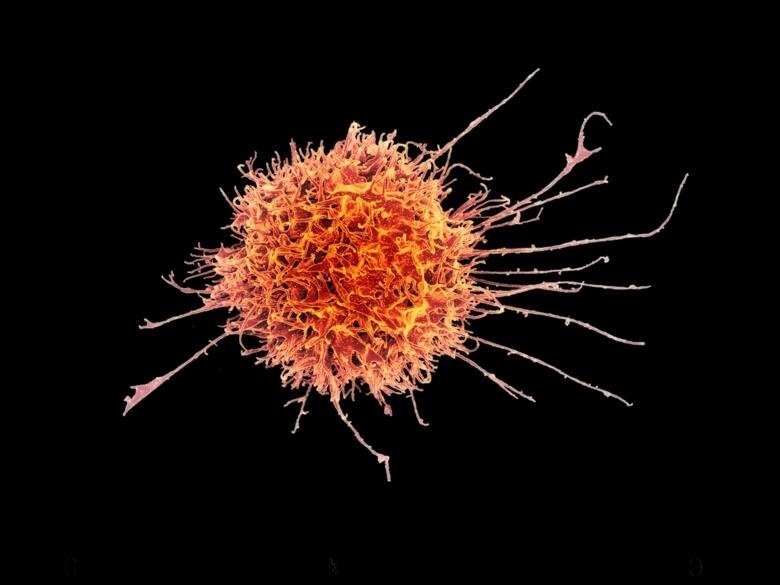
NK cells are white blood cells that are part of the innate immune system. Unlike cells in the adaptive immune defense, they can recognize and kill cancer cells and virus-infected cells immediately without having encountered them before. This ability is controlled by a balance between the NK cells’ activating and inhibiting receptors, which can react to different molecules on the surface of other cells. NK cells are part of the innate immune system. Image: NIAID
The virus is revealed by a peptide

A new study shows why certain NK cells are activated when encountering a cell infected with SARS-CoV-2. The infected cells contain a peptide from the virus that triggers a reaction in NK cells that carry a particular receptor, NKG2A, able to detect the peptide.

“Our study shows that SARS-CoV-2 contains a peptide that is displayed by molecules on the cell surface,” says Quirin Hammer, a researcher at the Center for Infectious Medicine (CIM), Karolinska Institutet. “The activation of NK cells is a complex reaction, and here the peptide blocks the inhibition of the NK cells, which allows them to be activated. This new knowledge is an important piece of the puzzle in our understanding of how our immune system reacts in the presence of this viral infection.”

The study was a major collaboration between Karolinska Institutet, Karolinska University Hospital, and research laboratories and universities in Italy, Germany, Norway, and the USA. The first phase was to test their hypothesis using supercomputer simulations that were then confirmed in the laboratory. The decisive phase was the infection of human lung cells with SARS-CoV-2 in a controlled environment, whereupon the researchers could show that NK cells with the receptor in question are activated to a greater degree than the NK cells without it.

Monitoring new virus variants

“These findings are important to our understanding of how immune cells recognize cells infected with SARS-CoV-2,” says Dr. Hammer. “This may become significant when monitoring new virus variants to determine how well the immune system responds to them.”

The study is now being followed up with the help of a biobank at Karolinska University Hospital and Karolinska Institutet containing blood samples from over 300 people treated for COVID-19 during the first wave of the pandemic.

“We’ll be examining if the composition of NK cells a person has contributes to how severe their symptoms are when infected with SARS-CoV-2,” he continues.
UK builds a new sea ice fragmentation module to help improve climate model predictions

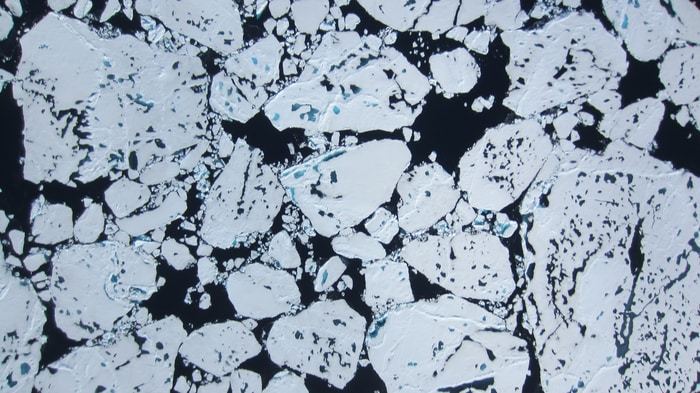
ARCTIC sea ice is an important indicator of climate change and its rapid decline in past decades has been a wake-up call to scientists, policy-makers, and the general public.  Arctic sea-ice in summer

Now, an innovative new project featuring Dr. Byongjun (Phil) Hwang from the University of Huddersfield’s School of Applied Sciences will determine the role of sea ice fragmentation in the accelerated retreat of the Arctic ice-cap by combining new and emerging observations, new theory and process modeling. 

The research is being funded by the National Environment Research Council (NERC) as part of a responsive project award titled ‘Fragmentation and Melt of Arctic Sea-Ice’.

Climate model accuracy 

The latest assessment from the Intergovernmental Panel on Climate Change (IPCC) concluded that it was likely that the Arctic would become reliably ice-free by 2050 assuming greenhouse gas emissions continue to increase. However, the climate simulations used by the IPCC often fail to realistically capture large-scale properties of the Arctic sea ice, such as the extent, variability, and recent trends which can lead to the impairment of climate model accuracy. 

“This is why it is imperative we improve simulations of Arctic sea ice so we can provide a better understanding of the recent observed changes and deliver credible projections of the future,” said Dr. Hwang, who is Director of the University's Centre for Climate Resilient Societies.

“By building a fundamental understanding of sea ice fragmentation we will improve climate model predictions. This will help assess risks and opportunities as well as inform important policy decisions about adaptation and mitigation.”

The three-year project, which is being led by Professor Danny Feltham at the University of Reading, will result in a new sea ice fragmentation module delivered to climate and weather modeling groups including the Met Office, the National Oceanography Centre, the British Antarctic Survey, and the European Centre for Medium-Range Weather Forecasts.

As a geophysicist and remote sensing expert, Korean-born Dr. Hwang has developed a specialism in the dynamics and thermodynamics of snow and sea ice in polar regions.  He has undertaken a large number of expeditions to the Arctic, including some tough mid-winter assignments.

A seasoned Arctic researcher, Dr. Hwang has already made 15 voyages to the region, observing, recording, and analyzing seasonal changes in the ice. The data he has gathered on Arctic sea ice retreat has been an important contribution to the scientific debate about climate change.

Japanese built network models may help us understand the spread of new variants in a pandemic

New simulation shows how infectivity of new variants affects spread

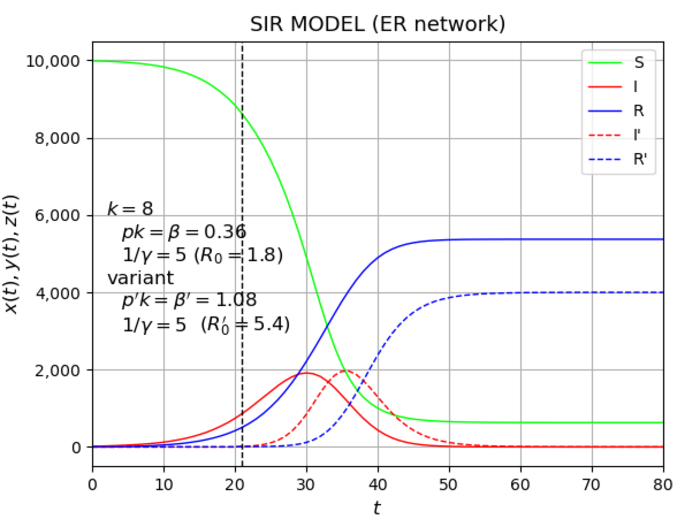
Researchers from Tokyo Metropolitan University have performed numerical simulations based on network theory which show how numbers of infections in a pandemic change when a new variant emerges. They found a non-linear dependence between how infectious the new variant is compared to the existing one, an effect not seen in previous work. Their model may be applied to understand real pandemics such as COVID-19 and inform control measures. Simulation on a network of numbers of susceptible (S), infected (I) and recovered (R) from a pandemic and its variant (I’, R’) over time. At t=21, a variant was added.

Ever since it began to spread in late 2019, COVID-19 has had a devastating impact on people’s lives. With wave after wave of new variants continuing to wreak havoc around the world, scientists have been looking for ways to understand how the disease spreads. In particular, there is the issue of how new variants appear, spread, and end up displacing the existing strain. Understanding the dynamics of variants in a population is vital to controlling their spread.

A classic framework for modeling pandemic dynamics is the “compartmental” SIR model, looking at the numbers of susceptible (S), infected (I), and recovered (R) members of a population. The numbers are related by equations and solved, giving many of the salient features of how a disease spreads; the pandemic spreads rapidly before slowing down as the number of susceptible cases decreases and more patients recover. However, the model cannot account for the varied nature of the population i.e. a given infected individual does not have an equal probability of infecting all others, and the number of contacts that people have can vary greatly from one person to another. Any model that tries to capture pandemic dynamics and get to grips with where and how it spreads needs to use a more sophisticated model.

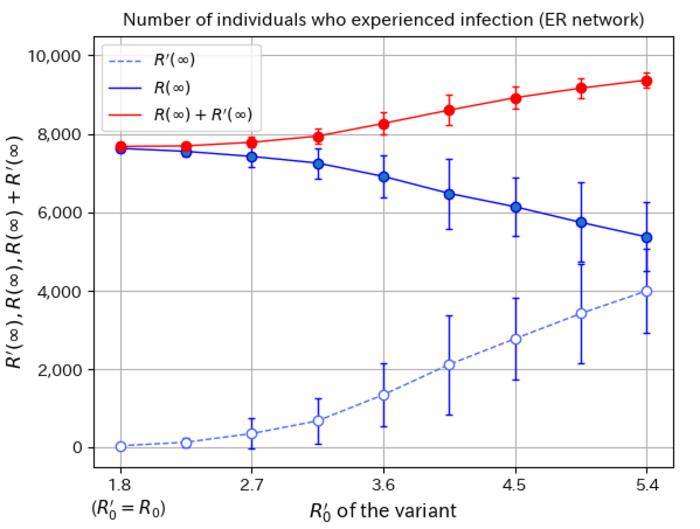
That’s why Emeritus Professor Yutaka Okabe and Professor Akira Shudo from Tokyo Metropolitan University have turned to network theory, a mathematical framework that can capture how different members of a population connect to others. Using different types of networks, they were able to create a more realistic model for how an infectious disease might spread. Key features included dynamic absorbing states, states in which the network can get stuck in overtime e.g. a state with no infected people. With a few infections and low infectivity, the network would collapse back to the infection-free state. Contrary to conventional models, the number of individuals who experienced infection does not scale linearly with how much more infectious a variant is compared to the existing strain.

The team performed a numerical simulation of the microscopic model on the network; in the middle of a simulation of infectious disease, they added a variant that is more transmissible than the original strain.  Looking at the numbers, the team found that a variant with the same infectivity as the existing strain fails to take off at all. This is a direct result of the non-linear nature of the simulation, as the network collapses back to an absorbing state with no infections. As the infectivity of the new variant is ramped up, the population becomes more likely to become infected with the variant as opposed to the existing strain, increasing the rate for the new strain at the expense of the old one. The non-linear nature of how the infection numbers increase with the variant infectivity is a product of the microscopic nature of the network model, giving a more detailed, nuanced picture than before.

The team hopes that their model may be utilized to form effective strategies to contain infectious diseases, looking at points of significant connectivity in the network and understanding how their isolation affects overall infections. As the COVID-19 pandemic continues to rage, fundamental studies of how diseases spread are a vital piece in informed decision-making aimed at bringing normal life back to society.