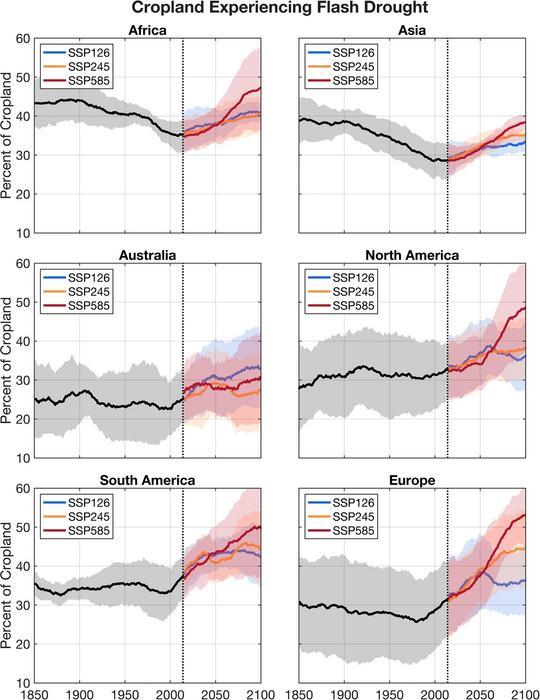
The multi-model mean of the yearly percentage of cropland experiencing flash drought over entire continents for the historical (black), SSP126 (blue), SSP245 (orange), and SSP585 (red) scenarios. A 30-year centered moving average is applied to each time series. The shaded regions indicate the variability (±1σ) among the 30-year centered moving averages between all six models for the corresponding historical and future scenarios.

OU’s climate researcher Christian projects cropland risk from flash droughts using global climate models

The rapid development of unexpected drought, called flash drought, can severely impact agricultural and ecological systems with ripple effects that extend even further. Researchers at the University of Oklahoma are assessing how our warming climate will affect the frequency of flash droughts and the risk to croplands globally. Jordan Christian, a postdoctoral researcher, is the lead author of the study.

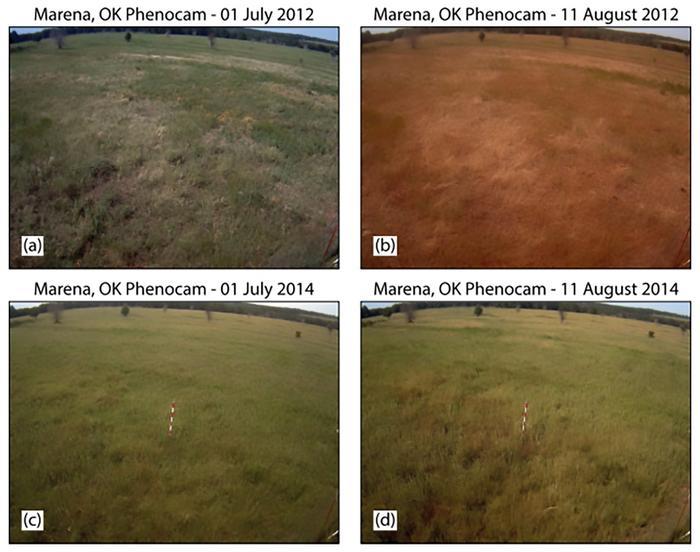
“In this study, projected changes in flash drought frequency and cropland risk from flash drought are quantified using global climate model simulations,” Christian said. “We find that flash drought occurrence is expected to increase globally among all scenarios, with the sharpest increases seen in scenarios with higher radiative forcing and greater fossil fuel usage.” A figure showing the impact of a flash drought on a grassland in Oklahoma. The photos on the top row show the impact of the flash drought on the ecosystem compared with photos of the same area without flash drought impacts (bottom row).

Radiative forcing describes the imbalance of radiation where more radiation enters Earth’s atmosphere than leaves it. Like burning fossil fuels, these activities are among the most significant contributors to climate warming. The changing climate is expected to increase severe weather events from storms, flash flooding, flash droughts, and more.

“Flash drought risk over cropland is expected to increase globally, with the largest increases projected across North America and Europe,” Christian said.

“CMIP6 models projected a 1.5 times increase in the annual risk of flash droughts over croplands across North America by 2100, from the 2015 baseline of a 32% yearly risk in 2015 to 49% in 2100, while Europe is expected to have the largest increase in the most extreme emissions scenario (32% to 53%), a 1.7 times increase in annual risk,” he said.

Jeffrey Basara, an associate professor in the School of Meteorology in the College of Atmospheric and Geographic Sciences and the School of Civil Engineering and Environmental Sciences in the Gallogly College of Engineering, is Christian’s faculty advisor and study co-author. Basara is the executive associate director of the hydrology and water security program and leads OU’s Climate, Hydrology, Ecosystems, and Weather research group. The researchers have been investigating ways to improve flash drought identification and prediction since 2017, with multiple papers published in journals.

“This study continues to emphasize that agricultural producers, both domestic and abroad, will face increasing risks associated with water availability due to the rapid development of drought. As a result, socioeconomic pressures associated with food production, including higher prices and social unrest, will also increase when crop losses occur due to flash drought,” Basara said.


Caltech physicists listen closely to black holes ring

New methods will allow for better tests of Einstein's general theory of relativity using LIGO data

Albert Einstein's general theory of relativity describes how the fabric of space and time, or spacetime, is curved in response to mass. Our sun, for example, warps space around us such that planet Earth rolls around the sun like a marble tossed into a funnel (Earth does not fall into the sun due to the Earth's sideways momentum). Dongjun Li

The theory, which was revolutionary at the time it was proposed in 1915, recast gravity as a curving of spacetime. As fundamental as this theory is to the very nature of space around us, physicists say it might not be the end of the story. Instead, they argue that theories of quantum gravity, which attempt to unify general relativity with quantum physics, hold secrets to how our universe works at the deepest levels.

One place to search for signatures of quantum gravity is in the mighty collisions between black holes, where gravity is at its most extreme. Black holes are the densest objects in the universe—their gravity is so strong that they squeeze objects falling into them into spaghetti-like noodles. When two black holes collide and merge into one larger body, they roil space-time around them, sending ripples called gravitational waves outward in all directions.

The National Science Foundation-funded LIGO, managed by Caltech and MIT, has been routinely detecting gravitational waves generated by black hole mergers since 2015 (its partner observatories, Virgo and KAGRA, joined the hunt in 2017 and 2020, respectively). So far, however, the general theory of relativity has passed test after test with no signs of breaking down.

Now, two new Caltech-led papers, in Physical Review X and Physical Review Letters, describe new methods for putting general relativity to even more stringent tests. By looking more closely at the structures of black holes, and the ripples in space-time they produce, scientists are seeking signs of small deviations from general relativity that would hint at the presence of quantum gravity.

"When two black holes merge to produce a bigger black hole, the final black hole rings like a bell," explains Yanbei Chen (Ph.D. '03), a professor of physics at Caltech and a co-author of both studies. "The quality of the ringing, or its timbre, may be different from the predictions of general relativity if certain theories of quantum gravity are correct. Our methods are designed to look for differences in the quality of this ringdown phase, such as the harmonics and overtones, for example."

The first paper, led by Caltech graduate student Dongjun Li, reports a new single equation to describe how black holes would ring within the framework of certain quantum gravity theories, or in what scientists refer to as the beyond-general-relativity regime.

The work builds upon a ground-breaking equation developed 50 years ago by Saul Teukolsky (Ph.D. '73), the Robinson Professor of Theoretical Astrophysics at Caltech. Teukolsky developed a complex equation to better understand how the ripples of space-time geometry propagate around black holes. In contrast to numerical relativity methods, in which supercomputers are required to simultaneously solve many differential equations about general relativity, the Teukolsky equation is much simpler to use and, as Li explains, provides direct physical insight into the problem.

"If one wants to solve all the Einstein equations of a black hole merger to accurately simulate it, they must turn to supercomputers," Li says. "Numerical relativity methods are incredibly important for accurately simulating black hole mergers, and they provide a crucial foundation for interpreting LIGO data. But it is extremely hard for physicists to draw intuitions directly from the numerical results. The Teukolsky equation gives us an intuitive look at what is going on in the ringdown phase."

Li was able to take Teukolsky's equation and adapt it for black holes in the beyond-general-relativity regime for the first time. "Our new equation allows us to model and understand gravitational waves propagating around black holes that are more exotic than Einstein predicted," he says.

The second paper, published in Physical Review Letters, led by Caltech graduate student Sizheng Ma, describes a new way to apply Li's equation to actual data acquired by LIGO and its partners in their next observational run. This data analysis approach uses a series of filters to remove features of a black hole's ringing predicted by general relativity so that potentially subtle, beyond-general-relativity signatures can be revealed.

"We can look for features described by Dongjun's equation in the data that LIGO, Virgo, and KAGRA will collect," Ma says. "Dongjun has found a way to translate a large set of complex equations into just one equation, and this is tremendously helpful. This equation is more efficient and easier to use than methods we used before." Dongjun Li's equation describes how black holes would ring in the beyond-general-relativity regime.

The two studies complement each other well, Li says. "I was initially worried that the signatures my equation predicts would be buried under the multiple overtones and harmonics; fortunately, Sizheng's filters can remove all these known features, which allows us to just focus on the differences," he says.

Chen added: "Working together, Li and Ma's findings can significantly boost our community's ability to probe gravity."


Operation of a skyrmion transistor. a) Skyrmion transistor device geometry. The blue dashed box is a skyrmion channel. The red dashed box acts as a skyrmion generator and the green dashed box is a skyrmion gate. Scale bar, 10 µm. b) From the initial state; c) a skyrmion is generated; and d–f) the skyrmion moves and passes through the skyrmion gate region. g–k) After lowering PMA in the skyrmion gate region by applying a positive gate voltage pulse, k) the generated skyrmion is blocked at the right interface of the skyrmion gate region. l–p) After returning PMA in the skyrmion gate region by applying a negative gate voltage pulse, p) a skyrmion can pass the skyrmion gate region again.

Korea's KRISS propels quantum, AI research with new skyrmion transistors

Skyrmion flow control is expected to accelerate the development of next-generation ultra-low-power devices 

In an era marked by an escalating energy crisis, the world stands on the precipice of a transformative revolution in spintronics technology, promising ultra-low power consumption paired with superior performance. To illustrate the potential, consider this: the power consumed by AlphaGo during its famous Go game in 2016 equaled the daily power use of 100 households. By 2021, Tesla's autonomous driving AI required over ten times that amount of power for learning.

In response to this growing demand, the Korea Research Institute of Standards and Science (KRISS, President Hyun-min Park) has pioneered the world's first transistor capable of controlling skyrmions. This breakthrough paves the way for the development of next-generation ultra-low-power devices and is anticipated to make significant contributions to quantum and AI research.

Skyrmions, arranged in a vortex-like spin structure, are unique because they can be miniaturized to several nanometers, making them movable with exceptionally low power. This characteristic positions them as a crucial element in the evolution of spintronics applications.

The explosive growth of electronic engineering in the 21st century can be traced back to the 1947 invention of the transistor at Bell Laboratories in the United States. Acting as an amplifier and switch for electrical currents, the transistor has been pivotal in the field of electronic engineering. The discovery of the skyrmion in 2009 sparked widespread research into a skyrmion-based transistor, but the absence of essential technology to control the skyrmion movement thwarted these efforts.

This bottleneck has been overcome with KRISS's newly developed skyrmion transistor, which leverages proprietary technology to electronically manage the movement of skyrmions created in magnetic materials. This innovative solution enables the precise control of skyrmion flow or halting, akin to how conventional transistors modulate electric current.

A critical aspect of managing magnetic skyrmion movement lies in controlling magnetic anisotropy, which influences the energy of skyrmions. Previous research endeavored to regulate magnetic anisotropy through oxygen movement within devices but failed to achieve uniform control. Overcoming this challenge, the KRISS Quantum Spin Team developed a groundbreaking method for uniform control of magnetic anisotropy by leveraging hydrogen within aluminum oxide insulators, marking a world-first in the experimental implementation of skyrmion transistors.

This milestone represents yet another foundational technology for spintronic devices, following the institute's 2021 achievement in the generation, deletion, and movement of skyrmions. The advent of the spintronics transistor is set to expedite the development of spintronics-based devices, such as neuromorphic and logic devices, which offer substantial advantages in power consumption, stability, and speed over traditional electronic devices.

Dr. Chan Yong Hwang, a director of the KRISS Quantum Technology Institute, expressed, "Major Korean companies are pivoting their focus to next-generation semiconductors that utilize spintronics to transcend the constraints of current silicon semiconductors. We plan to advance spintronics-related technology further and incorporate them into next-generation semiconductor devices and quantum technology."

Reflecting on the significance of the achievement, Dr. Seungmo Yang, a senior researcher at KRISS, stated, "The transistor ignited the digital revolution of the 20th century. Now, the skyrmion transistor is poised to catalyze a similar transformation, propelling the spintronics technology revolution of the 21st century."