

SUPERCOMPUTING NEWS SUPERCOMPUTING NEWS
    • MEDIA KIT
    • MOST READ
    • RSS FEED
    • ACADEMIA
    • AEROSPACE
    • APPLICATIONS
    • ASTRONOMY
    • AUTOMOTIVE
    • BIG DATA
    • BIOLOGY
    • CHEMISTRY
    • CLIENTS
    • CLOUD
    • DEFENSE
    • DEVELOPER TOOLS
    • EARTH SCIENCES
    • ECONOMICS
    • ENGINEERING
    • ENTERTAINMENT
    • GAMING
    • GOVERNMENT
    • HEALTH
    • OIL & GAS
    • INDUSTRY
    • INTERCONNECTS
    • MANUFACTURING
    • MIDDLEWARE
    • MOVIES
    • NETWORKS
    • PHYSICS
    • PROCESSORS
    • RETAIL
    • SCIENCE
    • STORAGE
    • SYSTEMS
    • VISUALIZATION
    • AcyMailing subscription form

    • ADD YOUR VIDEOS
    • MANAGE VIDEOS
    • CONVERSATION INBOX
    • SOCIAL ADVERTISER
    • SOCIAL NETWORK VIDEOS
    • SURVEYS
    • GROUPS
    • PAGES
    • MARKETPLACE LISTINGS
    • APPLICATIONS BROWSER
    • PRIVACY CONFIRM REQUEST
    • PRIVACY CREATE REQUEST
    • LEADERBOARD
    • POINTS LISTING
      • BADGES
    • TRADE SHOWS
Sign In
Tyler O'Neal, Staff Editor HEALTH May 16, 2022, 7:23 am

UFZ modeler finds the European drought was the most intense in over 250 years

Withered meadows and fields, dry stream beds, dead forests, and reduced power plant outputs – the drought years of 2018, 2019, and 2020 were exceptional and had substantial impacts on nature and the economy. Previously it was not clear where they should be classified in their historical dimension. Now we know: "The 2018 to 2020 drought sets a new benchmark for droughts in Europe", says Dr. Oldrich Rakovec, UFZ modeler and lead author of the article published in the Earth’s Future journal of the American Geophysical Union. The scientists documented this with an extensive compilation of data and modeling techniques which allowed them to reconstruct historical droughts back to 1766 and compare their extents with the drought of 2018 to 2020.

The drought from 2018 to 2020 thus affected approximately one-third of the land area of Europe, especially in central Europe, such as Germany, France, and the Czech Republic. "No other drought event over the last 250 years had such a large spatial extent as this one", explains Oldrich Rakovec. The total duration of the drought event in Europe was also unusually long, starting in April 2018 and not ending until December 2020: 33 months. Only the drought between 1857 and 1860 lasted slightly longer for a total of 35 months. What’s more: The drought from 2018 to 2020 also continued in 2021 and 2022 in deeper soils (i.e., up to 2m below the ground surface). "Although 2021 was wetter and supplied much-needed water in the upper soil important for sustainable agriculture activities, the moisture did not penetrate to greater depths", says the UFZ modeler. 

The average drought duration was also unusually long in the 50 x 50 km grid cells in which the scientists subdivided Europe for their modeling activity. Because a drought event develops dynamically in space and time (i.e., it starts at one point, then continues developing, and finally ends somewhere else) its mean duration differs from its total one. In this case, the 2018-2020 event exhibited a mean drought duration of 12 months. (a) Mean area and duration of European droughts over the period from 1766 to 2020 based on model simulations. Bubble size corresponds to total drought intensity. (b) Temporal evolution of drought intensity. The 2018–2020 event exhibits the largest drought intensity in comparison to all other events over the entire time. (c–e) Spatial maps depicting the distribution of mean drought duration in months during three major drought events. The inset plots in the maps show areal coverage over the course of the respective drought period.
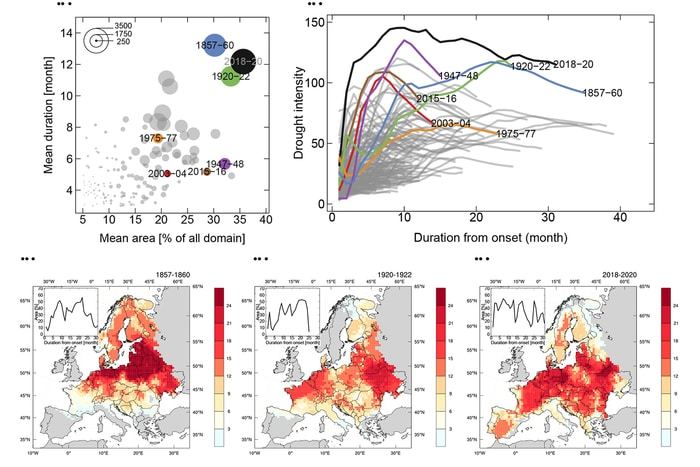
In the past, only the drought event from 1857 to 1860 lasted longer, with a mean duration of 13 months. The scientists define drought as the time in which the current soil-water content in the top 2-m soil falls below the level that has been reached only 20 percent of the time during the 250 years. To reconstruct these historical droughts, the scientists used the mHM hydrologic model developed at the UFZ. Among other things, this environmental model can be used to estimate soil moisture content based on past temperature and precipitation records.

The rise in air temperature also reached a historical record during the 2018-2020 drought event, with an anomaly of 2.8 degrees Celsius above the long-term average over the past 250 years. "The droughts in the past were colder than recent droughts in which the average temperature hardly changed", says Dr. Rohini Kumar, UFZ modeler and co-author of the article. The effects of a drought event become significantly more severe if, in addition to the precipitation deficit (approximately 20 percent for major drought events in past centuries), the warmer conditions prevail. This combined effect results in greater evaporation losses, leading to declining soil-water levels. The scientists also examined the consequences of the lack of water for agriculture during this drought event. They compared average annual crop yields for wheat, grain maize, and barley, between 2018 and 2020 with those between 1961 and 2021. The results indicate that harvests were significantly reduced in countries affected primarily by the 2018-2020 drought. For example, grain maize production decreased between 20 and 40 percent in the Benelux countries, Germany, and France; wheat reduced by up to 17.5 percent in Germany, and barley reduced by 10 percent in nearly all of Europe.

How droughts will develop in Europe in the future also depends on the severity of global warming. The scientists modeled the potential extent and duration of droughts for two representative concentration pathways (RCPs), which describe whether the future greenhouse gas emission scenarios will be more moderate (RCP4.5) or will continue unhindered (RCP8.5) up to the year 2100. The scientists determined that the mean drought duration increases significantly to up to 100 months for an RCP4.5 scenario, while the drought areal extent is projected to increase, covering up to 50 percent of Europe. The situation is different for the extreme RCP8.5 scenario: In this case, the mean drought duration could be more than 200 months, and the areal extent could affect up to 70 percent of Europe. "Decision-makers should be prepared for significantly more severe drought events in the future. Especially for devising new agricultural policies, this should be considered as a wake-up call to assess suitable measures to mitigate the threatening lack of water", says Dr. Luis Samaniego, co-author of the article and Head of the Stochastic and Land Surface Hydrology Working Group at the UFZ. On a regional basis, this could be the establishment of large water reservoirs, such as underground storage systems; intelligent and smart irrigation technologies, or the breeding of more heat-resistant cultivars.
Small microring array enables large complex-valued matrix multiplication

Tyler O'Neal, Staff Editor HEALTH May 13, 2022, 4:41 pm

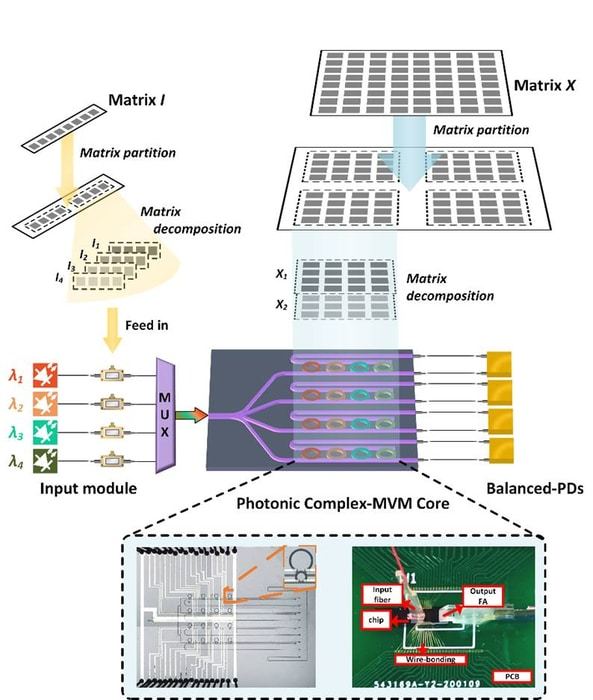
Optical supercomputing uses photons instead of electrons to perform computations, which can significantly increase the speed and energy efficiency of computations by overcoming the inherent limitations of electrons. The basic principle of optical computing is the light-matter interaction. Matrix computing has become one of the most widely used and indispensable information processing tools in science and engineering, contributing a large number of computational tasks to most signal processing, such as discrete Fourier transforms and convolution operations. As the basic building block of artificial neural networks (ANNs), matrix multiplication occupies most of the computational resources. Due to the properties of electronic components, performing simple matrix multiplications require a large number of transistors to work together, while matrix multiplications can be easily implemented by fundamental photonic components such as microring, Mach Zehnder interferometer (MZI), and the diffractive plane. Therefore, the speed of optical supercomputing is several orders of magnitude faster than electronic computing and consumes much less power. However, the traditional incoherent matrix-vector multiplication method focuses on real-valued operations and does not work well in complex-valued neural networks and discrete Fourier transforms. Working principle of the photonic complex matrix-vector multiplier chip.  CREDIT Junwei Cheng, Yuhe Zhao, Wenkai Zhang, Hailong Zhou, Dongmei Huang, Qing Zhu, Yuhao Guo, Bo Xu, Jianji Dong, Xinliang Zhang;

Researchers led by Prof. Jianji Dong at Huazhong University of Science and Technology (HUST), China, have proposed a photonic complex matrix-vector multiplier chip that can support arbitrary large-scale and complex-valued matrix multiplications. The chip breaks the bottleneck that traditional non-coherent optical computing schemes are difficult to achieve arbitrary large-scale complex-valued matrix multiplications and also enables artificial intelligence applications such as discrete Fourier transform, discrete cosine transform, Walsh transform, and image convolution. Their idea is to design matrix decomposition and matrix partitioning intelligent algorithms for the microring array architecture to extend matrix multiplications from real to complex domain and from small scale to large scale. The researchers successfully experimentally demonstrated several typical artificial intelligence applications, showing the great potential of the photonic complex matrix-vector multiplier chip for applications in artificial intelligence computing. The work entitled “A small microring array that performs large complex-valued matrix-vector multiplication” was published on Apr. 28 2022 in Frontiers of Optoelectronics.

Australian geologist reveals new way to model past climate on Mars

Tyler O'Neal, Staff Editor HEALTH May 13, 2022, 3:52 pm

A study led by a Monash University geologist has provided fresh evidence for when high rates of erosion occurred throughout the history of Mars.

The findings, published today in Geology date when the climate was far more erosive in Mars’ past — with the implication that there were sustained periods when liquid water moved across the planet’s surface. Sands blown by wind into craters on Mars’ surface can be linked to the climate history of the planet.

Scientists have long been keen to understand how Mars went from a state potentially more like modern Earth, to the desolate inhospitable place it is today.

“If we want to know if there was life on Mars, we need to understand the sedimentary rock record,” said lead study author Dr. Andrew Gunn, from the Monash University School of Earth, Atmosphere, and Environment.

“Our study determines the timing and rates of sediment erosion and accumulation over Mars’ geologic history in a completely novel way, and for the first time quantifies a measure of the erodibility of each of the types of rocks we see on Mars’ surface,” he said.

“It is significant because we show that the abundance of sands blown by the wind into craters on Mars’ surface can be linked to the climate history of the planet, unlocking a new way to understand when in geologic time Mars may have been habitable.”

The researchers drew on multiple datasets to estimate the size of crater sand deposits and what produced them, this included geologic maps, climate simulations, and satellite data. They synthesized and interpreted these data to understand the controls and timing of erosion on Mars.

On Earth and Mars, there is a sedimentary cycle where surface rocks are slowly eroded into sediments, the sediments bury each other, new rocks are made, and the process continues. On Earth the surface is recycled by tectonics, erasing the old sediments across most of the planet, but on Mars sediment accumulations on the surface are mostly preserved to the modern-day.

The erosion of rocks occurs much faster when they collide with one another in liquid relative to gas since liquids can carry larger, heavier rocks. To produce sediment that can be moved by wind, often it must be broken down into smaller particles by rivers beforehand.

“Seeing high rates of accumulation in a certain period of Mars’ history indicates that it was much more likely there were active rivers eroding material then,” said Dr. Gunn.

“Plenty of evidence for surface water in Mars’ past has been published before—meaning there was liquid water on the surface and an atmosphere to sustain it (i.e., conditions more conducive to life)—but the jury is still out on when exactly, and for how long, this occurred.”

  1. Japanese scientists create an inexpensive sensor for real-time measurement of rain, wind
  2. Rice, Waseda team up to crack complexity with modeling car tires

Page 6 of 28

  • 1
  • 2
  • 3
  • 4
  • 5
  • 6
  • 7
  • 8
  • 9
  • 10
POPULAR RIGHT NOW
  • Supercomputers replace ‘bathtub’ flood maps with physics-based digital twins of Britain’s coastline
    Supercomputers replace ‘bathtub’ flood maps with physics-based digital twins of Britain’s coastline
  • Supercomputers push neural quantum simulation beyond previous limits
    Supercomputers push neural quantum simulation beyond previous limits
  • Intel’s AI supercomputing revival: Q2 financial surge signals new era for CPU-powered HPC infrastructure
    Intel’s AI supercomputing revival: Q2 financial surge signals new era for CPU-powered HPC infrastructure
  • AWS supercomputing investment reaches historic scale as Amazon’s AI strategy powers record financial results
    AWS supercomputing investment reaches historic scale as Amazon’s AI strategy powers record financial results
  • AI infrastructure financing fears shake semiconductor sector
    AI infrastructure financing fears shake semiconductor sector
  • Catching the wave of the future: Supercomputers unlock the hidden dynamics of Venus
    Catching the wave of the future: Supercomputers unlock the hidden dynamics of Venus
  • NCAR supercomputers run planet scale climate experiments impossible in the real world
    NCAR supercomputers run planet scale climate experiments impossible in the real world
  • AI hunts the cosmos: Machine learning helps astronomers discover the first ‘Wandering’ supermassive black hole caught destroying a star
    AI hunts the cosmos: Machine learning helps astronomers discover the first ‘Wandering’ supermassive black hole caught destroying a star
  • Supercomputing for the masses: Meta's vision of a personal superintelligence for everyone
    Supercomputing for the masses: Meta's vision of a personal superintelligence for everyone
  • NVIDIA helps turn AI compute into a new asset class as Wall Street mobilizes $500 billion
    NVIDIA helps turn AI compute into a new asset class as Wall Street mobilizes $500 billion
THIS YEAR'S MOST READ
  • Wall Street wants to trade supercomputing power like oil
    Wall Street wants to trade supercomputing power like oil
  • Beamforming the future: BeammWave's 6G push signals the rise of orbital-terrestrial wireless networks
    Joakim Axmon
    Joakim Axmon
  • Cosmic ambition at scale: UK’s supercomputer unlocks a 2.5 petabytes universe
    Cosmic ambition at scale: UK’s supercomputer unlocks a 2.5 petabytes universe
  • Hidden order, revealed at scale: Supercomputing, electron ptychography uncover the inner workings of relaxor ferroelectrics
    Hidden order, revealed at scale: Supercomputing, electron ptychography uncover the inner workings of relaxor ferroelectrics
  • Intel's Q1 results signal supercomputing surge driving Xeon momentum
    Intel's Q1 results signal supercomputing surge driving Xeon momentum
  • When stars fall apart: Supercomputing reveals the hidden physics of black holes
    When stars fall apart: Supercomputing reveals the hidden physics of black holes
  • MIT develops computational framework to probe dark matter via gravitational waves
    MIT develops computational framework to probe dark matter via gravitational waves
  • Explainable AI moves into the watershed: FAMU-FSU engineers build predictive framework for real-time E. coli forecasting
    FAMU-FSU College of Engineering Assistant Professor Nasrin Alamdari. (Scott Holstein/FAMU-FSU College of Engineering)
    FAMU-FSU College of Engineering Assistant Professor Nasrin Alamdari. (Scott Holstein/FAMU-FSU College of Engineering)
  • Multi-layer simulations reveal the hidden supply chain of solar prominences
    Multi-layer simulations reveal the hidden supply chain of solar prominences
  • Japanese scientists decode dolphin speed with supercomputing: Turbulence, vortices, and the hidden physics of propulsion
    Japanese scientists decode dolphin speed with supercomputing: Turbulence, vortices, and the hidden physics of propulsion
  • FRONTPAGE
  • LATEST
  • POPULAR
  • REGISTER
  • SOCIAL
  • VIDEO
  • SUBSCRIPTION
  • RSS
  • GUIDELINES
  • PRIVACY
  • TOS
  • ABOUT
  • +1 (816) 799-4488
  • editorial@supercomputingonline.com
© 2001 - 2026 SuperComputingOnline.com, LLC. All rights reserved. This material may not be published, broadcast, rewritten or redistributed without permission.
Sign In
  • FRONT PAGE
  • LATEST
    • MEDIA KIT
    • MOST READ
    • RSS FEED
    • ACADEMIA
    • AEROSPACE
    • APPLICATIONS
    • ASTRONOMY
    • AUTOMOTIVE
    • BIG DATA
    • BIOLOGY
    • CHEMISTRY
    • CLIENTS
    • CLOUD
    • DEFENSE
    • DEVELOPER TOOLS
    • EARTH SCIENCES
    • ECONOMICS
    • ENGINEERING
    • ENTERTAINMENT
    • HEALTH
    • INDUSTRY
    • INTERCONNECTS
    • GAMING
    • GOVERNMENT
    • MANUFACTURING
    • MIDDLEWARE
    • MOVIES
    • NETWORKS
    • OIL & GAS
    • PHYSICS
    • PROCESSORS
    • RETAIL
    • SCIENCE
    • STORAGE
    • SYSTEMS
    • VISUALIZATION
  • VIDEOS
    • ADD YOUR VIDEOS
    • MANAGE VIDEOS
  • COMMUNITY
    • TRADE SHOWS
    • SOCIAL NETWORK VIDEOS
    • SURVEYS
    • APPLICATIONS BROWSER
    • CONVERSATION INBOX
    • SOCIAL ADVERTISER
    • GROUPS
    • MARKETPLACE LISTINGS
    • PAGES
    • LEADERBOARD
    • POINTS LISTING
      • BADGES
    • PRIVACY CONFIRM REQUEST
    • PRIVACY CREATE REQUEST

Hey there! We noticed you’re using an ad blocker.