Materials physics researchers at Linköping University revolutionize the synthesis of 2D materials, paving the way for groundbreaking advancements
In a blend of artificial intelligence (AI) and advanced supercomputer simulations, scientists at Linköping University have opened the door to a new era of 2D materials. These ultra-thin materials, comprised of just a few atoms, possess extraordinary properties that make them highly desirable for applications including energy storage, catalysis, and water purification. The team's groundbreaking method for synthesizing hundreds of novel 2D materials has now been published in the prestigious journal Science.
Since the discovery of graphene, the field of research into 2D materials has experienced an exponential surge. These exceptionally thin materials boast a remarkably high surface area-to-volume ratio, resulting in a plethora of unique physical phenomena and properties. Among these properties are exceptional conductivity, remarkable strength, and heat resistance. As such, 2D materials have captured the attention of researchers worldwide, both for fundamental scientific investigations and practical applications.
Professor Johanna Rosén, a materials physicist at Linköping University, explains, "In a film only a millimeter thin, there can be millions of layers of these materials. The spaces between layers offer immense potential for chemical reactions and, as a result, 2D materials can be employed for energy storage or fuel synthesis."
The expansive family of materials known as MXenes has long dominated the field of 2D materials synthesis. MXenes are derived from a three-dimensional precursor material called a MAX phase, which consists of three elements: a transition metal (M), an (A-group) element (A), and carbon or nitrogen (X). Through a process called exfoliation, the A element is removed, resulting in the formation of a 2D material. Until now, MXenes were the only material family created in this way.
Linköping researchers, however, have made a significant breakthrough in expanding the universe of 2D materials. They have developed a theoretical model capable of predicting other three-dimensional materials suitable for transformation into 2D materials, and they have indeed confirmed the model's consistency with reality.
The researchers meticulously followed a three-step process. First, they devised the theoretical model to identify parent materials suitable for synthesis. Drawing upon the immense computational power of the National Supercomputer Centre, the researchers scrutinized a database comprising a staggering 66,643 materials, ultimately identifying 119 promising three-dimensional candidates.
Next came the laboratory experiments. Assistant Professor Jie Zhou, from the Department of Physics, Chemistry, and Biology, explains, "We screened the 119 candidates for chemical stability and selected the most promising ones. Synthesizing the 3D material itself was a challenging task. Finally, we achieved a high-quality sample that allowed us to exfoliate and etch away specific atomic layers using hydrofluoric acid."
By removing yttrium (Y) from the parent material YRu2Si2, the team successfully obtained a two-dimensional material called Ru2SixOy.
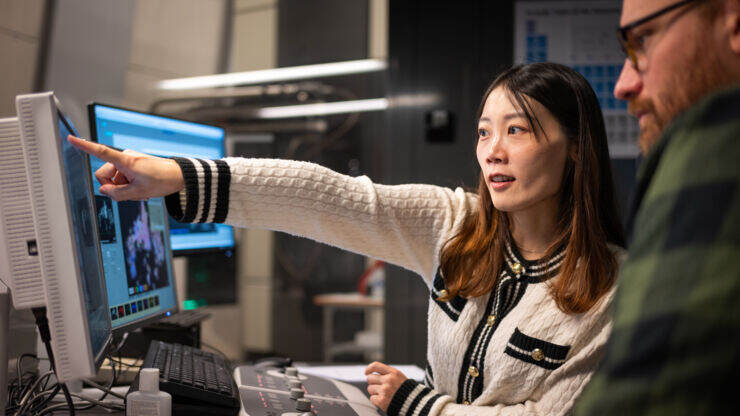
To validate their breakthrough in the lab, the researchers turned to the state-of-the-art scanning transmission electron microscope Arwen at Linköping University. This remarkable equipment enabled them to visualize the material's atomic structure and composition with unprecedented precision.
Jonas Björk, an associate professor at the division of Materials Design, enthused, "We were able to confirm that our theoretical model worked extremely well and that the resulting material indeed consisted of the correct atoms. The images of the exfoliated material resembled the pages of a book. Putting this theory into practice has expanded the concept of chemical exfoliation beyond the realm of MXenes into numerous other material families."
This breakthrough discovery ushers in an era of seemingly endless possibilities for unique 2D materials and their remarkable properties. These materials could serve as the foundation for an array of technological applications. Moving forward, the researchers intend to explore additional precursor materials and expand their experimental scale. Professor Rosén believes that the potential applications for 2D materials are nearly limitless, envisioning their utilization in carbon capture and water purification projects. The researchers also emphasize the need for sustainable synthesis methods as they scale up their experiments.
This study was made possible thanks to the generous support of several organizations including the Knut and Alice Wallenberg Foundation, the Wallenberg Initiative Materials Science for Sustainability (WISE), the Göran Gustafsson Foundation for Research in Natural Sciences and Medicine, the Swedish Foundation for Strategic Research, the European Union, the Swedish Research Council, and the Swedish Government Strategic Research Area in Materials Science on Advanced Functional Materials (AFM) at Linköping University.
This cutting-edge research project combines diverse perspectives from around the globe, utilizing artificial intelligence and supercomputer simulations to unleash the transformative potential of 2D materials.
Researchers at Linköping University are using AI and supercomputers to explore the possibilities of 2D materials.