UCL predicts equatorial plasma bubbles with SWARM

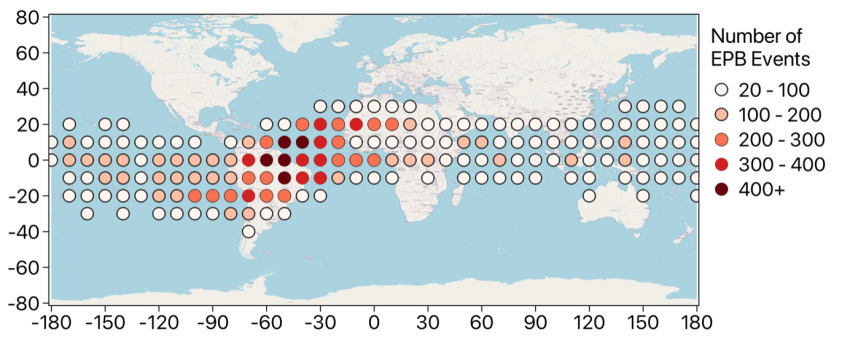
Changes in atmospheric density after sunset can cause hot pockets of gas called ‘plasma bubbles’ to form over the Earth’s equator, resulting in communication disruptions between satellites and the Earth. New AI models are now helping scientists to predict plasma bubble events and create a forecast. The work was presented this week at the National Astronomy Meeting (NAM 2022) by Sachin Reddy, a PhD student at University College London. Map of Equatorial Plasma Bubble (EPB) events across the Earth. Most bubbles occur over the Atlantic in a region called the ‘South Atlantic Anomaly’. Here high energy particles and gamma rays penetrate deep into our atmosphere and influence the creation of bubbles. Credit Sachin Reddy/University College London/Mullard Space Science Laboratory
Shortly after sunset, pockets of super-heated gas called ‘plasma bubbles’ form in the upper atmosphere and stretch into space (up to 900km above the Earth’s surface). These bubbles start small and grow rapidly – from the size of a soccer pitch to that of a small country in just a couple of hours. As the bubbles grow bigger, they can prevent satellites from communicating with the Earth by blocking and warping their radio signals.

To predict plasma bubbles, a team of researchers has collated 8 years of data from the SWARM satellite mission. The spacecraft has an automatic bubble detector on-board called the Ionospheric Bubble Index. This compares changes in the density of electrons and the magnetic field strength to check if bubbles are present: a strong correlation between the two indicates the presence of a plasma bubble.

The satellite flies at an altitude of 460km (about 30x higher than a commercial plane) through the middle of most plasma bubbles. The model combines the data collection from SWARM with a machine learning approach to make predictions on the likelihood of a plasma bubble event occurring at any time.

The results show that the number of plasma bubble events varies from season to season, just like the weather, and that the number of events increases with solar activity. Despite this, the model finds location to be a far more crucial element in predicting plasma bubbles than the time of year, with most events occurring over a region in the Atlantic called the South Atlantic Anomaly. The AI model predicts events with an accuracy of 91% across different tests.

Reddy says: “Just like the weather forecast on earth, we need to be able to forecast bubbles to prevent major disruptions to satellite services. Our aim is to be able to say something like: “At 8pm tomorrow there is a 30% chance of a bubble appearing over the Horn of Africa.” This kind of information is extremely useful for spacecraft operators and for people who depend on satellite data every day, just like you and me.”
 

Cyborg finds 40,000 ring galaxies

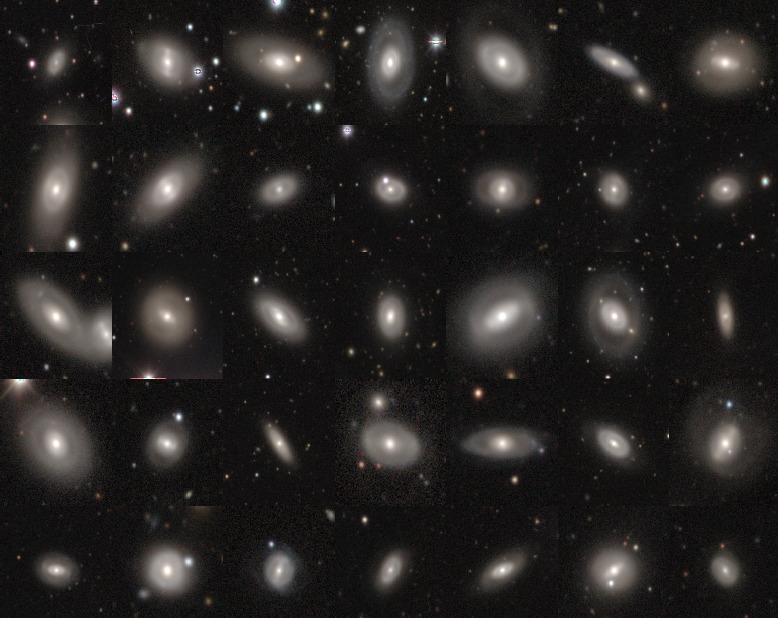
Human and machine intelligence worked together to find 40,000 ring galaxies, scientists at the National Astronomy Meeting will announce this week. Dr. Mike Walmsley of the University of Manchester and the Galaxy Zoo alliance will present the new work, describing how this “cyborg” approach measured the shapes of millions of galaxies. The ring galaxy NGC 3081, imaged by the Hubble Space Telescope. Credit: ESA/Hubble & NASA Acknowledgement: R. Buta (University of Alabama)

Galaxies live chaotic life. Collisions with other galaxies and bursts of energy from supermassive black holes disrupt the colors and orbits of billions of stars, leaving tell-tale markers that volunteers search for on the Galaxy Zoo website. But understanding exactly which cosmic events lead to which markers require millions of measured images - more than humans could ever search.

To help, Dr. Mike Walmsley used a decade of Galaxy Zoo volunteer measurements (totaling over 96 million clicks) to create an automatic assistant - a new AI algorithm. The algorithm, affectionately named “Zoobot”, can not only accurately predict what volunteers would say but understands where they might be mistaken.

The discovery of 40,000 rare ring-shaped galaxies is six times more than previously known. Rings take billions of years to form and are destroyed in galaxy-galaxy collisions, and so this giant new sample will help reveal how isolated galaxies evolve. The dataset will also tell scientists how galaxies age more generally.

Zoobot is designed to be retrained again and again for new science goals. Just like a musician can learn a new instrument faster than their first instrument, Zoobot can learn to answer new shape questions easily because it has already learned to answer more than 50 different questions. Dr. Walmsley says: “With Zoobot, humans and machines are collaborating to push the science of astronomy forward. We’re helping other astronomers solve questions we never thought to ask”.

Galaxy Zoo Deputy Principal Investigator Dr. Brooke Simmons, of the University of Lancaster, adds: “Galaxy Zoo turns 15 years old this week, and we are still innovating. The work Dr. Walmsley is leading will make it possible for a new generation of discoveries to be made from upcoming large galaxy surveys.”

DePaul biologist, computer scientist team up for fish project

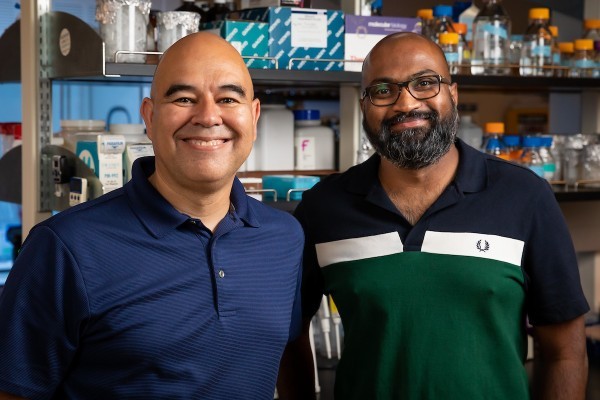
The genetic evolution of freshwater fish in Ecuador could unlock new insights for conservation ecologists. A new collaboration between biologists and computer scientists at DePaul seeks to sequence the genomes of these species. Windsor Aguirre, associate professor of evolutionary biology, and Thiru Ramaraj, assistant professor in the School of Computing, earned a University Research Council collaboration grant to fund their computational biology project. (DePaul University/Jeff Carrion)

“This has the potential to give us a real insight into the evolution and adaptation of these fishes, as well as the nature of the planet and the challenges we face," says Windsor Aguirre, an associate professor of evolutionary biology and a co-lead on the project.

Aguirre and Thiru Ramaraj, an assistant professor in the School of Computing, earned a University Research Council collaboration grant to fund the project. They will create a high-quality reference genome for two species of the endemic characid genus Rhoadsia and conduct resequencing of 20 additional specimens. This will not only augment Aguirre's research and contribute to the history of the species, but also be a publicly available resource for researchers around the world who study the evolution of genomes.

“Humans are having an extraordinary effect on the planet, so every species is being forced to respond to humans," Aguirre says. “Every ecosystem has been affected to some degree or another, and many are being affected very severely."

Their research will use next-generation DNA sequencing and bioinformatics to examine why certain species persisted over time but others did not.

Ecuadorian fish hold genetic clues
Aguirre has been researching Ecuador's freshwater fish since 2008 and calls it a “global biodiversity hotspot." Last year Aguirre and his Ecuadorian co-authors published a review on the conservation threats to fisheries in Ecuador — the first comprehensive summary of the status of the fish.

Many labs have access to model genomes such as a mouse, rat, fruit fly, or zebrafish. Aguirre wanted to take the next step in sequencing the genome of these endemic fish, and in turn, create a resource researchers around the world can use to study and investigate the evolution of genomes. He also hopes it will encourage more research on the evolution of freshwater fishes in this important region.​

Ramaraj joined DePaul in 2019 and the two met through a bioinformatics group formed by faculty in the Jarvis College of Computing and Digital Media and the College of Science and Health.

“Thiru's expertise in the field of bioinformatics and computation science is incredibly important," Aguirre says. “With advances in technology, it is becoming very easy to generate these large amounts of data. The challenge becomes being able to understand them, and that requires computational tools working at high speed to filter, organize and process very large amounts of data."

In his previous position at a nonprofit biotechnology research institute, Ramaraj was a bioinformatics scientist and worked with next-generation sequencing data for almost a decade. He sequenced data from DNA and RNA across all domains.

“I have collaborated with microbiologists, zoologists, plant and human geneticists, and biochemists," Ramaraj says. He sought to continue that work at DePaul, and the projects with Aguirre were a perfect fit.

Genome sequencing is no longer a moonshot
When the first draft of the human genome was published in 2001, Aguirre says it was a significant milestone.

“That was a massive, international effort involving government and private institutions, hundreds of millions of dollars at a massive scale," he notes. Now researchers can create genomes of comparable sizes for a few thousand dollars.

“Something that just 20 years ago was basically the equivalent to a moonshot we can now do in a university setting and tell our students about generating really extraordinary data on the basic evolutionary history of organisms," Aguirre says.

They will generate data using Pacific Biosciences sequencing technology, which produces long, high-quality DNA sequences and uses a computational method to put them back into a complete genome.

“The analogy is taking a book, ripping it apart, and putting it back together," Ramaraj says. “Once we have data, we can mine for interesting patterns, look at where the genes are, and understand their function. We can also determine how the genomes themselves are different from closely related species."

Both researchers plan to leverage the project to increase awareness among DePaul students in biology, computer science, and other areas about the field of computational biology. Data science can help provide real-world solutions to environmental problems, making it an excellent career path.

“As a computer scientist with this knowledge, you can work for pharmaceutical and plant biotechnology companies," Ramaraj says. “Everything you learn here can be applied in those fields."​