

SUPERCOMPUTING NEWS SUPERCOMPUTING NEWS
    • MEDIA KIT
    • MOST READ
    • RSS FEED
    • ACADEMIA
    • AEROSPACE
    • APPLICATIONS
    • ASTRONOMY
    • AUTOMOTIVE
    • BIG DATA
    • BIOLOGY
    • CHEMISTRY
    • CLIENTS
    • CLOUD
    • DEFENSE
    • DEVELOPER TOOLS
    • EARTH SCIENCES
    • ECONOMICS
    • ENGINEERING
    • ENTERTAINMENT
    • GAMING
    • GOVERNMENT
    • HEALTH
    • OIL & GAS
    • INDUSTRY
    • INTERCONNECTS
    • MANUFACTURING
    • MIDDLEWARE
    • MOVIES
    • NETWORKS
    • PHYSICS
    • PROCESSORS
    • RETAIL
    • SCIENCE
    • STORAGE
    • SYSTEMS
    • VISUALIZATION
    • AcyMailing subscription form

    • ADD YOUR VIDEOS
    • MANAGE VIDEOS
    • CONVERSATION INBOX
    • SOCIAL ADVERTISER
    • SOCIAL NETWORK VIDEOS
    • SURVEYS
    • GROUPS
    • PAGES
    • MARKETPLACE LISTINGS
    • APPLICATIONS BROWSER
    • PRIVACY CONFIRM REQUEST
    • PRIVACY CREATE REQUEST
    • LEADERBOARD
    • POINTS LISTING
      • BADGES
    • TRADE SHOWS
Sign In
Tyler O'Neal, Staff Editor NETWORKS September 26, 2022, 7:00 am

WSU shows how monitoring networks linked with niche-based models to explore factors shaping the dynamics of invasive pest species

A foul-smelling, voracious, wide-spread pest could become even more ubiquitous with climate change. A brown marmorated stink bug feeding on a pepper. These bugs are generalists and are known to eat nearly 170 different kinds of plants. Photo by Jason Ondreicka on iStock.
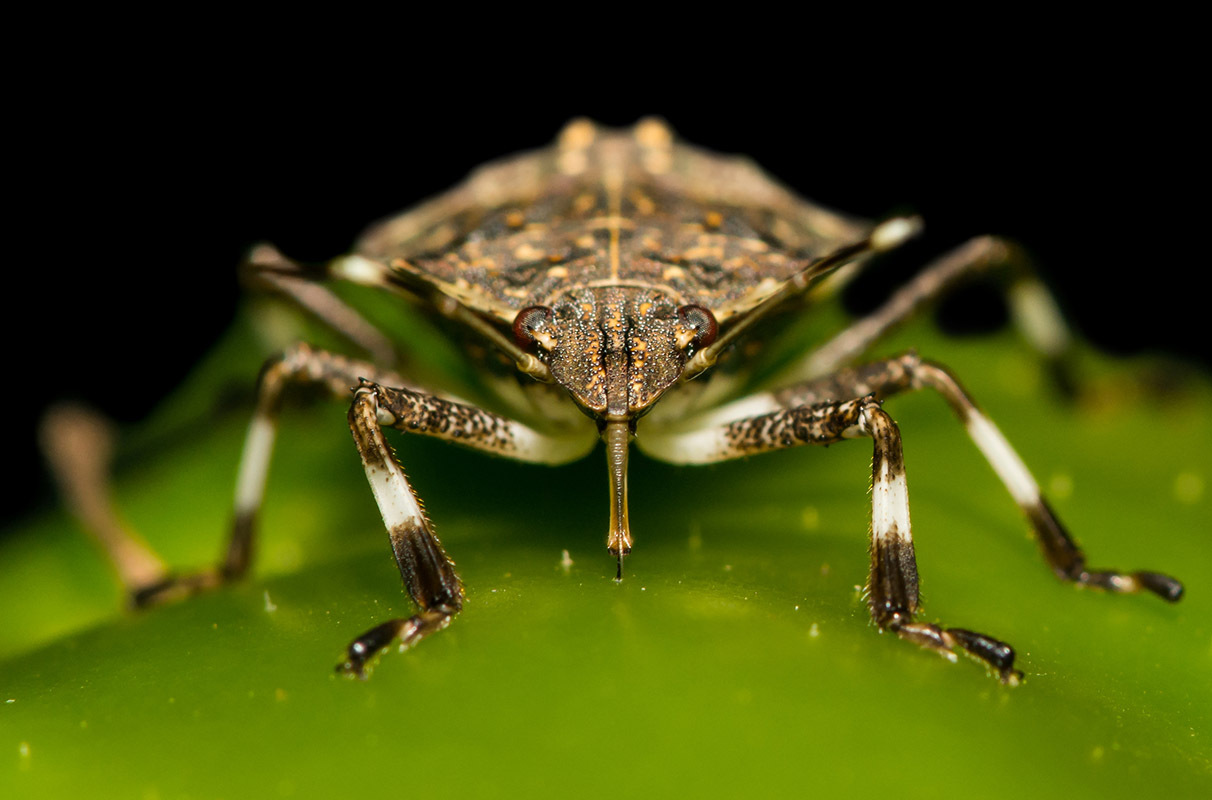
A recent modeling study found that changing weather could increase suitable habitat for the brown marmorated stink bug in the United States by 70%. The study, published in Pest Management Science, draws on data from a three-year stink bug monitoring effort in 17 states as well as several potential climate scenarios. However, whether the insects will thrive in new places depends on the conditions of each area and possible mitigation measures.

“Every system will change with climate change, so the fact that you can grow garbanzo beans, lentils, or wheat without these pests now, doesn't mean that you will not have them in a few years,” said study lead author Javier Gutierrez Illan, a Washington State University entomologist. “There are mitigating things that we can do, but it is wise to prepare for change.”

The study found that overall, there is likely to be a northward shift in stink bug-friendly conditions. Regions that may be particularly affected include the Mid-Atlantic, areas surrounding the Great Lakes, and the valleys of the West Coast, such as the Sacramento Valley in California and the Treasure Valley in Idaho.

The brown marmorated stink bug is a generalist herbivore – it is known to feast on nearly 170 different plants including crops and ornamental plants. Originating in Asia, this type of stink bug first appeared in the U.S. about 20 years ago and has since spread coast to coast. It’s been detected in 46 states and considered a pest in 15 of them.

Homeowners may recognize brown marmorated stink bugs because they like to overwinter indoors. In fact, the study found that proximity to populated areas appeared to help the insects get established in new places, but once there, they did not need to be near people to proliferate. Other factors like the availability of water mattered more for their abundance.

People are likely inadvertently transporting stink bugs in vehicles or farm equipment to areas that would otherwise be hard for them to reach by flying alone, said Gutierrez Illan.

Stink bugs dislike cold winters, but the rising temperatures brought by climate change are not necessarily a good thing if the land becomes too dry. They need water, so the researchers said that changing patterns of precipitation will likely influence where the stink bugs will thrive.

In some states including Washington, officials and researchers are employing a parasitoid insect, called the samurai wasp, to control stink bugs. The wasps lay their own eggs inside stink bug eggs. This destroys the affected eggs, and when the wasp larvae hatch, they eat other developing stink bugs. Measures like these might help prevent or minimize stink bug spread into new areas, Gutierrez Illan said.

For Washington growers, the researcher recommended using WSU’s DAS, or Decision Aid System, a web-based tool that provides information to help prepare for changes to their agricultural systems, including the possible appearance of these pests.

Gutierrez Illan also advised growers to familiarize themselves with the brown marmorated stink bug through sites like stopbsmb.org, even if they have never had the pest in their fields.

“Most growers learn from their parents or from the previous generation, but the information that they had is probably no longer as useful because the climate is changing, so they need these types of tools,” Gutierrez Illan said.

Schlumberger expands global AI innovation network

Tyler O'Neal, Staff Editor NETWORKS May 2, 2022, 12:28 pm

Expanding the Benefits of Enterprise-Scale AI: Agile, Collaborative Development to Extract Maximum Value from Data

Schlumberger has expanded its global INNOVATION FACTORI network with the inauguration of a new center in Oslo, Norway.

“At INNOVATION FACTORI, customer teams will benefit from an agile, collaborative development approach with our domain and data science experts to address their strategic demands, such as drilling automation, digital twins for production optimization, and carbon capture and storage modeling,” said Rajeev Sonthalia, president, Digital & Integration, Schlumberger. “Through INNOVATION FACTORI, customers can turn promising concepts into fully deployed digital solutions that extract maximum value from data to drive a major leap in business performance and, in turn, sustainability.”

Schlumberger customers will gain access to a powerful machine learning platform with market-leading AI capabilities. Through its partnership with Dataiku, a world leader in “Every Day AI,” Schlumberger will empower its customers to leverage a single, centralized platform to design, deploy, govern, and manage AI and analytics applications.

Schlumberger’s INNOVATION FACTORI network expansion comes after its successful inauguration of two AI centers in the Americas, one in Rio, Brazil, and a recently opened AI center in Houston, Texas. These centers complement the global network of experts in Abu Dhabi, Beijing and Kuala Lumpur.

Cornell's Townsend builds rational neural network that advances machine-human discovery

Tyler O'Neal, Staff Editor NETWORKS April 5, 2022, 5:00 pm

Math is the language of the physical world, and Alex Townsend sees mathematical patterns everywhere: in weather, in the way soundwaves move, and even in the spots or stripes zebrafish develop in embryos.

“Since Newton wrote down calculus, we have been deriving calculus equations called differential equations to model physical phenomena,” said Townsend, associate professor of mathematics in the College of Arts and Sciences at Cornell University.

This way of deriving laws of calculus works, Townsend said, if you already know the physics of the system. But what about learning physical systems for which physics remains unknown?

In the new and growing field of partial differential equation (PDE) learning, mathematicians collect data from natural systems and then use trained computer neural networks to try to derive underlying mathematical equations. In a new paper, Townsend, together with co-authors Nicolas Boullé of the University of Oxford and Christopher Earls, professor of civil and environmental engineering in the College of Engineering, advance PDE learning with a novel “rational” neural network, which reveals its findings in a manner that mathematicians can understand: through Green’s functions – a right inverse of a differential equation in calculus.

This machine-human partnership is a step toward the day when deep learning will enhance scientific exploration of natural phenomena such as weather systems, climate change, fluid dynamics, genetics, and more.

A subset of machine learning, neural networks are inspired by the simple animal brain mechanism of neurons and synapses – inputs and outputs, Townsend said. Neurons – called “activation functions” in the context of computerized neural networks – collect inputs from other neurons. Between the neurons are synapses, called weights, that send signals to the next neuron.

“By connecting together these activation functions and weights in combination, you can come up with very complicated maps that take inputs to outputs, just like the brain might take a signal from the eye and turn it into an idea,” Townsend said. “Particularly here, we are watching a system, a PDE, and trying to get it to estimate the Green’s function pattern that would predict what we are watching.”

Mathematicians have been working with Green’s functions for nearly 200 years, said Townsend, who is an expert on them. He usually uses Green’s function to rapidly solve a differential equation. Earls proposed using Green’s functions to understand a differential equation rather than solve it, a reversal.

To do this, the researchers created a customized rational neural network, in which the activation functions are more complicated but can capture the extreme physical behavior of Green’s functions. Townsend and Boullé introduced rational neural networks in a separate study in 2021.

“Like neurons in the brain, there are different types of neurons from different parts of the brain. They’re not all the same,” Townsend said. “In a neural network, that corresponds to selecting the activation function – the input.”

Rational neural networks are potentially more flexible than standard neural networks because researchers can select various inputs.

“One of the important mathematical ideas here is that we can change that activation function to something that can actually capture what we expect from a Green’s function,” Townsend said. “The machine learns the Green’s function for a natural system. It doesn’t know what it means; it can’t interpret it. But we as humans can now look at the Green’s function because we’ve learned something we can mathematically understand.”

For each system, there is a different physics, Townsend said. He is excited about this research because it puts his expertise in Green’s functions to work in a modern direction with new applications.

  1. Edge processing research takes Surrey discovery closer to use in AI networks
  2. ADVA launches sustainable supplier program to tackle CO2 emissions

Page 5 of 12

  • 1
  • 2
  • 3
  • 4
  • 5
  • 6
  • 7
  • 8
  • 9
  • 10
POPULAR RIGHT NOW
  • Meta’s next frontier may not be social media; it may be supercomputing
    Meta’s next frontier may not be social media; it may be supercomputing
  • The future of cancer research runs on supercomputers
    Jill Mesirov, PhD
    Jill Mesirov, PhD
  • Rebuilding a lost continent: Supercomputers reveal Antarctica before the ice
    Antarctic ice meets the rocky coastline. Researchers traced landscape features from the two-kilometre-high coastal escarpment of Dronning Maud Land to the subglacial Gamburtsev Mountains, buried beneath 1–3 km of ice  Credit Matt Palmer
    Antarctic ice meets the rocky coastline. Researchers traced landscape features from the two-kilometre-high coastal escarpment of Dronning Maud Land to the subglacial Gamburtsev Mountains, buried beneath 1–3 km of ice Credit Matt Palmer
  • Supercomputers uncover a new class of cosmic explosions hidden in plain sight
    Supercomputers uncover a new class of cosmic explosions hidden in plain sight
  • AI supercharges the hunt for stronger magnets: Iowa State researchers launch a new era of intelligent materials discovery
    AI supercharges the hunt for stronger magnets: Iowa State researchers launch a new era of intelligent materials discovery
  • IBM's Historic stock collapse raises questions for the future of enterprise supercomputing
    IBM's Historic stock collapse raises questions for the future of enterprise supercomputing
  • Could a novel dark matter theory simultaneously resolve multiple cosmic enigmas? Supercomputer simulations provide a compelling, albeit currently unverified, potential solution
    Could a novel dark matter theory simultaneously resolve multiple cosmic enigmas? Supercomputer simulations provide a compelling, albeit currently unverified, potential solution
  • Melting icebergs may be reshaping Earth’s greatest ocean current
    Melting icebergs may be reshaping Earth’s greatest ocean current
  • Supercomputers replace ‘bathtub’ flood maps with physics-based digital twins of Britain’s coastline
    Supercomputers replace ‘bathtub’ flood maps with physics-based digital twins of Britain’s coastline
  • Supercomputers push neural quantum simulation beyond previous limits
    Supercomputers push neural quantum simulation beyond previous limits
MOST READ THIS YEAR
  • Cosmic ambition at scale: UK’s supercomputer unlocks a 2.5 petabytes universe
    Cosmic ambition at scale: UK’s supercomputer unlocks a 2.5 petabytes universe
  • Hidden order, revealed at scale: Supercomputing, electron ptychography uncover the inner workings of relaxor ferroelectrics
    Hidden order, revealed at scale: Supercomputing, electron ptychography uncover the inner workings of relaxor ferroelectrics
  • Intel's Q1 results signal supercomputing surge driving Xeon momentum
    Intel's Q1 results signal supercomputing surge driving Xeon momentum
  • FRONTPAGE
  • LATEST
  • POPULAR
  • REGISTER
  • SOCIAL
  • VIDEO
  • SUBSCRIPTION
  • RSS
  • GUIDELINES
  • PRIVACY
  • TOS
  • ABOUT
  • +1 (816) 799-4488
  • editorial@supercomputingonline.com
© 2001 - 2026 SuperComputingOnline.com, LLC. All rights reserved. This material may not be published, broadcast, rewritten or redistributed without permission.
Sign In
  • FRONT PAGE
  • LATEST
    • MEDIA KIT
    • MOST READ
    • RSS FEED
    • ACADEMIA
    • AEROSPACE
    • APPLICATIONS
    • ASTRONOMY
    • AUTOMOTIVE
    • BIG DATA
    • BIOLOGY
    • CHEMISTRY
    • CLIENTS
    • CLOUD
    • DEFENSE
    • DEVELOPER TOOLS
    • EARTH SCIENCES
    • ECONOMICS
    • ENGINEERING
    • ENTERTAINMENT
    • HEALTH
    • INDUSTRY
    • INTERCONNECTS
    • GAMING
    • GOVERNMENT
    • MANUFACTURING
    • MIDDLEWARE
    • MOVIES
    • NETWORKS
    • OIL & GAS
    • PHYSICS
    • PROCESSORS
    • RETAIL
    • SCIENCE
    • STORAGE
    • SYSTEMS
    • VISUALIZATION
  • VIDEOS
    • ADD YOUR VIDEOS
    • MANAGE VIDEOS
  • COMMUNITY
    • TRADE SHOWS
    • SOCIAL NETWORK VIDEOS
    • SURVEYS
    • APPLICATIONS BROWSER
    • CONVERSATION INBOX
    • SOCIAL ADVERTISER
    • GROUPS
    • MARKETPLACE LISTINGS
    • PAGES
    • LEADERBOARD
    • POINTS LISTING
      • BADGES
    • PRIVACY CONFIRM REQUEST
    • PRIVACY CREATE REQUEST

Hey there! We noticed you’re using an ad blocker.