

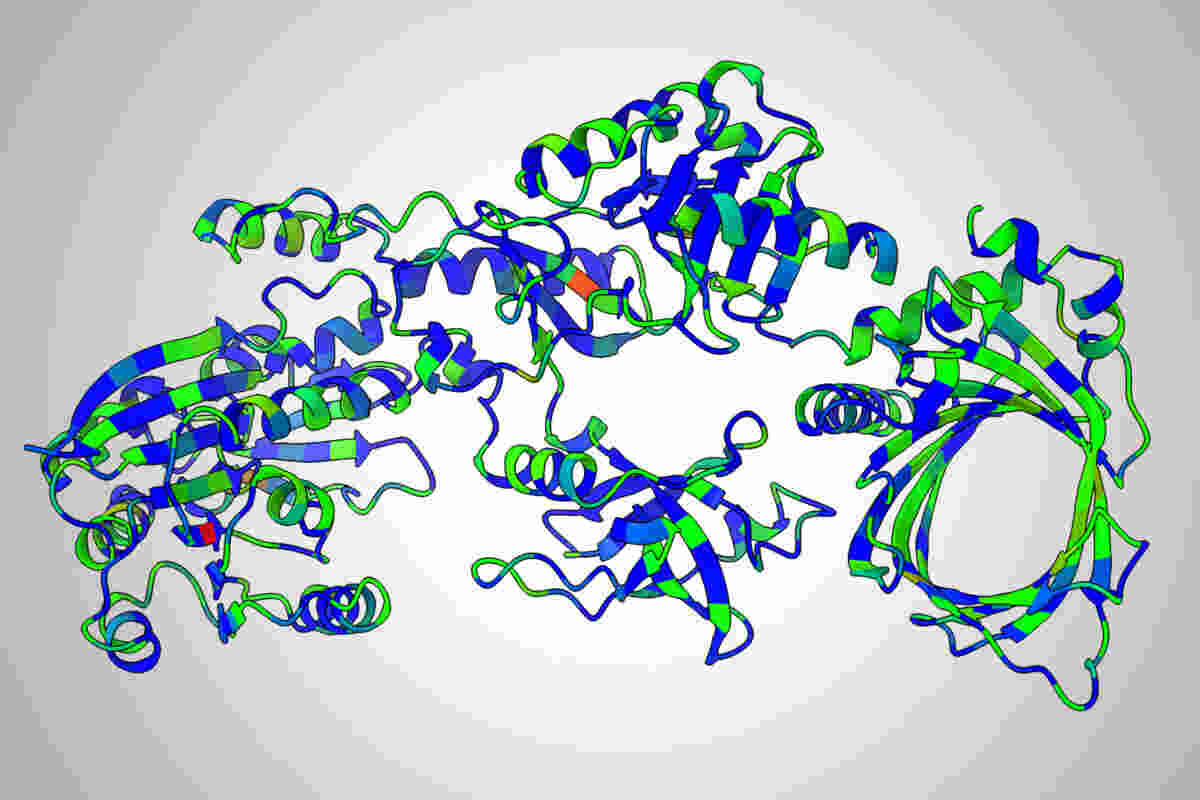
In this example, the model recommends keeping the blue parts the same as the natural version of the protein and strongly considering mutating the red parts. Credit: Danny Diaz/University of Texas at Austin.

Artificial intelligence transforms biomedical science with groundbreaking protein discoveries

A groundbreaking artificial intelligence (AI) model called EvoRank was developed at the University of Texas at Austin. This AI model leverages evolutionary processes to create advanced protein-based therapies and vaccines, revolutionizing drug development and scientific innovation in biotechnology.

EvoRank was unveiled at the International Conference on Machine Learning and featured in a paper in Nature Communications. It has broken barriers in the quest for innovative proteins by utilizing the natural variations of millions of proteins to usher in potential breakthroughs in medicine and biomanufacturing.

Daniel Diaz, a research scientist in computer science and co-lead of the Deep Proteins group at UT, emphasized that EvoRank distills the fundamental principles of protein evolution to guide the development of new protein-based applications, revolutionizing drug development, vaccines, and other biotechnological pursuits.

The implications of EvoRank go beyond academic research and extend to real-world applications. With a grant of nearly $2.5 million from the Advanced Research Projects Agency for Health, the UT team, in collaboration with vaccine-maker Jason McLellan and the La Jolla Institute for Immunology, aims to use AI in protein engineering to develop breakthrough vaccines to combat herpesviruses.

EvoRank is not only theoretically powerful but also has a tangible impact on the development of protein-based biotechnologies. It provides a roadmap to arrive at groundbreaking designs faster and more efficiently, capturing the attention of the scientific community and industry.

Unlike its contemporaries, EvoRank goes beyond predicting the shape and structure of proteins; it empowers scientists to make alterations in proteins for specific functions, propelling the boundaries of what is conceivable in protein therapeutics. Jason McLellan, in awe of EvoRank's capabilities, revealed, "The models have come up with substitutions we never would have thought of...finding new space for stabilizing."

The potential of EvoRank to revolutionize drug development, reduce time and costs, and enhance the efficacy of protein-based therapeutics has captured the attention of diverse perspectives within the scientific and medical communities. It presents a significant opportunity to democratize and expedite the creation of transformative medical interventions, paving the way for a future where the boundaries of what is possible in biomedical science are redefined.

With such resounding success, Daniel Diaz sheds light on the future, expressing plans to develop a "multicolumn" version of EvoRank. This version aims to assess the impact of multiple mutations on a protein's structure and stability and to enhance predictive tools linking protein structure and function.

The unveiling of EvoRank ultimately stands as a symbol of human ingenuity, showcasing how the fusion of artificial intelligence and biological research can transform the landscape of medicine and healthcare, igniting a curious fervor for the endless possibilities that lie ahead. The journey of EvoRank is just beginning, promising an accelerated future of scientific and pharmaceutical exploration, where the barriers to what is conceivable are relentlessly challenged and reshaped.

Concerns raised over potential securities law violations by Supermicro

Recently, a report by Hindenburg Research raised serious concerns about Super Micro Computer, Inc. (Nasdaq: SMCI) and its adherence to federal securities laws. The report suggests that the company may have provided misleading information to the public, casting doubt on the accuracy of its financial disclosures and corporate governance practices.

The report reveals troubling issues surrounding Supermicro, a well-known manufacturer of server and storage solutions based in San Jose, California. Despite being listed on the Nasdaq and included in major indices like the S&P 500 and the Nasdaq 100, the company is facing controversy due to allegations of improper revenue recognition and corporate governance concerns.

A significant focus of the report is the significant drop in Supermicro's gross margins, a departure from its historical performance. In previous fiscal years, the company consistently reported gross margins above 15%, but this figure plunged to 11.2% in Q4 2024. This sudden decline raises questions about the company's financial health and the sustainability of its business model.

Additionally, the report discusses governance concerns such as channel stuffing, deceptive revenue reporting practices, and improper revenue recognition. The Securities and Exchange Commission (SEC) previously accused Supermicro of prematurely recognizing over $200 million in revenue from FY 2015 through FY 2017, leading to the company's delisting in 2018 and an SEC charge in 2020.

Of equal concern is the rehiring of key employees allegedly associated with past unlawful accounting actions. Despite the company's assertion that accounting issues were in the past following a settlement with the SEC in 2020, a lawsuit filed in 2024 alleges that individuals connected to past accounting scandals were reinstated, raising questions about the company's commitment to sound corporate governance practices.

The report also reveals the rehiring of individuals linked to previous accounting improprieties, including Howard Hideshima, who faced SEC charges for engaging in improper accounting practices. Despite these allegations, Hideshima was rehired as a consultant to a related entity of Supermicro, sparking concerns about accountability and ethical oversight within the organization.

As the investigation delves deeper into the web of financial misconduct and governance lapses, investors and industry observers are left grappling with the implications of these troubling revelations. The potential violations of federal securities laws highlighted in the report cast uncertainty over Super Micro's future trajectory and raise doubts about the company's commitment to transparency, integrity, and ethical business practices.

CoreWeave was Supermicro’s biggest customer in the last year, according to Bloomberg Intelligence. However, in December 2023, Dell revealed a deal with CoreWeave for "thousands" of GPU servers, potentially valued at over $1 billion.

Nvidia is a major partner and chip supplier for Supermicro. In May 2024, CEO Jensen Huang publicly endorsed Supermicro’s competitor: “Nobody is better at building end-to-end systems of very large scale for the enterprise than Dell.”

Given these concerning developments, stakeholders and regulatory bodies are urged to conduct a thorough review of Supermicro's financial practices, governance structures, and compliance mechanisms. The allegations of misleading business information and potential violations of securities laws underscore the critical importance of vigilance and accountability in safeguarding investor interests and upholding market integrity.

One of the main importers of Supermicro products in Russia is a supplier to one of Russia’s largest supercomputers at a formerly secret, now-sanctioned research center. This importer, Niagara Computers, has received at least $46.3 million worth of Supermicro products since the start of the Russia-Ukraine war, according to trade data.

As Super Micro Computer, Inc. faces increased scrutiny, the need for greater transparency, ethical conduct, and robust governance practices becomes apparent, signaling a critical moment for the company and the broader supercomputing community as they grapple with the implications of these explosive allegations.

UK researchers explore supercomputer modeling for prediction of extreme rainfall

In a groundbreaking development, a group of climate experts led by the UK Met Office and Newcastle University has introduced an innovative supercomputer modeling system. This system aims to transform the prediction of extreme rainfall events. The research is marking a crucial moment in our quest for accurate early warning systems in the face of the increasing impacts of the changing climate.

Under the leadership of Met Office Principal Fellow and Newcastle University's Visiting Professor, Paul Davies, the research team explored the complex dynamics of extreme rainfall environments. Their work has paved the way for a significant shift in our understanding of short-duration, life-threatening flash floods. Their key finding is a three-layered atmospheric structure that unravels the complexities of localized downpours, challenging traditional knowledge and pushing the boundaries of meteorological science.

Professor Hayley Fowler, a key collaborator on the study and a leading expert in Climate Change Impacts at Newcastle University, emphasized the transformative potential of this groundbreaking modeling system. By uncovering the thermodynamic nuances underlying sub-hourly rainfall processes, the research provides insight into a future where extreme rainfall warnings are proactive rather than reactive, enabling communities to prepare for the impact of nature's fury.

Professor Davies emphasized the urgent need for improved prediction capabilities in the face of increasingly severe weather events caused by climate change. The modeling system's unrivaled ability to decode the atmospheric intricacies of extreme rainfall events signifies a significant milestone in strengthening the UK's resilience and preparedness for the ever-intensifying climate hazards that lie ahead.

The research team aims to turn their advanced model into an operational system that aligns with the UN's mandate for Early Warnings for All by 2027. This ambitious initiative seeks to provide access to life-saving early warning systems for all, reflecting humanity's collective determination to address the challenges posed by climate variability and extreme weather events.

As the world grapples with unprecedented climate disruptions, the launch of this supercomputer modeling system signifies a new era of scientific excellence and foresight. The Met Office's vital role as a Category 2 Responder underscores the critical importance of swift and accurate forecasting in preventing catastrophic outcomes, highlighting the indispensable role of cutting-edge technology in strengthening our defenses against nature's most formidable threats.

In conclusion, the introduction of this revolutionary modeling system challenges existing norms and encourages us to imagine a future where science and technology converge to protect lives, safeguard communities, and pave the way for a more resilient and sustainable world.