Supercomputers illuminate the North Atlantic's climate enigma

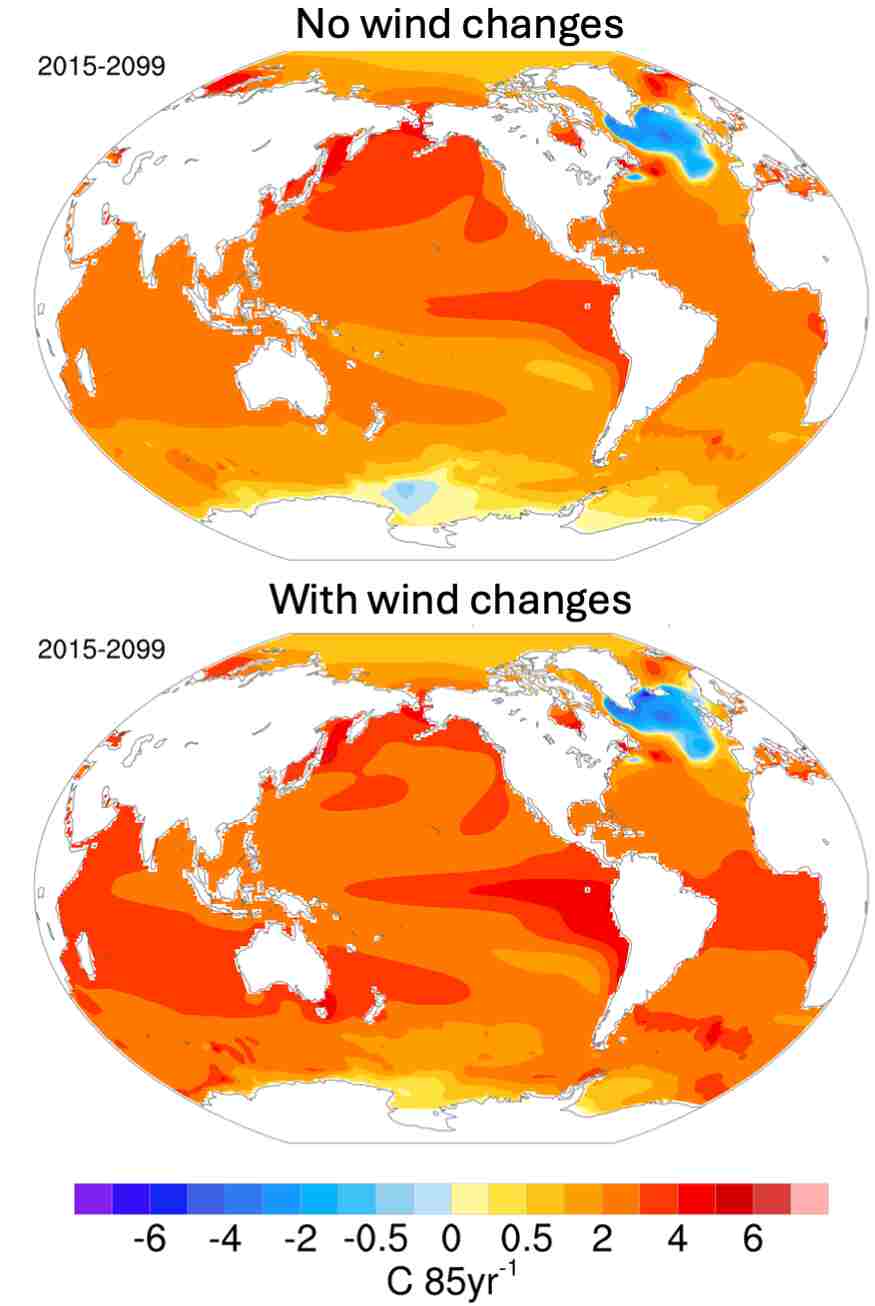
In the vast expanse between Greenland and Ireland lies a curious climatic anomaly: the North Atlantic warming hole. Contrary to its name, this region is experiencing a relative cooling trend amidst global warming. Recent research from the University of Alaska Fairbanks (UAF) explores this phenomenon, utilizing advanced supercomputer models to unravel its mysteries.

Decoding the Cooling

While the planet's oceans are generally warming due to climate change, this particular area in the North Atlantic remains an exception. Scientists have long observed this cooling patch but lacked a comprehensive understanding of its underlying mechanisms. The new study suggests that shifting wind patterns, influenced by climate change, play a pivotal role in this anomaly. Specifically, these winds affect ocean circulation, leading to reduced mixing of warm subsurface waters to the surface, thereby amplifying the cooling effect.

Harnessing Computational Power

To investigate this further, researchers employed sophisticated computer models to simulate two scenarios: one in which changing winds impact ocean circulation and another in which they don't. The models, based on moderate to high greenhouse gas emission projections, indicate that by around 2040, wind-driven changes will begin to enhance cooling in the North Atlantic. This cooling is expected to persist for several decades, potentially influencing precipitation patterns and temperatures across the broader region.

Implications for the Future

Understanding the dynamics of the North Atlantic warming hole is crucial, as it holds significant implications for regional and global climates. Accurate models are essential for predicting future climate scenarios and informing policy decisions. The insights gained from this study underscore the importance of integrating atmospheric and oceanic data to capture the complex interplay of factors driving climate anomalies.

As we continue to refine our models and expand our understanding, the enigmatic cooling of the North Atlantic serves as a reminder of the intricate and interconnected nature of Earth's climate system.


Assistant Professor of Physics and Astronomy Karan Jani. Photos by Joe Howell

AI illuminates the cosmos: Vanderbilt scientists uncover hidden black holes

In a remarkable fusion of astrophysics and artificial intelligence, researchers at Vanderbilt University have unveiled compelling evidence for the existence of intermediate-mass black holes (IMBHs)—the elusive "missing links" in black hole evolution. This breakthrough deepens our understanding of the universe's formative years and showcases the transformative power of AI in deciphering cosmic mysteries.

Bridging the Black Hole Gap

Black holes are typically categorized into two distinct classes: stellar-mass black holes, which are about five to 50 times the mass of our sun, and supermassive black holes, boasting masses millions to billions of times greater. IMBHs, ranging between 100 and 300 solar masses, have long been theorized but remained undetected—until now.

Led by Assistant Professor Karan Jani, the Vanderbilt team reanalyzed data from the Laser Interferometer Gravitational-Wave Observatory (LIGO) in the U.S. and the Virgo detector in Italy. Their findings revealed gravitational waves from black hole mergers within the IMBH mass range, marking the heaviest such events.

AI: The Cosmic Signal Whisperer

Detecting gravitational waves is akin to hearing a whisper amidst a hurricane. To isolate these faint signals from overwhelming noise, the team employed advanced artificial intelligence models. Postdoctoral fellow Chayan Chatterjee spearheaded the development of deep learning algorithms capable of discerning genuine gravitational wave signals from environmental and instrumental noise.

These AI models, part of Vanderbilt's "AI for New Messengers" program, demonstrated exceptional proficiency in reconstructing gravitational wave signals, ensuring the integrity of the data and bolstering confidence in the IMBH detections.

A Glimpse into the Universe's Youth

The discovery of IMBHs offers a unique window into the early universe, potentially shedding light on the formation of the first stars and galaxies. "Black holes are the ultimate cosmic fossils," Jani remarked. "This new population opens an unprecedented window into the very first stars that lit up our universe".

Charting the Future: Space-Based Observatories and Lunar Detectors

Looking ahead, the team is enthusiastic about the prospects of the upcoming Laser Interferometer Space Antenna (LISA) mission, a collaboration between the European Space Agency and NASA, set to launch in the late 2030s. LISA's ability to monitor gravitational waves over extended periods will provide deeper insights into the life cycles of IMBHs.

Moreover, the researchers are exploring the potential of lunar-based detectors. The moon's unique environment could offer access to lower-frequency gravitational waves, unveiling aspects of black hole behavior inaccessible from Earth-based observatories.

Conclusion

This pioneering research exemplifies the synergy between cutting-edge technology and scientific inquiry. By harnessing the capabilities of artificial intelligence, Vanderbilt's team has not only confirmed the existence of intermediate-mass black holes but also opened new avenues for exploring the cosmos. As we stand on the cusp of a new era in astrophysics, the fusion of AI and space science promises to unravel the universe's deepest secrets.

Darkening oceans: New study reveals alarming decline in marine light zones

A groundbreaking study by researchers at the University of Plymouth and Plymouth Marine Laboratory in the UK has used supercomputing to unveil a significant and concerning trend: over the past two decades, more than 21% of the global ocean has experienced a reduction in the depth of its photic zones—the sunlit upper layers crucial for marine life.

Shrinking Sunlit Habitats

The photic zone, where sunlight penetrates the ocean, supports approximately 90% of marine life by enabling photosynthesis in organisms like phytoplankton. These microscopic plants form the base of the aquatic food web and are vital for carbon cycling and oxygen production. The study found that in some regions, the depth of the photic zone has decreased by over 50 meters, with 2.6% of the ocean experiencing reductions exceeding 100 meters.

Causes of Ocean Darkening

The research attributes this darkening to several factors:

- Coastal Runoff: Increased agricultural runoff and rainfall wash nutrients and sediments into the ocean, promoting algal blooms that reduce water clarity.

- Climate Change: Changes in sea surface temperatures and ocean currents affect the distribution and composition of phytoplankton, impacting light penetration.

- Sediment Loading: Increased sediment influx from rivers and coastal erosion contributes to murkier waters.

Implications for Marine Ecosystems

Dr. Thomas Davies, Associate Professor of Marine Conservation at the University of Plymouth, emphasized the ecological implications: "If the photic zone is reduced by around 50 meters in large areas of the ocean, animals that require light will be forced closer to the surface, where they will have to compete for food and other necessary resources. This could bring about fundamental changes in the entire marine ecosystem."

Global Patterns and Regional Variations

While the overall trend indicates a darkening ocean, the study also observed that approximately 10% of the ocean has become lighter over the same period. Notably, areas such as the top of the Gulf Stream and regions around the Arctic and Antarctic—zones experiencing significant climate-induced changes—show prominent reductions in photic zone depth.

Call to Action

These findings underscore the need for increased attention to oceanic changes in climate models and conservation strategies. Protecting the integrity of photic zones is essential not only for marine biodiversity but also for the services oceans provide to humanity, including oxygen production, climate regulation, and food resources.

As the oceans continue to evolve under the pressures of human activity and climate change, understanding and mitigating the impacts of diminishing light zones will be critical for sustaining marine ecosystems and the benefits they offer.