Seeing the unseeable: How AI, Supercomputers provide a clearer view of black holes

The world gasped when the first image of the black hole M87 was released in 2019. The hazy ring with a dark core confirmed what Einstein predicted decades prior: black holes cast "shadows" where no light escapes.
 
However, for scientists at the Perimeter Institute for Theoretical Physics (PI) in Canada, this image was merely the starting point. Now, thanks to supercomputing and the rise of artificial intelligence (AI), researchers are uncovering layers of cosmic fog, enabling them not only to see black holes but also to understand their dynamics with unprecedented precision.

From fuzzy ring to data-rich portraits

The tool doing much of this heavy lifting is a machine-learning model developed by PI researcher Avery Broderick and his team. Their system, called ALINet, can generate billions of candidate images, a thousand times faster than traditional methods, enabling scientists to compare real observational data against thousands of theoretical black hole models in a matter of hours.
 
Traditionally, interpreting data from the Event Horizon Telescope (EHT) meant painstakingly reconstructing images, then matching them by hand to models of how black hole plasma behaves. That process could take weeks, even on powerful hardware. Now, with ALINet, what once took a month can be achieved in a day, using a fraction of the computational cores.

Denoising the cosmos, even through the galactic haze

The challenge isn’t just speed. The center of our own galaxy, home to Sagittarius A*, the supermassive black hole at the Milky Way’s heart, lies behind a dense curtain of interstellar gas, dust and turbulent plasma. That material distorts radio waves, blurring and scattering the signals that astronomers receive.
 
Broderick’s team has now trained neural networks to perform “de-scattering,” essentially deblurring cosmic interference and letting scientists peer through the galactic veil. Early results published in 2025 show this can almost completely reverse the scattering at the EHT’s operational wavelength, offering a much clearer view of Sgr A*.

Supercomputing + AI: a combo that changes the game

This isn’t just about pretty pictures. Supermassive black holes, M87*, Sagittarius A*, and many more, are extreme gravitational laboratories. Understanding their behavior helps physicists probe deep questions: how matter behaves under extreme gravity, how space–time warps, how quantum effects might play out in the most intense conditions in the cosmos.
 
In fields beyond imaging, AI + high-performance computing (HPC) is already making waves. Teams have used distributed AI models running on supercomputers to detect gravitational wave signals from colliding black holes, and do so far faster than older methods. The success of such efforts shows that combining AI with raw compute scale isn’t just clever, it’s essential for the next frontier of astrophysics.

Why this matters, and why now

With tools like ALINet, astronomers can now treat black hole observations as data-rich investigations rather than fuzzy guesses. Instead of asking "Does this look like a ring?", scientists can now ask, "What spin, mass, and plasma configuration best matches the data?" They can also get answers rapidly, enabling more frequent updates as new observations come in.
 
For humanity, this means black holes, once relegated to science fiction and unreachable math, are becoming real, measurable entities. AI and supercomputers are turning the unknown into the known.
 
As Broderick puts it, this is "enabling technology," transforming a month-long computational slog into a swift, repeatable analysis. The cosmos just got sharper.

Big numbers, big bets: Dell scales up HPC for the AI era

Dell Technologies (Dell) posted strong third-quarter results for fiscal 2026, with $27.0 billion in revenue, up 11% year-over-year, and diluted EPS of $2.28. Its Infrastructure Solutions Group (servers and networking) was the standout, delivering $10.1 billion in revenue, up 37% YoY, with overall ISG revenue hitting $14.1 billion, up 24%.
 
Dell says this growth stems from surging demand for AI servers, with $12.3 billion in new AI-server orders during the quarter alone, and a year-to-date pipeline of about $30 billion, mixed across enterprise, sovereign-cloud, and large-scale "neocloud" customers.
 
In plain terms: Dell is investing heavily in high-performance computing infrastructure. This includes building large HPC clusters, deploying custom AI servers, and providing flexible scaling options for global enterprises and sovereign cloud buyers. Their ability to provide complete HPC solutions, including compute, networking, support, and storage, makes them a key partner for organizations needing powerful, scalable computing resources, from research institutions to cloud providers.

The GPU King: Nvidia’s Q3 Rocket Fuel for HPC Infrastructure

NVIDIA delivered blow-out third-quarter results: $57.0 billion in revenue, a 62% increase over last year. Data center revenue alone hit a record $51.2 billion, up 66% YoY.
 
Nvidia executives highlighted that demand for its latest GPU architecture, NVIDIA Blackwell, remains red-hot and that cloud GPUs are “sold out.” The firm sees this demand driven by exploding workloads in training and inference for generative AI, large-language models, HPC, and emerging “agentic” AI. 
 
On margins and profitability, Nvidia remains a beast, non-GAAP gross margin of around 73.6%, operating income and EPS both rising sharply.
 
Bottom line: Nvidia is arguably the single most influential driver of high-performance AI and HPC compute capacity today. Its GPUs, systems, and software stack (e.g., CUDA) have become the backbone for data centers, research labs, and cloud providers racing to build next-gen AI infrastructure.

Dell vs. Nvidia: Two Sides of the HPC Coin

Business Model
Selling servers, networking gear, storage, services, full-stack HPC and AI infrastructure.
Selling GPU accelerators (and full systems) the compute “engines” behind AI/HPC workloads.
Q3 FY26 Results (scale) Revenue: $27B; Servers & Networking revenue up 37% YoY; strong cash-flow, $30B+ pipeline in AI server orders. Revenue: $57B; Data-center revenue: $51.2B; GPU demand “off the charts”, high margins.
Value Prop in HPC
Custom, turnkey computing + networking + support, ideal for enterprises, sovereign clouds, large HPC deployments.
Massive compute density and efficiency, enabling cutting-edge AI training/inference and HPC workloads; the horsepower behind workloads.
Strategic Strength
Engineering and integration, combining compute + infrastructure + global support + customization.
Tech leadership, GPU performance, software ecosystem, scale, and brand dominance in AI/HPC.
Best Fit Use Cases Organizations that want turnkey HPC clusters, enterprise AI deployments, or regulated/sovereign environments. Entities needing raw GPU compute for AI training, large-scale inference, simulation, scientific computing where maximum performance matters.
 
In other words: Dell builds the highway; Nvidia builds the engines that run fastest on it.

Why This Matters and What’s Next

With both firms posting record results, the HPC and AI-infrastructure space is clearly firing on all cylinders. For enterprises and institutions in any region, this means two things:
  • Access to enterprise-grade HPC infrastructure is becoming easier and more affordable. Institutions needing heavy compute (data analysis, big data, simulation, AI modeling) can now tap into turnkey server/GPU clusters from Dell, powered by Nvidia GPUs.
  • AI and HPC scale are accelerating. Given Nvidia’s GPU dominance and Dell’s global delivery + support capabilities, the barrier to entry for building powerful AI-powered compute environments is dropping. We might soon see more data-heavy, compute-intensive startups or public-sector deployments outside traditional tech hubs.
Looking ahead, if current order backlogs, demand for AI servers, and GPU supply hold, we could be on the brink of a new wave of HPC deployments across research, modeling, enterprise AI, climate modeling, healthcare genomics, and other data-heavy fields.
 
This quarter's numbers from Dell and Nvidia aren't just financial wins; they signal that high-performance computing is shifting from niche to mainstream. As someone involved in software, and big data, this is a signal worth paying attention to.

SC25 pushes network frontiers as Pegatron unveils modular server ambitions

In STL, the high-performance computing world thrives on pushing limits, and this year’s SC25 conference delivered another leap forward, both on the show floor and across the wires of the legendary SCinet network.
 
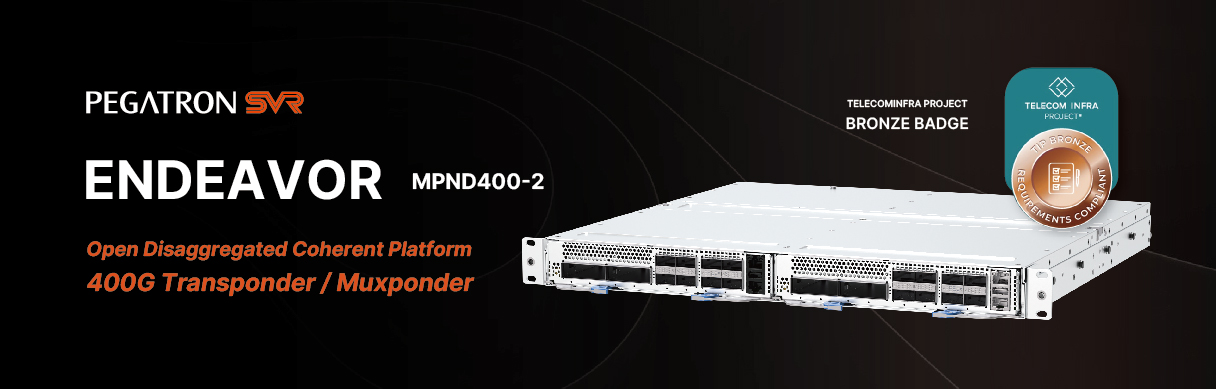
Pegatron, a global leader in electronics manufacturing, showcased its next-generation server roadmap, emphasizing the company’s vision for modular, power-efficient systems engineered for the AI-accelerated era. Today’s press release has highlighted a strategic expansion into advanced rack-scale design, with an emphasis on flexibility, field-replaceable modules, and full-stack energy optimization. But even that technical momentum was matched, if not eclipsed, by the sheer scale of the network beneath attendees’ feet.

SCinet Hits a New Threshold: 13.72 TB/s

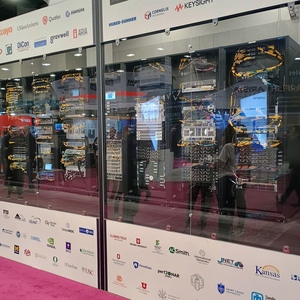
SCinet, the volunteer-built engineering marvel that powers every Supercomputing conference, announced its highest throughput ever recorded: 13.72 terabytes per second (TB/s) for SC25.
 
To put this into perspective, SCinet’s wide-area network (WAN) backbone has grown at a pace few global networks can match:
  • SC25 (St. Louis): 13.72 TB/s
  • SC24 (Atlanta): 8.71 Tbps
  • SC23 (Denver): 6.71 Tbps
  • SC22: 5.01 Tbps
  • SC19: 4.22 Tbps
Every year, SCinet is torn down and rebuilt by an army of volunteers of engineers, network architects, and researchers from around the world, who converge to create the fastest temporary network on Earth. Its sole mission: enable the bleeding-edge demos that define the HPC community.
 
As datasets balloon and GPU clusters grow hungrier by the day, SCinet’s growth isn’t a luxury; it’s a necessity.

Pegatron’s Modular Pivot: A Server for the AI Era

In its SC25 release, Pegatron detailed its next-gen server platform built around modularity, thermal efficiency, and rapid deployment, all themes dominating this year’s conference.
 
Key takeaways from Pegatron’s announcement include:
• Modular AI-ready infrastructure
Pegatron outlined blade-style compute modules designed to scale from traditional HPC to dense GPU and accelerator configurations.
• Energy-optimized design
The company emphasized new power-distribution and cooling architectures intended to support the surge of high-wattage AI accelerators without sacrificing stability or serviceability.
• Manufacturing muscle
 
Leveraging Pegatron’s global supply chain, the company aims to support hyperscalers, enterprise AI builders, and research labs that need rapid, consistent deployment cycles as models grow more compute-intensive.
 
Pegatron’s SC25 presence signals its intent to be more than an OEM; it wants to shape the future of rack-scale AI infrastructure.

Why the Two Stories Intersect

SCinet’s explosive bandwidth growth and Pegatron’s hardware ambitions aren’t isolated trends, they’re parallel responses to the same fundamental shift: AI workloads are becoming the dominant driver of HPC system design.
 
Training runs now require:
  • Uncompressed terabyte-scale dataset transfers
  • Multi-site distributed training
  • Real-time visualization pipelines
  • Exascale-class telemetry
At SC25, the relationship between compute, cooling, networking, and manufacturing has never been more visible. Pegatron’s modular hardware approach pairs naturally with a world where SCinet-class networks will soon be the norm, not the exception.

A Future Built on Collaboration and Momentum

SCinet’s volunteers, the invisible heroes of the SC conference, have once again demonstrated what’s possible when the global HPC community collaborates without restraint.
 
Pegatron’s announcement adds another layer of optimism: that the companies powering AI and HPC infrastructure are evolving just as quickly as the workloads they support.
 
SC25 feels like a hinge moment. Faster networks. Smarter servers. Greener cooling systems. More modular racks. And an industry that’s learning to innovate at the pace of AI itself.
 
The bar has officially been raised. And judging by the energy on the SC25 floor, the community seems ready to clear it again next year.