MMS data reveal a mechanism for accelerating heavy ions in galactic cosmic rays

Scientists have used data from the Southwest Research Institute-led Magnetospheric Multiscale (MMS) mission to explain the presence of energetic heavy elements in galactic cosmic rays (GCRs). GCRs are composed of fast-moving energetic particles, mostly hydrogen ions called protons, the lightest and most abundant elements in the universe. Scientists have long debated how trace amounts of heavy ions in GCRs are accelerated.

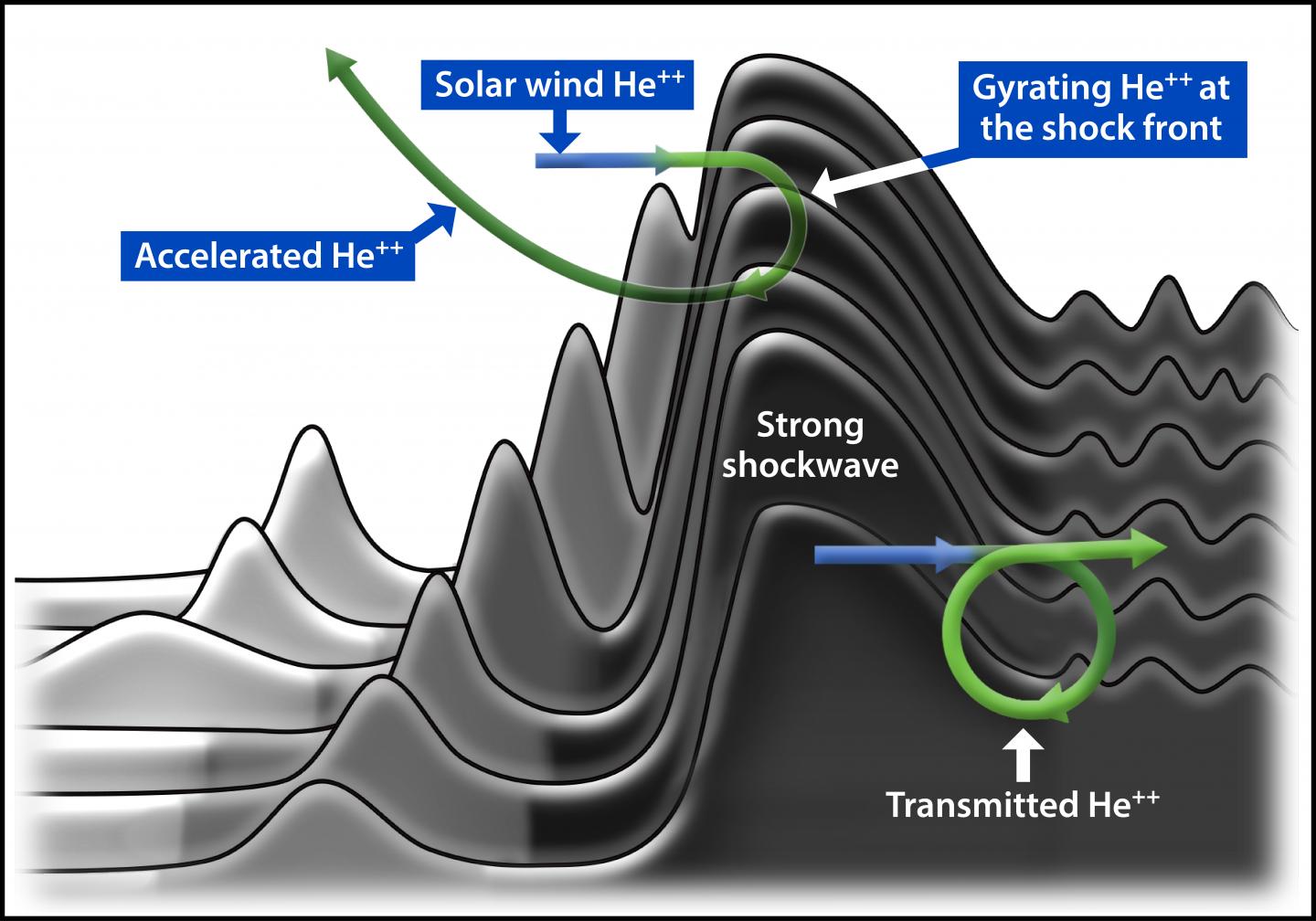
The supernova explosion of a dying star creates massive shockwaves that propagate through the surrounding space, accelerating ions in their path to very high energies, creating GCRs. How heavy ions are energized and accelerated is important because they affect the redistribution of mass throughout the universe and are essential for the formation of even heavier and more chemically complex elements. They also influence how we perceive astrophysical structures. Scientists at SwRI developed this conceptual image of heavy ion dynamics based on MMS observations. The colored trajectory lines illustrate how alpha particles (He++) behave as they encounter an extreme shock. Strong magnetic fields effectively change their trajectory, placing them in the acceleration zones. This process explains how trace heavy elements could be accelerated into galactic cosmic rays by supernova events.
"Heavy ions are thought to be insensitive to an incoming shockwave because they are less abundant, and the shock energy is overwhelmingly consumed by the preponderance of protons. Visualize standing on a beach as waves move the sand under your feet, while you remain in place," said SwRI's Dr. Hadi Madanian, the lead author of the paper about this research published in Astrophysical Journal Letters. "However, that classical view of how heavy ions behave under shock conditions is not always what we have seen in high-resolution MMS observations of the near-Earth space environment."

Shock phenomena also occur in the near-Earth environment. The Sun's magnetic field is carried through interplanetary space by the supersonic solar wind flow, which is obstructed and diverted by the Earth's magnetosphere, a bubble of protection around our home planet. This interaction region is called the bow shock due to its curved shape, comparable to the bow waves that occur as a boat travels through water. The Earth's bow shock forms at a much smaller scale than supernova shocks. However, at times, conditions of this small shock resemble those of supernova remnants. The team used high-resolution in-situ measurements from the MMS spacecraft at the bow shock to study how heavy ions are accelerated.

"We observed intense amplification of the magnetic field near the bow shock, a known property associated with strong shocks such as supernova remnants. We then analyzed how different ion species behaved as they encountered the bow shock," Madanian said. "We found that these enhanced fields significantly modify the trajectory of heavy ions, redirecting them into the acceleration zone of the shock."

While this behavior was not expected to occur for heavy ions, the team identified direct evidence for this process in alpha particles, helium ions that are four times more massive than protons and have twice the charge.

"The superb resolution of MMS observations has given us a much clearer picture of how a shockwave energizes the heavy elements. We will be able to use this new understanding to improve our computer models of cosmic ray acceleration at astrophysical shocks," said David Burgess, a professor of mathematics and astronomy at the Queen Mary University of London and a co-author of the paper. "The new findings have significant implications for the composition of cosmic rays and the observed radiation spectra from astrophysical structures."
University of Barcelona's Mark Gieles discovers a supersized black hole population in the star cluster Palomar 5

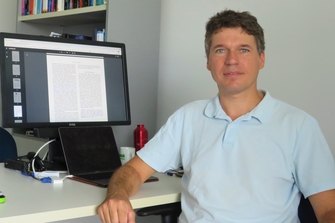
Palomar 5 is a unique star cluster. First of all, it is one of the “fluffiest” clusters in the halo of our Galaxy, with the average distance between the stars being a few light-years, comparable to the distance from the Sun to the nearest star. Secondly, it has a specular stellar stream associated with it that spans more than 20 degrees across the sky. In a study, an international team of astronomers and astrophysicists led by the University of Barcelona show that both distinguishing features of Palomar 5 are likely the result of massive black hole populations of more than 100 black holes in the center of the cluster. ICCUB researcher Mark Gieles. Image: ICCUB

“The number of black holes is roughly three times larger than expected from the number of stars in the cluster, and it means that more than 20% of the total cluster mass is made of black holes. They each have a mass of about 20 times the mass of the Sun, and they formed in supernova explosions at the end of the lives of massive stars when the cluster was still very young” says Prof Mark Gieles, from the Institute of Cosmos Sciences of the University of Barcelona (ICCUB) and lead author of the study.

Tidal streams are streams of stars that were ejected from disrupting star clusters or dwarf galaxies. In the last few years, nearly thirty thin streams have been discovered in the Milky Way halo. "We do not know how these streams form, but one idea is that they are disrupted star clusters. However, none of the recently discovered streams have a star cluster associated with them, hence we can not be sure. So, to understand how these streams formed, we need to study one with a stellar system associated with it. Palomar 5 is the only case, making it a Rosetta Stone for understanding stream formation and that is why we studied it in detail" explains Gieles.

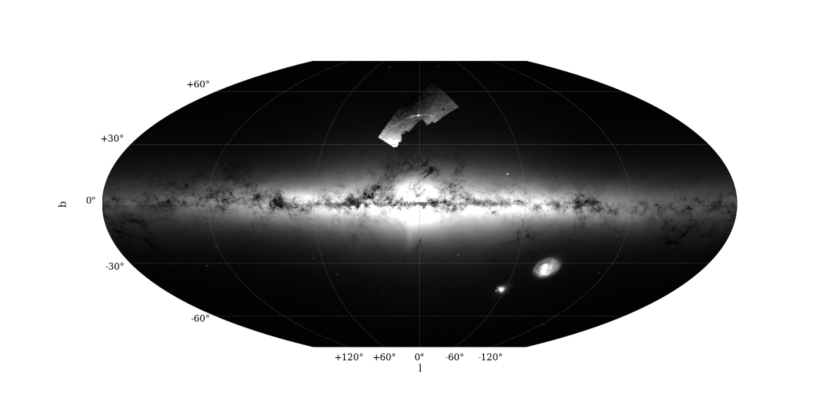
The researchers use supercomputers to simulate the orbits and the evolution of each star from the formation of the cluster until the final dissolution. They varied the initial properties of the cluster until a good match with observations of the stream and the cluster was found. The team finds that Palomar 5 formed with a lower black hole fraction, but stars escaped more efficiently than black holes, such that the black hole fraction gradually increased. The black holes dynamically puffed up the cluster in gravitational slingshot interactions with stars, which led to even more escaping stars and the formation of the stream. Just before it completely dissolves - roughly a billion years from now - the cluster will consist entirely of black holes. Above is a all sky view in galactic coordinates. The number of stars is higher in brighter regions. Most of the image, where the Milky Way plane is visible (b = 0 degrees), is produced using Gaia eDR3 data. The small patch in the top-centre shows a region where deeper DESI Legacy Imaging Survey (DECaLS) data is available, which allows for Palomar 5 and its tidal tails to be seen. Image: M. Gieles et al./Gaia eDR3/DESI DECaLS

Gieles points out that "we have shown that the presence of a large black hole population may have been common in all the clusters that formed the streams." This is important for our understanding of globular cluster formation, the initial masses of stars, and the evolution of massive stars.

This work also has important implications for gravitational waves.

Palomar 5 is a globular cluster discovered in 1950 by Walter Baade. It is in the Serpens constellation at a distance of about 65,000 light-years, and it is one of the roughly 150 globular clusters that orbit around the Milky Way. It is older than 10 billion years, like most other globular clusters, it formed in the earliest phases of galaxy formation. It is about 10 times less massive and 5 times more extended than a typical globular cluster and in the final stages of dissolution.

NASA, NOAA, FEMA help communities weather another year of tropical storms, hurricanes

The center of Hurricane Elsa has formed to the east of the Windward and the southern Leeward Islands and is expected to bring heavy rainfall to those areas over the weekend, according to an update today from the National Hurricane Center.

The storm is moving toward the west-northwest at almost 30 miles an hour, and its forecast track could bring it to the Florida Keys early next week.

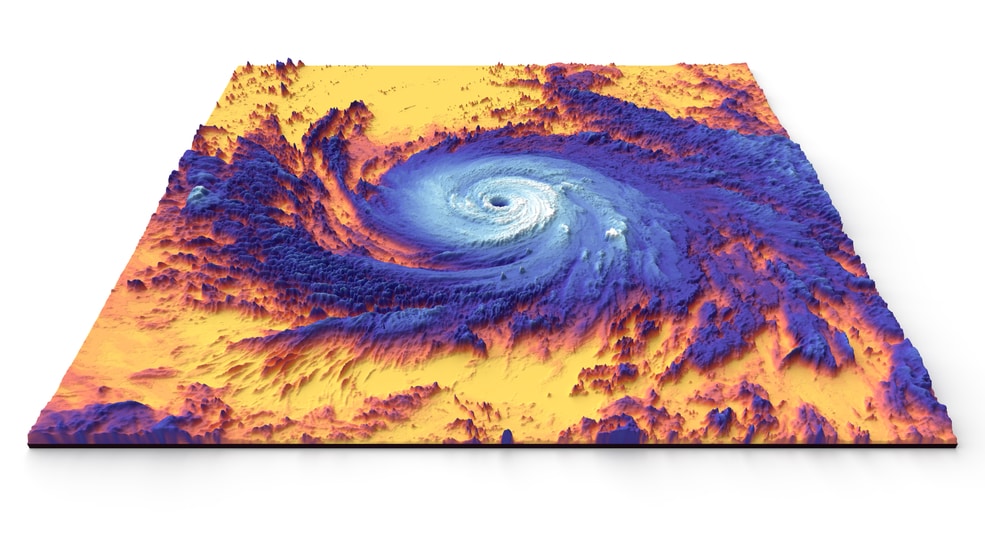
June 1 marked the official start of the Atlantic hurricane season, which officially ends Nov. 30. After 2020 brought a record number of named storms in the Atlantic basin, NASA is prepared to help understand and monitor these storms from the unique vantage of space with experts available to provide insights on hurricanes and other extreme weather events. NASA’s new Earth System Observatory will guide efforts related to climate change, disaster mitigation, fighting forest fires, and improving real-time agricultural processes – including helping to better understand Category 4 to 5 hurricanes such as Hurricane Maria, shown here in a 2017 thermal image captured by NASA’s Terra satellite. Credits: NASA

Using data from its 20-plus Earth-observing satellites, NASA plays a foundational role in the science of hurricanes. For operational forecasting, it has partnered with the National Oceanic and Atmospheric Administration (NOAA). NOAA is predicting another active season, with an above-average number of named storms. NASA is developing new technology and missions to study storm formation and impacts, including more ways to understand Earth as a system.

In 2020, a record-tying nine storms rapidly intensified. These quick changes in storm strength can leave communities in their path without time to properly prepare.

NASA builds and launches NOAA's satellites that provide the data feed into supercomputers that produce weather prediction models. Scientists from NASA and NOAA also collaborate to improve these models continuously. Researchers at NASA JPL have developed a machine learning model that could more accurately detect rapidly intensifying storms.

Climate change is increasing the heat in the ocean basins and making it more likely that storms will intensify faster and become stronger, a phenomenon NASA scientists continue to study.

"As climate change intensifies and makes natural hazards like hurricanes more damaging, NASA is more committed than ever to innovative Earth science research," said NASA Administrator Bill Nelson. "Our next-generation Earth System Observatory will build on NASA's existing capabilities to provide an unprecedented understanding of the Earth from bedrock to the atmosphere, so we are better prepared to protect our communities from hurricanes and other extreme weather events."

NASA's goal for disaster preparedness, response, mitigation, and recovery is bridging the gap between data and the people who need it. Before, during, and after a hurricane or tropical storm makes landfall, NASA satellites are in a prime position to identify impacts.

NASA works with local officials and first responders, federal agencies such as FEMA and the U.S. Army Corps of Engineers, and infrastructure experts to determine what information they need and to supply it in usable formats in real-time. Examples include information on infrastructure failures and disruptions, contaminated water supplies, and other hotspots for urgent response needs.