SUPERCOMPUTING NEWS SUPERCOMPUTING NEWS
    • MEDIA KIT
    • MOST READ
    • RSS FEED
    • ACADEMIA
    • AEROSPACE
    • APPLICATIONS
    • ASTRONOMY
    • AUTOMOTIVE
    • BIG DATA
    • BIOLOGY
    • CHEMISTRY
    • CLIENTS
    • CLOUD
    • DEFENSE
    • DEVELOPER TOOLS
    • EARTH SCIENCES
    • ECONOMICS
    • ENGINEERING
    • ENTERTAINMENT
    • GAMING
    • GOVERNMENT
    • HEALTH
    • OIL & GAS
    • INDUSTRY
    • INTERCONNECTS
    • MANUFACTURING
    • MIDDLEWARE
    • MOVIES
    • NETWORKS
    • PHYSICS
    • PROCESSORS
    • RETAIL
    • SCIENCE
    • STORAGE
    • SYSTEMS
    • VISUALIZATION
    • AcyMailing subscription form

    • ADD YOUR VIDEOS
    • MANAGE VIDEOS
    • CONVERSATION INBOX
    • SOCIAL ADVERTISER
    • SOCIAL NETWORK VIDEOS
    • SURVEYS
    • GROUPS
    • PAGES
    • MARKETPLACE LISTINGS
    • APPLICATIONS BROWSER
    • PRIVACY CONFIRM REQUEST
    • PRIVACY CREATE REQUEST
    • LEADERBOARD
    • POINTS LISTING
      • BADGES
    • TRADE SHOWS
Sign In
Tyler O'Neal, Staff Editor CHEMISTRY October 13, 2022, 5:00 am

Massive stars sound warning they are about to go supernova

An artist's impression of Betelgeuse's supernova. Credit European Southern Observatory/L. CalçadaAstronomers from Liverpool John Moores University and the University of Montpellier have devised an early warning system to sound the alert when a massive star is about to end its life in a supernova explosion. 

In this new study, researchers determined that massive stars (typically between 8 and 20 solar masses) in the last phase of their lives, the so-called ‘red supergiant’ phase, will suddenly become around a hundred times fainter in visible light in the last few months before they die. This dimming is caused by a sudden accumulation of material around the star, which obscures its light.

Until now, it was unknown how long it took the star to accrete this material. Now, for the first time, researchers have simulated how red supergiants might look when they are embedded within these pre-explosion cocoons. 

Old telescope archives show that images do exist of stars that went on to explode around a year after the image was taken. The stars appear normal in these images, meaning they cannot yet have built up the theoretical circumstellar cocoon. This suggests that the cocoon is assembled in less than a year, which is considered to be extremely fast.

Benjamin Davies from Liverpool John Moores University said: “The dense material almost completely obscures the star, making it 100 times fainter in the visible part of the spectrum. This means that the day before the star explodes, you likely wouldn't be able to see it was there. Until now, we’ve only been able to get detailed observations of supernovae hours after they’ve already happened. With this early-warning system, we can get ready to observe them in real-time, point the world’s best telescopes at the precursor stars, and watch them getting ripped apart in front of our eyes.”

Penn uses computational chemistry to show how sulfur clouds can form in Venus' atmosphere

Tyler O'Neal, Staff Editor CHEMISTRY August 11, 2022, 5:04 am

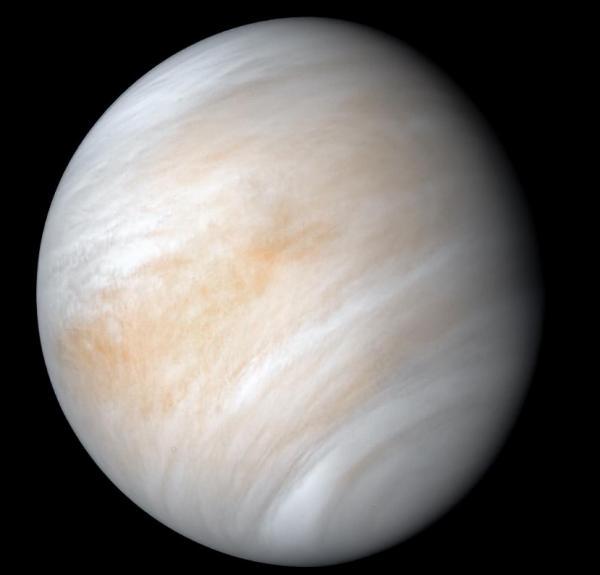
Scientists using sophisticated computational chemistry techniques have identified a new pathway for how sulfur particles can form in the atmosphere of Venus. These results may help to understand the long sought-after identity of the mysterious ultraviolet absorber on Venus. A reprocessed image of archived Mariner 10 data collected in 1974. This is a false color image created using orange and ultraviolet filters for the red and blue channels, respectively. The clouds are at about 60 kilometers altitude, and the image illustrates the presence of an unknown ultraviolet absorber in the atmosphere, a long unsolved mystery of Venus.

“We know that the atmosphere of Venus has abundant SO2 and sulfuric acid particles. We expect that ultraviolet destruction of SO2 produces sulfur particles. They are built up from atomic S (sulfur) to S2, then S4, and finally S8. But how is this process initiated, that is, how does S2 form?” said Planetary Science Institute Senior Scientist James Lyons. 

One possibility is to form S2 from two sulfur atoms, that is, a reaction of S and S. Molecules of S2 and S2 can then combine to form S4, and so on. Sulfur particles can form either by condensation of S8 or by condensation of S2, S4, and other allotropes – different physical forms in which an element can exist – which then rearrange to form condensed S8. 

“Sulfur particles, and the yellow sulfur we more commonly encounter, is made up of mostly S8, which has a ring structure. The ring structure makes S8 more stable against destruction by UV light than the other allotropes. To form S8, we can either start with two S atoms and make S2, or we can produce S2 by another pathway, which is what we’ve done in the paper,” said Lyons. 

“We found a new pathway for S2 formation, the reaction of sulfur monoxide (SO) and disulfur monoxide (S2O), which is much faster than combining two S atoms to make S2,” Lyons said. 

“For the first time, we are using computational chemistry techniques to determine which reactions are most important, rather than waiting for laboratory measurements to be done or using highly inaccurate estimates of the rate of unstudied reactions. This is a new and very much needed approach for studying the atmosphere of Venus,” Lyons said. “People are reluctant to go in the lab to measure rate constants for molecules made up of S, chlorine (Cl), and oxygen (O) – these are difficult and sometimes dangerous compounds to work with. Computational methods are the best – and only – alternative. 

Computational methods were used to supercompute the rate constants and to determine the expected reaction products. These are state-of-the-art computational models (what we call ab initio models). These ab initio calculations were done by the authors from Spain and the University of Pennsylvania. 

“This research illustrates another pathway to S2 and sulfur particle formation. Sulfur chemistry is dominant in Venus' atmosphere, and very likely plays a key role in the formation of the enigmatic UV absorber. More generally, this work opens the doors to using molecular ab initio techniques to disentangle the complex chemistry of Venus,” Lyons said. 

Antonio Francés-Monerris of Departament de Química Física, Universitat de València, Spain is lead author on the paper. Coauthors include Javier Carmona-García and Daniel Roca-Sanjuán also of the Universitat de València, Alfonso Saiz-Lopez of the Institute of Physical Chemistry Rocasolano in Madrid, and Tarek Trabelsi and Joseph S. Francisco of the University of Pennsylvania.


Rice combines MD simulations, stochastic models to sharpen genetic base editors

Tyler O'Neal, Staff Editor CHEMISTRY November 11, 2021, 10:00 am

The approach improves avoidance of ‘bystander’ edits in CRISPR-base editor treatments

Want to keep the riffraff out of the gene pool party? Sneak in and slam the gate before they arrive. 

That’s the central idea of a new strategy by Rice University scientists who seek to avoid gene-editing errors by fine-tuning specific CRISPR-base editing strategies in advance.

Rice chemical and biomolecular engineer Xue Sherry Gao and chemist Anatoly Kolomeisky and their labs' combined theory and experimentation for a comprehensive approach to building better base editors, molecular machines that target and fix faulty DNA at single-base resolution. A new strategy by Rice University scientists seeks to avoid gene-editing errors by fine-tuning specific CRISPR-base editing strategies in advance. Their theoretical framework is intended to eliminate trial and error in the design of a library of editors.  CREDIT Qian Wang/Rice University
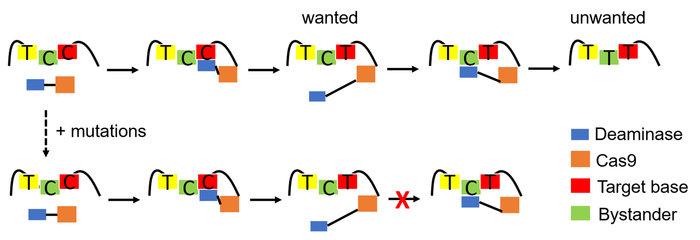
The study describes the molecular processes that base editors use to manipulate strands of DNA, cutting them where necessary and making way for replacement code. When it works, as it increasingly does to treat genetic diseases like sickle cell anemia and some cancers, the editor only edits the intended nucleotide. 

And when it doesn’t, that’s because bystander edits can cause undesired effects. 

The Rice strategy primarily seeks to eliminate wayward edits to bystanders, nucleotides adjacent to the base editor’s target. Gao’s lab previously introduced tools to improve the accuracy of CRISPR-based edits of cytosine mutations up to 6,000-fold.

For the new project, she engaged the Kolomeisky lab to help create a theoretical framework to eliminate trial and error in the design of a library of editors. These would better target mutations that cause disease while avoiding bystanders. In the process, the framework could help scientists better understand the chemical and physical processes that take place during base editing.

“Sherry and other experimental scientists already had results that worked,” Kolomeisky said, referring to the earlier paper, in which the lab used its editor to convert cytosines to thymines, correcting the DNA mutations while avoiding otherwise vulnerable cytosines upstream. “But despite these amazing developments, there’s been no microscopic understanding of what we have to do with these protein systems to improve editing.”

He said Qian Wang, a former postdoctoral researcher in Kolomeisky’s lab and now an assistant professor at the University of Science and Technology of China (USTC), Hefei, took on the challenge, using Gao’s cytosine experiment as a baseline. 

“We applied the model for that result and got some important parameters we then used to design what mutations and where are needed to get precise editing,” Kolomeisky said. “Ultimately, this symbiosis of theory and experiment allows us to work in a smart way.”

Their strategy combines molecular dynamics simulations and stochastic (aka random) models that pinpoint the binding energies between molecules required to achieve maximum editing selectivity. Experiments in Gao’s lab validated the results. 

Critically, the framework includes a way to characterize the binding affinity between deaminases -- enzymes that catalyze the removal of an amino group from a molecule -- and single-stranded DNA (ssDNA).

Ideally, they said, the deaminase stays on the ssDNA just long enough to complete the primary edit and releases before inadvertently editing a bystander site. 

“The important thing here is that one mutation doesn't work for different systems,” Kolomeisky said. “So, for every system, you have to do this procedure again, but at least it's clear what should be done.”

“The model has been very successful in reflecting what has already been done experimentally,” Gao said. “But since then, we’ve been able to turn down bystander effects in other base-editing systems. 

“Because the number of mutants could be in the thousands, it’s unrealistic for experimentalists alone to verify individual base editors,” she said. “Only this multidisciplinary approach will allow us to build a huge library of editors computationally, then narrow the numbers down to the most promising candidates for further experimental verifications. That’s what we’re working toward.”


  1. UAF space physicists upend understanding of upper atmospheric wind
  2. OSU modeling takes a step toward low-temperature preservation of 3D tissues, organs

Page 6 of 18

  • 1
  • 2
  • 3
  • 4
  • 5
  • 6
  • 7
  • 8
  • 9
  • 10
POPULAR RIGHT NOW
  • Meta’s next frontier may not be social media; it may be supercomputing
    Meta’s next frontier may not be social media; it may be supercomputing
  • The future of cancer research runs on supercomputers
    Jill Mesirov, PhD
    Jill Mesirov, PhD
  • Rebuilding a lost continent: Supercomputers reveal Antarctica before the ice
    Antarctic ice meets the rocky coastline. Researchers traced landscape features from the two-kilometre-high coastal escarpment of Dronning Maud Land to the subglacial Gamburtsev Mountains, buried beneath 1–3 km of ice  Credit Matt Palmer
    Antarctic ice meets the rocky coastline. Researchers traced landscape features from the two-kilometre-high coastal escarpment of Dronning Maud Land to the subglacial Gamburtsev Mountains, buried beneath 1–3 km of ice Credit Matt Palmer
  • Supercomputers uncover a new class of cosmic explosions hidden in plain sight
    Supercomputers uncover a new class of cosmic explosions hidden in plain sight
  • AI supercharges the hunt for stronger magnets: Iowa State researchers launch a new era of intelligent materials discovery
    AI supercharges the hunt for stronger magnets: Iowa State researchers launch a new era of intelligent materials discovery
  • IBM's Historic stock collapse raises questions for the future of enterprise supercomputing
    IBM's Historic stock collapse raises questions for the future of enterprise supercomputing
  • Could a novel dark matter theory simultaneously resolve multiple cosmic enigmas? Supercomputer simulations provide a compelling, albeit currently unverified, potential solution
    Could a novel dark matter theory simultaneously resolve multiple cosmic enigmas? Supercomputer simulations provide a compelling, albeit currently unverified, potential solution
  • Melting icebergs may be reshaping Earth’s greatest ocean current
    Melting icebergs may be reshaping Earth’s greatest ocean current
  • Supercomputers replace ‘bathtub’ flood maps with physics-based digital twins of Britain’s coastline
    Supercomputers replace ‘bathtub’ flood maps with physics-based digital twins of Britain’s coastline
  • Supercomputers push neural quantum simulation beyond previous limits
    Supercomputers push neural quantum simulation beyond previous limits
MOST READ THIS YEAR
  • Cosmic ambition at scale: UK’s supercomputer unlocks a 2.5 petabytes universe
    Cosmic ambition at scale: UK’s supercomputer unlocks a 2.5 petabytes universe
  • Hidden order, revealed at scale: Supercomputing, electron ptychography uncover the inner workings of relaxor ferroelectrics
    Hidden order, revealed at scale: Supercomputing, electron ptychography uncover the inner workings of relaxor ferroelectrics
  • Intel's Q1 results signal supercomputing surge driving Xeon momentum
    Intel's Q1 results signal supercomputing surge driving Xeon momentum
  • FRONTPAGE
  • LATEST
  • POPULAR
  • REGISTER
  • SOCIAL
  • VIDEO
  • SUBSCRIPTION
  • RSS
  • GUIDELINES
  • PRIVACY
  • TOS
  • ABOUT
  • +1 (816) 799-4488
  • editorial@supercomputingonline.com
© 2001 - 2026 SuperComputingOnline.com, LLC. All rights reserved. This material may not be published, broadcast, rewritten or redistributed without permission.
Sign In
  • FRONT PAGE
  • LATEST
    • MEDIA KIT
    • MOST READ
    • RSS FEED
    • ACADEMIA
    • AEROSPACE
    • APPLICATIONS
    • ASTRONOMY
    • AUTOMOTIVE
    • BIG DATA
    • BIOLOGY
    • CHEMISTRY
    • CLIENTS
    • CLOUD
    • DEFENSE
    • DEVELOPER TOOLS
    • EARTH SCIENCES
    • ECONOMICS
    • ENGINEERING
    • ENTERTAINMENT
    • HEALTH
    • INDUSTRY
    • INTERCONNECTS
    • GAMING
    • GOVERNMENT
    • MANUFACTURING
    • MIDDLEWARE
    • MOVIES
    • NETWORKS
    • OIL & GAS
    • PHYSICS
    • PROCESSORS
    • RETAIL
    • SCIENCE
    • STORAGE
    • SYSTEMS
    • VISUALIZATION
  • VIDEOS
    • ADD YOUR VIDEOS
    • MANAGE VIDEOS
  • COMMUNITY
    • TRADE SHOWS
    • SOCIAL NETWORK VIDEOS
    • SURVEYS
    • APPLICATIONS BROWSER
    • CONVERSATION INBOX
    • SOCIAL ADVERTISER
    • GROUPS
    • MARKETPLACE LISTINGS
    • PAGES
    • LEADERBOARD
    • POINTS LISTING
      • BADGES
    • PRIVACY CONFIRM REQUEST
    • PRIVACY CREATE REQUEST

Hey there! We noticed you’re using an ad blocker.