Goethe University physicists develop model of a relativistic jet emitted by a supermassive black hole

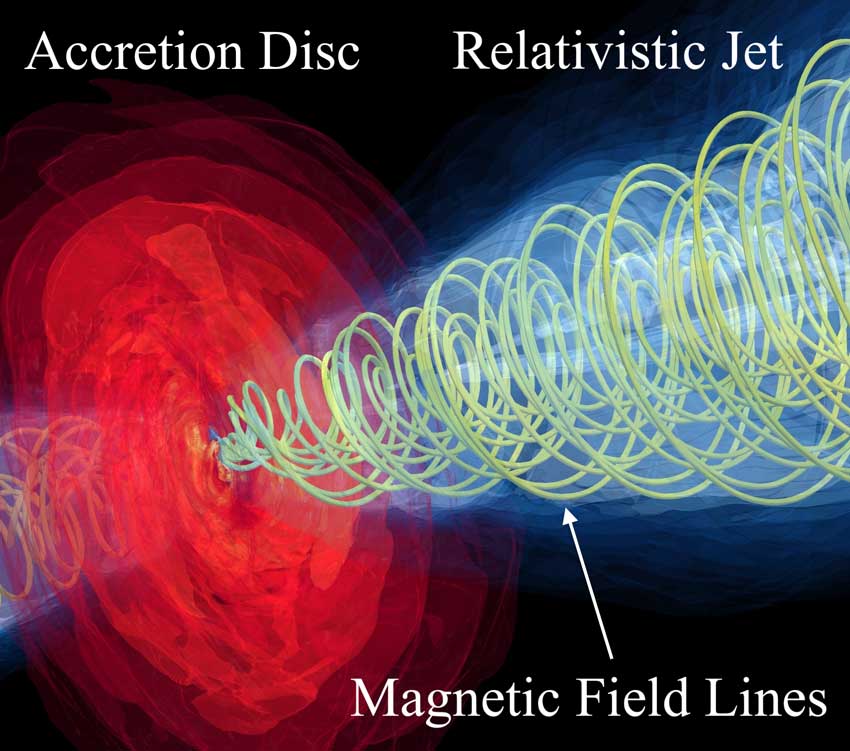
An enormous jet of particles emitted by the giant galaxy M87 can be observed astronomically in various wavelengths. Dr. Alejandro Cruz Osorio and Professor Luciano Rezzolla from Goethe University Frankfurt together with an international team of scientists have succeeded in developing a theoretical model of the morphology of this jet using complex supercomputer calculations. The images from these calculations provide an unprecedented match with astronomical observations and confirm Einstein’s theory of general relativity. Along the magnetic field lines, the particles are accelerated so efficiently that they form a jet out to scales of 6000 light years in the case of M87. Credit: Alejandro Cruz-Osorio

The galaxy Messier 87 (M87) is located 55 million light-years away from Earth in the Virgo constellation. It is a giant galaxy with 12,000 globular clusters, making the Milky Way’s 200 globular clusters appear modest in comparison. A black hole of six and a half billion sun masses is harbored at the center of M87. It is the first black hole for which an image exists, created in 2019 by the international research collaboration Event Horizon Telescope.

This black hole (M87) shoots a jet of plasma at near the speed of light, a so-called relativistic jet, on a scale of 6,000 light-years. The tremendous energy needed to power this jet probably originates from the gravitational pull of the black hole, but how a jet-like this comes about and what keeps it stable across the enormous distance is not yet fully understood.

The black hole M87 attracts matter that rotates in a disc in ever-smaller orbits until it is swallowed by the black hole. The jet is launched from the center of the accretion disc surrounding M87, and theoretical physicists at Goethe University, together with scientists from Europe, the USA, and China, have now modeled this region in great detail.

They used highly sophisticated three-dimensional supercomputer simulations that use the staggering amount of a million CPU hours per simulation and had to simultaneously solve the equations of general relativity by Albert Einstein, the equations of electromagnetism by James Maxwell, and the equations of fluid dynamics by Leonhard Euler.

The result was a model in which the values calculated for the temperatures, the matter densities, and the magnetic fields correspond remarkably well with what was deduced from the astronomical observations. On this basis, scientists were able to track the complex motion of photons in the curved spacetime of the innermost region of the jet and translate this into radio images. They were then able to compare these supercomputer-modeled images with the observations made using numerous radio telescopes and satellites over the past three decades.

Dr. Alejandro Cruz-Osorio, the lead author of the study, comments: “Our theoretical model of the electromagnetic emission and of the jet morphology of M87 matches surprisingly well with the observations in the radio, optical and infrared spectra. This tells us that the supermassive black hole M87 is probably highly rotating and that the plasma is strongly magnetized in the jet, accelerating particles out to scales of thousands of light-years.”

Professor Luciano Rezzolla, Institute for Theoretical Physics at Goethe University Frankfurt, remarks: “The fact that the images we calculated are so close to the astronomical observations is another important confirmation that Einstein’s theory of general relativity is the most precise and natural explanation for the existence of supermassive black holes in the center of galaxies. While there is still room for alternative explanations, the findings of our study have made this room much smaller.”

OIST Japan finds machine learning useful for quantum control

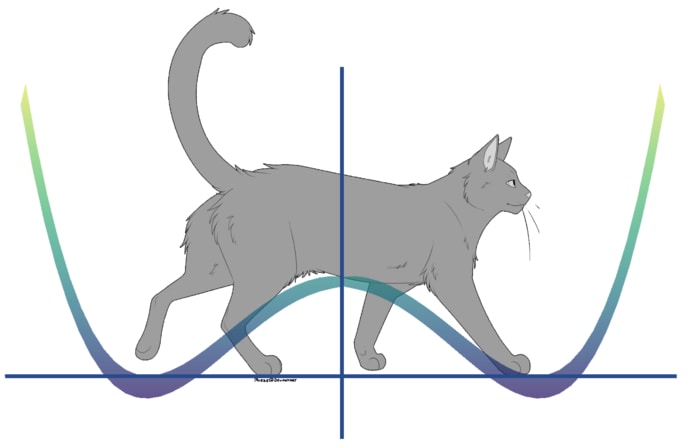
In the ordinary, everyday world, we can perform measurements with nearly unlimited precision. But, in the quantum world—the realm of atoms, electrons, photons, and other tiny particles—this becomes much harder. Every measurement made disturbs the object and results in measurement errors. Everything from the instruments used to the system’s properties might impact the outcome, which scientists call noise. Using noisy measurements to control quantum systems, particularly in real-time, is problematic. So, finding the means for accurate measurement-based control is essential for use in quantum technologies like powerful quantum supercomputers and devices for healthcare imaging. Schrödinger's cat illustrates the paradox of superposition. In this scenario, a cat was placed in a closed box with a flask of poison. After a while, the cat could be considered simultaneously alive and dead. In analogy to quantum mechanics, this refers to a quantum particle simultaneously being in the two wells. If someone were to open the box fully, they would find out whether the cat is either alive or dead, so the rules of the ordinary, classical world would resume. However, if one were to open the box just a little, they might see just a small part of the cat, perhaps the tail, and if they were to see the tail twitch, they might assume, without certainty, that the cat was still alive. This refers to the weak measurements that the machine was giving the researchers as data points.  CREDIT OIST. Cat created by: https://www.deviantart.com/nuzze/art/free-cat-lineart-base-587706438.

Now, an international group of researchers from the Quantum Machines Unit at the Okinawa Institute of Science and Technology Graduate University (OIST), Japan, and the University of Queensland, Australia, has shown, through simulations, that reinforcement learning, a type of machine learning, can be used to produce accurate quantum control even with noisy measurements. Their research was recently published in Physical Review Letters.

Dr. Sangkha Borah, Postdoctoral Scholar within the Unit and lead author of the paper, explained the idea using a simple example. “Imagine a ball on top of a hill. The ball can easily roll to the left or the right, but the aim is to keep it in the same place. To achieve this, one needs to see which way it is going to roll. If it is inclined to go to the left, the force needs to be applied on the right and vice versa. Now, imagine that a machine is applying that force, and, using reinforcement learning, the machine can be taught how much force to apply and when.” 

Reinforcement learning is often used in robotics where a robot might learn to walk through a trial-and-error approach. But such applications within the realm of quantum physics are rare. Although the ball-atop-a-hill is a tangible example, the system that the researchers were simulating was on a much smaller scale. Instead of a ball, the object was a small particle moving in a double-well which Dr. Borah and his colleagues were trying to control using real-time measurements.

“The bottom of the two wells is called the quantum ground state,” said Dr. Bijita Sarma, Postdoctoral Scholar within the Unit and co-author of the paper. “That’s where we wanted the particle to eventually be located. For that, we need to perform measurements continuously to extract information about the particle’s state and depending on that, apply some force to push it to the ground state. However, the measurements typically used in quantum mechanics do not allow us to do that. Hence, we need to have a smarter way to control the system.”

Interestingly, when in the ground state, the particle will be in both wells simultaneously. This is called quantum superposition, and it’s a necessary state for the system to be in, given its importance in various quantum technologies. To detect the location (or locations) of the particle in the well, the machine agent is given the measurement records from continuous weak measurements in real-time that it uses as data points for learning. And because this used a reinforcement loop, any information that the machine learned from the system would be used to make its future measurements more accurate.

Adding to the complexity of this system was the fact that it is nonlinear, meaning that the change in its output was not related to the changes in its input. These systems are confusing and chaotic when compared to so-called linear systems. For such nonlinear systems, there is no standard method of quantum control, but this research has shown that with reinforcement learning, the machine can learn to control the quantum system completely autonomously.

"As we gradually move towards a future largely dominated by artificial intelligence, the time is ripe to explore the utility of artificial intelligence, such as machine learning, in solving some problems that cannot be solved by conventional means,” concluded Dr. Borah. “This is especially applicable to controlling particle dynamics at the quantum level, where everything is dramatically counterintuitive.”

Prof. Jason Twamley, who leads the OIST Unit, added: "For nonlinear systems, there is no known method of efficient feedback control. In this work, we have shown that reinforcement learning can indeed be effective for such control, which is amazing and futuristic.”

BYU researchers create algorithm that predicts when an adolescent will become suicidal with 91% accuracy

Study reveals which risk factors are most strongly associated with suicidal thoughts and behavior among teens

Researchers from Brigham Young University, Johns Hopkins, and Harvard have created an algorithm that can predict suicidal thoughts and behavior among adolescents with 91% accuracy.

The researchers outline their machine learning approach in an article published today in PLOS ONE, where they also detail risk factors that are leading predictors of suicidal ideation and behavior among adolescents: online harassment and bullying.

“Suicide is the second leading cause of death among adolescents in the U.S.,” said Michael Barnes, study co-author and Associate Dean of the BYU College of Life Sciences. “It’s critical we have a better understanding of the risk factors — and the protective factors — associated with this heartbreaking issue.”

The study results show researchers can predict with high accuracy which adolescents will exhibit suicidal thoughts (consider or planning) or suicidal behavior (attempting) based on experiences they face.

The team analyzed data from 179,384 junior high and high school students, along with those who participated in the Student Health and Risk Prevention survey from 2011-2017. The dataset includes responses to 300+ survey questions and 8000+ bits of demographic information, resulting in a total of 1.2 billion data points that were processed. Researchers then applied various algorithms to the data and found a machine-learning model that accurately predicted which adolescents went on to have suicidal thoughts and behaviors (STB) based on the data provided.

The data showed females were more likely to experience suicidal thoughts and behavior (17.7%) than males (10.8%), and that those adolescents without a father in the home were 72.6% more likely to have suicidal ideation than those that did.

Most importantly, the algorithm discovered which risk factors were the leading predictors of suicidal thoughts and behavior:

  • Being threatened or harassed through digital media
  • Being picked on or bullied by a student at school
  • Exposure/involvement in serious arguments and yelling at home

“This analysis finds the most important root causes of suicidal thoughts and behavior in adolescents and creates risk profiles that give us a clearer picture of adolescents that are at risk,” said study co-author Carl Hanson, professor of public health at BYU. “If you want to wrap your head around what you can do about it, these profiles are one good place to start.”

Researchers were not surprised to see some of the risk factors that rose to the top — bullying, and harassment — but were interested to see the heavy influence from family factors: three of the top ten predictive factors for STB were tied directly to family situations: 1) being in a family where there are serious arguments, 2) being in a family that argues about the same things over and over and 3) being in a family that yells and insults each other.

The team said the implications of the research are critical for prevention programming and policymaking. Specifically, they hope policymakers use the STB risk profile and its associate rankings to prepare services, resources, and assessments aimed at school, community, and family settings.

“Clearly the results speak to the need for prevention and schools may be the best place to start by helping to mitigate bullying and online harassment. The results also indicate a need to strengthen families,” Hanson said. “For communities, we need programming that can help support and strengthen the family.”