York scientists build AI model to understand protein-sugar structures better

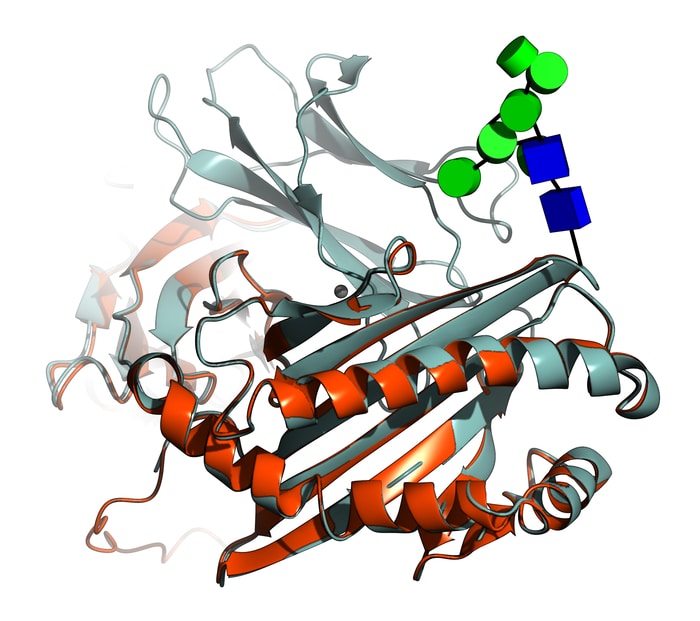
New research building on AI algorithms has enabled scientists to create more complete models of the protein structures in our bodies paving the way for faster design of therapeutics and vaccines. Sugars attached with the reported software are a very good match to both AlphaFold and experimental protein models.  CREDIT Credit: Dr Jon Agirre

The study led by the University of York, UK used artificial intelligence (AI) to help researchers understand more about the sugar that surrounds most proteins in our bodies. 

Up to 70 percent of human proteins are surrounded or scaffolded with sugar, which plays an important part in how they look and act. Moreover, some viruses like those behind AIDS, Flu, Ebola, and COVID-19 are also shielded behind sugars (glycans). The addition of these sugars is known as a modification.

To study the proteins, researchers created software that adds missing sugar components to models created with AlphaFold, which is an artificial intelligence program developed by Google's DeepMind which performs predictions of protein structures.

Senior scholar, Dr. Jon Agirre from the Department of Chemistry said: “The proteins of the human body are tiny machines that in their billions, make up our flesh and bones, transport our oxygen, allow us to function, and defend us from pathogens. And just like a hammer relies on a metalhead to strike pointy objects including nails, proteins have specialized shapes and compositions to get their jobs done."

“The AlphaFold method for protein structure prediction has the potential to revolutionize workflows in biology, allowing scientists to understand a protein and the impact of mutations faster than ever."

“However, the algorithm does not account for essential modifications that affect protein structure and function, which gives us only part of the picture. Our research has shown that this can be addressed in a relatively straightforward manner, leading to a more complete structural prediction.”

The recent introduction of AlphaFold and the accompanying database of protein structures has enabled scientists to have accurate structure predictions for all known human proteins.

Dr. Agirre added: "It is always great to watch an international collaboration grow to bear fruit, but this is just the beginning for us. Our software was used in the glycan structural work that underpinned the mRNA vaccines against SARS-CoV-2, but now there is so much more we can do thanks to the AlphaFold technological leap. It is still early stages, but the objective is to move on from reacting to changes in a glycan shield to anticipating them."

The research was conducted with Dr. Elisa Fadda and Carl A. Fogarty from Maynooth University. Haroldas Bagdonas, a Ph.D. student at the York Structural Biology Laboratory, which is part of the Department of Chemistry, also worked on the study with Dr. Agirre.

Syracuse prof uncovers the secrets behind Earth’s first major mass extinction

A team of geoscience researchers has announced a new study exploring the cause of the Late Ordovician mass extinction. Zunli Lu

We all know that the dinosaurs died in mass extinction. But did you know that there were other mass extinctions? There are five most significant mass extinctions, known as the “big five,” where at least three-quarters of all species in existence across the entire Earth faced extinction during a particular geological time. With current trends of global warming and climate change, many researchers now believe we may be in a sixth.

Discovering the root cause of Earth’s mass extinctions has long been a hot topic for scientists, as understanding the environmental conditions that led to the elimination of the majority of species in the past could potentially help prevent a similar event from occurring in the future.

A team of scientists from Syracuse University’s Department of Earth and Environmental Sciences, the University of California, Berkeley and the University of California, Riverside, Université Bourgogne Franche-Comté, the University of New Mexico, the University of Ottawa, the University of Science and Technology of China and Stanford University recently co-authored a paper exploring the Late Ordovician mass extinction (LOME), which is the first, or oldest of the “big five (~445 million years ago).” Around 85% of marine species, most of which lived in shallow oceans near continents, disappeared during that time.

Lead scholar Alexandre Pohl, from UC Riverside (now a postdoctoral research fellow at Université Bourgogne Franche-Comté in Dijon, France) and his co-authors investigated the ocean environment before, during, and after the extinction to determine how the event was brewed and triggered. 

To paint a picture of the oceanic ecosystem during the Ordovician Period, mass extinction expert Seth Finnegan, associate professor at UC Berkeley, says that seas were full of biodiversity. Oceans contained some of the first reefs made by animals but lacked an abundance of vertebrates.

“If you had gone snorkeling in an Ordovician sea you would have seen some familiar groups like clams and snails and sponges, but also many other groups that are now very reduced in diversity or entirely extinct like trilobites, brachiopods, and crinoids,” says Finnegan.

Unlike with rapid mass extinctions, like the Cretaceous-Tertiary extinction event where dinosaurs and other species died off suddenly some 65.5 million years ago, Finnegan says LOME played out over a substantial time, with estimates between less than half a million to almost two million years.

One of the major debates surrounding LOME is whether the lack of oxygen in seawater caused that period’s mass extinction. To investigate this question, the team integrated geochemical testing with numerical simulations and supercomputer modeling.

Zunli Lu, professor of Earth and environmental sciences at Syracuse University, and his students took measurements of iodine concentration in carbonate rocks from that period, contributing important findings of oxygen levels at various ocean depths. The concentration of the element iodine in carbonate rocks serves as an indicator for changes in oceanic oxygen levels in Earth's history.

Their data, combined with supercomputer modeling simulations, suggested that there was no evidence of anoxia ­­– or lack of oxygen ­– strengthening during the extinction event in the shallow ocean animal habitat where most organisms lived, meaning that climate cooling that occurred during the Late Ordovician period combined with additional factors likely was responsible for LOME.

On the other hand, there is evidence that anoxia in deep oceans expanded during that same time, a mystery that cannot be explained by the classic model of ocean oxygen, climate modeling expert Alexandre Pohl says.

“Upper-ocean oxygenation in response to cooling was anticipated because atmospheric oxygen preferentially dissolves in cold waters,” Pohl says. “However, we were surprised to see expanded anoxia in the lower ocean since anoxia in Earth’s history is generally associated with volcanism-induced global warming.”

They attribute the deep-sea anoxia to the circulation of seawater through global oceans. Pohl says that a key point to keep in mind is that ocean circulation is a very important component of the climatic system.

He was part of a team led by senior modeler Andy Ridgwell, professor at UC Riverside, whose supercomputer modeling results show that climate cooling likely altered ocean circulation patterns, halting the flow of oxygen-rich water in shallow seas to the deeper ocean.

Better supercomputer models of atmospheric detergent can help predict climate change

New research from Rochester scientist Lee Murray will aid in building more accurate computer models of the hydroxyl radical (OH), an important ‘detergent of the atmosphere.’

Earth’s atmosphere has a unique ability to cleanse itself by way of invisible molecules in the air that act as minuscule cleanup crews. The most important molecule in that crew is the hydroxyl radical (OH), nicknamed the “detergent of the atmosphere” because of its dominant role in removing pollutants. When the OH molecule chemically interacts with a variety of harmful gases, including the potent greenhouse gas methane, it is able to decompose the pollutants into forms that can be removed from Earth’s atmosphere.

It is difficult to measure OH, however, and it is not directly emitted. Instead, researchers predict the presence of OH based on its chemical production from other, “precursor” gases. To make these predictions, researchers use supercomputer simulations. In the Earth’s atmosphere, hydroxyl radical (OH) plays a dominant role in removing pollutants—but the OH molecule is difficult to measure. New research from Rochester scientist Lee Murray and his colleagues explains why the supercomputer models used to predict future levels of OH have traditionally produced widely varying forecasts. (Getty Images)

Lee Murray, an assistant professor of earth and environmental sciences at the University of Rochester, outlines why supercomputer models used to predict future levels of OH—and, therefore, how long air pollutants and reactive greenhouse gases last in the atmosphere—have traditionally produced widely varying forecasts. The study is the latest in Murray’s efforts to develop models of the dynamics and composition of Earth’s atmosphere and has important implications in advancing policies to combat climate change.

“We need to understand what controls changes in hydroxyl radical in Earth’s atmosphere in order to give us a better idea of the measures we need to take to rid the atmosphere of pollutants and reactive greenhouse gases,” Murray says.

Building accurate computer models to predict OH levels is similar to baking: just as you must add precise ingredients in the proper amounts and order to make an edible cake, precise data and metrics must be input into supercomputer models to make them more accurate.

The various existing supercomputer models used to predict OH levels have traditionally been designed with data input involving identical emissions levels of OH precursor gases. Murray and his colleagues, however, demonstrated that OH levels strongly depend on how much of these precursor emissions are lost before they react to produce OH. In this case, different bakers follow the same recipe of ingredients (emissions), but end up with different sizes of cake (OH levels) because some bakers throw out different portions of batter in the middle of the process.

“Uncertainties in future predictions are primarily driven by uncertainties in how models implement the fate of reactive gases that are directly emitted,” Murray says.

As Murray and his colleagues show, the computer models used to predict OH levels must evaluate the loss processes of reactive precursor gases, before they may be used for accurate future predictions.

But more data is needed about these processes, Murray says.

“Performing new measurements to constrain these processes will allow us to provide more accurate data about the amount of hydroxyl in the atmosphere and how it may change in the future,” he says.