

SUPERCOMPUTING NEWS SUPERCOMPUTING NEWS
    • MEDIA KIT
    • MOST READ
    • RSS FEED
    • ACADEMIA
    • AEROSPACE
    • APPLICATIONS
    • ASTRONOMY
    • AUTOMOTIVE
    • BIG DATA
    • BIOLOGY
    • CHEMISTRY
    • CLIENTS
    • CLOUD
    • DEFENSE
    • DEVELOPER TOOLS
    • EARTH SCIENCES
    • ECONOMICS
    • ENGINEERING
    • ENTERTAINMENT
    • GAMING
    • GOVERNMENT
    • HEALTH
    • OIL & GAS
    • INDUSTRY
    • INTERCONNECTS
    • MANUFACTURING
    • MIDDLEWARE
    • MOVIES
    • NETWORKS
    • PHYSICS
    • PROCESSORS
    • RETAIL
    • SCIENCE
    • STORAGE
    • SYSTEMS
    • VISUALIZATION
    • AcyMailing subscription form

    • ADD YOUR VIDEOS
    • MANAGE VIDEOS
    • CONVERSATION INBOX
    • SOCIAL ADVERTISER
    • SOCIAL NETWORK VIDEOS
    • SURVEYS
    • GROUPS
    • PAGES
    • MARKETPLACE LISTINGS
    • APPLICATIONS BROWSER
    • PRIVACY CONFIRM REQUEST
    • PRIVACY CREATE REQUEST
    • LEADERBOARD
    • POINTS LISTING
      • BADGES
    • TRADE SHOWS
Sign In
Tyler O'Neal, Staff Editor CLOUD September 18, 2019, 2:24 pm

Russian researchers develop new technologies for 6G modems

Researchers develop a spectrally efficient signal technology, which involves changing the shape of the transmitted signals

Scientists around the world are conducting researches on the concept of 6G information transfer standard, although the introduction of the 5G standard is still planned, and the 4G standard is still relevant and meets the requirements of users. One of the disadvantages of the applied signals is that the frequency bandwidth is too large. Researchers are trying to solve this problem by various methods, which usually lead to the quality deterioration of signal reception or the decrease in the communication range.

The effectiveness of modern information transmission equipment, including mobile communications equipment, is determined by various resulting characteristics. For example, an important parameter is an occupied frequency bandwidth. The economic value of this resource is extremely high and the reduction of the occupied frequency bandwidth will decrease the cost of implementing and maintaining communications. This will reduce the cost of services for subscribers. Also, an important parameter is the peak factor of the emitted oscillations, which determines the efficiency of the amplifiers and the operating time of the devices after the battery charge.

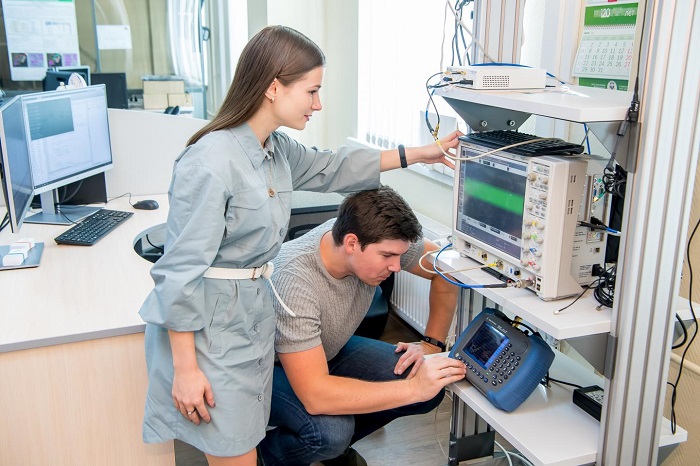
Researchers of the Higher School of Applied Physics and Space Technology of Peter the Great St.Petersburg Polytechnic University (SPbPU) develop a spectrally efficient signal technology, which involves changing the shape of the transmitted signals to regulate various resulting characteristics. Researchers to develop a prototype of a digital radio modem.{module In-article}
"Reducing the occupied bandwidth will not only decrease the costs but will also make it possible to use additional transmission channels in the appeared frequency resource. Thus it possible to increase the speed of information transfer or to increase the number of subscribers of the communication network," explains Sergey Zavjalov, associate professor at the Higher School of Applied Physics and Space Technology SPbPU.

According to scientists, such shapes of the signal are formed using a complex mathematical apparatus. Polytechnic University specialists developed a method for synthesizing such signals. "For various operating conditions of the information transmission system, an optimization problem is formulated. For calculations, we use the supercomputer center 'Polytechnic'. Then the signal shape is used for experimental verification," says Anna Ovsyannikova, the master student of the Higher School of Applied Physics and Space Technology.

The effectiveness of the proposed signals in real conditions is tested using software-defined radio platforms. "In our laboratory, this technology is used for experimental verification of signals in various scenarios. For example, the transmission of information is simulated in extreme industrial conditions of the plant or urban conditions," mentioned Ilya Lavrenyuk, the graduate student of the Higher School of Applied Physics and Space Technology SPbPU.

Currently, researchers are developing a prototype of a digital radio modem, which is to be used for 5G-6G information transfer standards. The research results have been presented to the International Telecommunication Union (ITU) for the implementation in the international standards of mobile communications, digital television and broadcasting.

The technology may be also applied in the Internet of things, Smart home systems, city management and monitoring of power plant systems.

Pitt researchers create first universal supercomputer model for metal nanoparticle adsorption

Tyler O'Neal, Staff Editor CLOUD September 18, 2019, 2:11 pm

Metal nanoparticles have a wide range of applications, from medicine to catalysis, from energy to the environment. But the fundamentals of adsorption--the process allowing molecules to bind as a layer to a solid surface--in relation to the nanoparticle's characteristics were yet to be discovered.

New research from the University of Pittsburgh Swanson School of Engineering introduces the first universal adsorption model that accounts for detailed nanoparticle structural characteristics, metal composition and different adsorbates, making it possible to not only predict adsorption behavior on any metal nanoparticles but screen their stability, as well. {module In-article}

The research combines computational chemistry modeling with machine learning to fit a large number of data and accurately predict adsorption trends on nanoparticles that have not previously been seen. By connecting adsorption with the stability of nanoparticles, nanoparticles can now be optimized in terms of their synthetic accessibility and application property behavior. This improvement will significantly accelerate nanomaterials design and avoid trial and error experimentation in the lab.

"This model has the potential to impact diverse areas of nanotechnology with applications in catalysis, sensors, separations and even drug delivery," says Giannis (Yanni) Mpourmpakis, the Swanson School's Bicentennial Alumni Faculty Fellow and associate professor of chemical and petroleum engineering, whose CANELa lab conducted the research. "Our lab, as well as other groups, have performed prior computational studies that describe adsorption on metals, but this is the first universal model that accounts for nanoparticle size, shape, metal composition and type of adsorbate. It's also the first model that directly connects an application property, such as adsorption and catalysis, with the stability of the nanoparticles."

Michigan Tech’s Shi creates mechanism modeling for better forecasts, climate predictions

Tyler O'Neal, Staff Editor CLOUD September 18, 2019, 1:59 pm

As hurricanes grow in power as the climate changes, accurately modeling the interactions between the atmosphere and the ocean grows increasingly important to prepare people to batten down or to evacuate. The many mechanisms of the atmosphere-ocean system -- known as air-sea flux -- make modeling extremely complicated, however.

Qi Shi, a postdoctoral researcher in the Great Lakes Research Center at Michigan Technological University, has created the first detailed analysis of ocean and atmospheric responses to currents, waves and wind. In the article "Coupling Ocean Currents and Waves with Wind Stress over the Gulf Stream"published in Remote Sensing this summer, Shi argues that current numerical models simply don't account for the impact of waves, currents and wind coupled together. This coupling is crucial because without it, models do not accurately represent marine atmospheric boundary layer processes.

"We quantified the impact of this coupling to improve the accuracy of air-sea fluxes, because without modeling currents, there is a constant bias in models," Shi said. "What causes that bias? Missing the full spectrum of feedback mechanisms." CAPTION Better modeling gives weather forecasters and climate scientists a more accurate picture of what happens where atmosphere and ocean meet.  CREDIT Sarah Atkinson/Michigan Tech{module In-article}

Simply put: Better modeling gives weather forecasters and climate scientists a more accurate picture of what happens where atmosphere and ocean meet.

Feedback Mechanisms

Part of what makes modeling air-sea flux so complicated are the sheer number of feedback mechanisms in the system: To model waves, one must account for surface roughness and wind; to model sea surface temperature, one must account for air-sea temperature differences, water vapor, humidity, evaporation and more. Modeling wind and surface currents are equally complex. 

Numerical models solve equations that describe the atmosphere, ocean, and land surface to predict future weather and climate. Interactions among each model component, such as heat exchange between atmosphere and ocean, play an important role in driving both oceanic and atmospheric circulation.

Hurricanes and Climate

Hurricanes are fueled with heat and moisture from the ocean. Ocean currents and waves modify wind shear and surface roughness, which are key variables for calculating the air-sea heat and momentum fluxes. Using a high-resolution, three-way coupled ocean-wave-atmospheric modeling system, Shi determined the role of coupling ocean currents, waves and wind stress in reducing model bias in air-sea flux over the Gulf Stream.

Shi's work is the first detailed mechanism study in the current-wave-stress coupling process, which can be applied to increase the accuracy of forecasts for hurricane intensity and climate prediction as well as to better use satellite observations in the numerical models. 

"We provide evidence that observation of currents is important and has significant influence on models," Shi said.

Shi said she hopes to see the eventual launch of a satellite that observes ocean currents to validate ground observations.

  1. Météo-France’s climate models consistently predict a pronounced global warming
  2. Cambridge scientist supercomputes to find a nanoparticle to transport anti-cancer agent to cells
  3. Dartmouth researchers advance noise canceling for quantum supercomputing

Page 20 of 25

  • 15
  • 16
  • 17
  • 18
  • 19
  • 20
  • 21
  • 22
  • 23
  • 24
POPULAR RIGHT NOW
  • IBM's Historic stock collapse raises questions for the future of enterprise supercomputing
    IBM's Historic stock collapse raises questions for the future of enterprise supercomputing
  • Could a novel dark matter theory simultaneously resolve multiple cosmic enigmas? Supercomputer simulations provide a compelling, albeit currently unverified, potential solution
    Could a novel dark matter theory simultaneously resolve multiple cosmic enigmas? Supercomputer simulations provide a compelling, albeit currently unverified, potential solution
  • Melting icebergs may be reshaping Earth’s greatest ocean current
    Melting icebergs may be reshaping Earth’s greatest ocean current
  • Supercomputers replace ‘bathtub’ flood maps with physics-based digital twins of Britain’s coastline
    Supercomputers replace ‘bathtub’ flood maps with physics-based digital twins of Britain’s coastline
  • Supercomputers push neural quantum simulation beyond previous limits
    Supercomputers push neural quantum simulation beyond previous limits
  • Intel’s AI supercomputing revival: Q2 financial surge signals new era for CPU-powered HPC infrastructure
    Intel’s AI supercomputing revival: Q2 financial surge signals new era for CPU-powered HPC infrastructure
  • AI infrastructure financing fears shake semiconductor sector
    AI infrastructure financing fears shake semiconductor sector
  • AWS supercomputing investment reaches historic scale as Amazon’s AI strategy powers record financial results
    AWS supercomputing investment reaches historic scale as Amazon’s AI strategy powers record financial results
  • Catching the wave of the future: Supercomputers unlock the hidden dynamics of Venus
    Catching the wave of the future: Supercomputers unlock the hidden dynamics of Venus
  • NCAR supercomputers run planet scale climate experiments impossible in the real world
    NCAR supercomputers run planet scale climate experiments impossible in the real world
THIS YEAR'S MOST READ
  • Wall Street wants to trade supercomputing power like oil
    Wall Street wants to trade supercomputing power like oil
  • Beamforming the future: BeammWave's 6G push signals the rise of orbital-terrestrial wireless networks
    Joakim Axmon
    Joakim Axmon
  • Cosmic ambition at scale: UK’s supercomputer unlocks a 2.5 petabytes universe
    Cosmic ambition at scale: UK’s supercomputer unlocks a 2.5 petabytes universe
  • Hidden order, revealed at scale: Supercomputing, electron ptychography uncover the inner workings of relaxor ferroelectrics
    Hidden order, revealed at scale: Supercomputing, electron ptychography uncover the inner workings of relaxor ferroelectrics
  • Intel's Q1 results signal supercomputing surge driving Xeon momentum
    Intel's Q1 results signal supercomputing surge driving Xeon momentum
  • When stars fall apart: Supercomputing reveals the hidden physics of black holes
    When stars fall apart: Supercomputing reveals the hidden physics of black holes
  • MIT develops computational framework to probe dark matter via gravitational waves
    MIT develops computational framework to probe dark matter via gravitational waves
  • Explainable AI moves into the watershed: FAMU-FSU engineers build predictive framework for real-time E. coli forecasting
    FAMU-FSU College of Engineering Assistant Professor Nasrin Alamdari. (Scott Holstein/FAMU-FSU College of Engineering)
    FAMU-FSU College of Engineering Assistant Professor Nasrin Alamdari. (Scott Holstein/FAMU-FSU College of Engineering)
  • Multi-layer simulations reveal the hidden supply chain of solar prominences
    Multi-layer simulations reveal the hidden supply chain of solar prominences
  • Japanese scientists decode dolphin speed with supercomputing: Turbulence, vortices, and the hidden physics of propulsion
    Japanese scientists decode dolphin speed with supercomputing: Turbulence, vortices, and the hidden physics of propulsion
  • FRONTPAGE
  • LATEST
  • POPULAR
  • REGISTER
  • SOCIAL
  • VIDEO
  • SUBSCRIPTION
  • RSS
  • GUIDELINES
  • PRIVACY
  • TOS
  • ABOUT
  • +1 (816) 799-4488
  • editorial@supercomputingonline.com
© 2001 - 2026 SuperComputingOnline.com, LLC. All rights reserved. This material may not be published, broadcast, rewritten or redistributed without permission.
Sign In
  • FRONT PAGE
  • LATEST
    • MEDIA KIT
    • MOST READ
    • RSS FEED
    • ACADEMIA
    • AEROSPACE
    • APPLICATIONS
    • ASTRONOMY
    • AUTOMOTIVE
    • BIG DATA
    • BIOLOGY
    • CHEMISTRY
    • CLIENTS
    • CLOUD
    • DEFENSE
    • DEVELOPER TOOLS
    • EARTH SCIENCES
    • ECONOMICS
    • ENGINEERING
    • ENTERTAINMENT
    • HEALTH
    • INDUSTRY
    • INTERCONNECTS
    • GAMING
    • GOVERNMENT
    • MANUFACTURING
    • MIDDLEWARE
    • MOVIES
    • NETWORKS
    • OIL & GAS
    • PHYSICS
    • PROCESSORS
    • RETAIL
    • SCIENCE
    • STORAGE
    • SYSTEMS
    • VISUALIZATION
  • VIDEOS
    • ADD YOUR VIDEOS
    • MANAGE VIDEOS
  • COMMUNITY
    • TRADE SHOWS
    • SOCIAL NETWORK VIDEOS
    • SURVEYS
    • APPLICATIONS BROWSER
    • CONVERSATION INBOX
    • SOCIAL ADVERTISER
    • GROUPS
    • MARKETPLACE LISTINGS
    • PAGES
    • LEADERBOARD
    • POINTS LISTING
      • BADGES
    • PRIVACY CONFIRM REQUEST
    • PRIVACY CREATE REQUEST

Hey there! We noticed you’re using an ad blocker.