SUPERCOMPUTING NEWS SUPERCOMPUTING NEWS
    • MEDIA KIT
    • MOST READ
    • RSS FEED
    • ACADEMIA
    • AEROSPACE
    • APPLICATIONS
    • ASTRONOMY
    • AUTOMOTIVE
    • BIG DATA
    • BIOLOGY
    • CHEMISTRY
    • CLIENTS
    • CLOUD
    • DEFENSE
    • DEVELOPER TOOLS
    • EARTH SCIENCES
    • ECONOMICS
    • ENGINEERING
    • ENTERTAINMENT
    • GAMING
    • GOVERNMENT
    • HEALTH
    • OIL & GAS
    • INDUSTRY
    • INTERCONNECTS
    • MANUFACTURING
    • MIDDLEWARE
    • MOVIES
    • NETWORKS
    • PHYSICS
    • PROCESSORS
    • RETAIL
    • SCIENCE
    • STORAGE
    • SYSTEMS
    • VISUALIZATION
    • AcyMailing subscription form

    • ADD YOUR VIDEOS
    • MANAGE VIDEOS
    • CONVERSATION INBOX
    • SOCIAL ADVERTISER
    • SOCIAL NETWORK VIDEOS
    • SURVEYS
    • GROUPS
    • PAGES
    • MARKETPLACE LISTINGS
    • APPLICATIONS BROWSER
    • PRIVACY CONFIRM REQUEST
    • PRIVACY CREATE REQUEST
    • LEADERBOARD
    • POINTS LISTING
      • BADGES
    • TRADE SHOWS
Sign In
Tyler O'Neal, Staff Editor CLOUD September 24, 2019, 2:54 pm

Russians try eyeballing a black hole's mass

There are no scales for weighing black holes. Yet astrophysicists from the Moscow Institute of Physics and Technology have devised a new way for indirectly measuring the mass of a black hole, while also confirming its existence. They tested the new method, reported in the Monthly Notices of the Royal Astronomical Society, on the Messier 87 active galaxy.

Active galactic nuclei are among the brightest and most mysterious objects in space. A galaxy is deemed active if it produces a thin long beam of matter and energy directed outward. Known as a relativistic jet, this phenomenon cannot be accounted for by the stars in the galaxy. The current consensus is that the jets are produced by some kind of "motors," termed galactic nuclei. While their nature is poorly understood, researchers believe that a spinning black hole could power an active galaxy.

Messier 87 in the Virgo constellation is an active galaxy that is closest to Earth, and also the one best studied. It has been observed on a regular basis since 1781, when it was first discovered as a nebula. It took some time before astronomers realized that it was a galaxy, and its optical jet -- discovered in 1918 -- was the first one ever to be observed.

The structure of the Messier 87 jet has been meticulously studied, with its plasma jet velocities mapped and the temperature and particle number density near the jet measured. The jet's boundary has been studied in such fine detail that researchers discovered it was inhomogeneous along its length, changing its shape from parabolic to conical. Originally discovered as an isolated case, this effect was later confirmed for a dozen other galaxies, though M87 remains the clearest example of the phenomenon.

The sheer bulk of observations allow for testing hypotheses regarding the structure of active galaxies, including the relation between the jet shape break and the black hole's gravitational influence. Jet behavior and the existence of the supermassive black hole are two sides of the same coin: The former can be explained in terms of the latter while theoretical models of black holes are tested via jet observations.

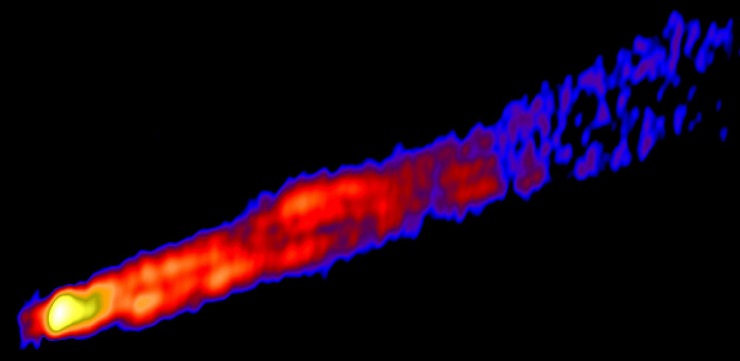
Astrophysicists exploited the fact that the jet boundary is made up of segments of two distinct curves and used the distance between the core and the break of the jet, together with the jet's width, to indirectly measure the black hole mass and spin. To that end, MIPT scientists developed a method that combines a theoretical model, supercomputer calculations, and telescope observations. CAPTION A radio interferometry image of the M87 galaxy at 2-centimeter wavelength with sub-parsec resolution  CREDIT Yuri Kovalev/MIPT{module In-article}
The researchers are trying to describe the jet as a flow of magnetized fluid. In this case, the shape of the jet is determined by the electromagnetic field in it, which in turn depends on various factors, such as the speed and charge of jet particles, the electric current within the jet, and the rate at which the black hole accretes matter. A complex interplay between these characteristics and physical phenomena gives rise to the observed break.

There is a theoretical model that predicts the break, so the team could determine which black hole mass results in the model reproducing the observed shape of the jet. This provided a new model for black hole mass estimation, a new measurement method, and a confirmation of the hypotheses underlying the theoretical model.

"The new independent method for estimation of black hole mass and spin is the key result of our work. Even though its accuracy is comparable to that of the existing methods, it has an advantage in that it brings us closer to the end goal. Namely, refining the parameters of the core 'motor' to deeper understand its nature," said Elena Nokhrina, the lead author of the paper and deputy head of the MIPT laboratory involved in the study.
Brown, Dartmouth researchers to explore materials, matter states for quantum technologies

Tyler O'Neal, Staff Editor CLOUD September 24, 2019, 2:30 pm

Quantum technologies have the potential to spur revolutions in computing, sensing, cryptography and beyond. With a $4 million grant from the National Science Foundation, a team of researchers from Brown University and Dartmouth College will work to better understand the materials and the exotic quantum states that make these technologies possible. 

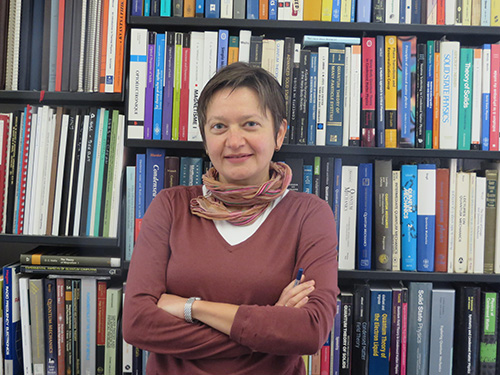
“We’re trying to understand these quantum materials and complex quantum states on a fundamental level that enables us to control and manipulate them in useful ways,” said Vesna Mitrović, a professor of physics at Brown and principal investigator on the grant. “This new understanding will help us to identify which of these materials or states is useful for which applications, which in turn will help us to move quantum technology forward.” Vesna Mitrović{module In-article}

Quantum technologies make use of the often peculiar rules that govern the behavior of individual particles. In the quantum world, particles can behave as if they are in more than one state at a given time, and influence each other's behavior even if they are far away in space. By taking advantage of those properties, quantum computers can process information in new ways, potentially performing calculations far beyond the reach of even the fastest of today's supercomputers. Quantum sensors far more powerful than those used today could be useful in applications ranging from medicine to seismology. And quantum cryptography could lead to intrinsically secure communication.

For all the promise, however, there are obstacles to overcome before these quantum technologies deliver their full potential. One problem is that quantum states are extremely fragile -- the slightest disturbance can destroy them. And scientists still don't fully understand how to model the complex correlations between particles in quantum systems. Those microscopic correlations are critically important, because they ultimately determine the properties of a material at the macroscopic scale.

Under this grant, the Brown-Dartmouth team will use a novel approach in which today's small quantum computers are combined with large-scale classical computing resources to study quantum materials and complex quantum states in microscopic detail. Experimental studies of existing materials will be combined with machine learning and artificial intelligence tools to inform the design of new materials, whose properties depend on correlated quantum states that are not so fragile.

"The ability to measure these correlations gives us the ability to better understand and control these quantum states," Mitrović said. "That could enable the design of new technologies including error-tolerant quantum computers, for example."

Mitrović is an expert in using a technique known as nuclear magnetic resonance to probe quantum states of materials. For the grant, she'll work with fellow Brown theorists and professors Dima Feldman and Brad Marston. The Dartmouth team is led by experimentalist Chandrasekhar Ramanathan and theorist James Whitfield. The team also includes experts in computer science and quantum physics.

"By leveraging their complementary expertise -- quantum materials at Brown and quantum information science at Dartmouth -- the grant will enable the creation of a New England center of excellence at the nexus of quantum and data sciences, both areas of national priority for science and technology development," Ramanathan said. "This collaboration will allow us to tackle some of the hard problems that stand in the way of deploying quantum technologies."

The combination of quantum information science and data science developed by this research could have broad impacts that benefit society, the researchers believe. And Mitrović said she's excited to work with this group of colleagues on this project.

"If you asked me to assemble the dream team of researchers to approach this problem, this would be the exact group I'd put together," she said. "It's exciting because I think we can make genuine progress on this."

Japanese researchers deploy weather balloons to boost forecasting skills

Tyler O'Neal, Staff Editor CLOUD September 20, 2019, 10:04 am

Observational data from radiosondes deployed in Antarctica improve the forecasting accuracy for severe Antarctic cyclones, according to a Japanese research team led by the Kitami Institute of Technology, Hokkaido, Japan.

In parts of the Earth that are very sparsely populated, such as the Antarctic, direct observational weather data can be hard to come by, and with Antarctica's extreme climate, failure to accurately predict severe weather can easily become deadly. The team conducted a study that focused on the impacts of these data on forecasting an extreme cyclonic event, and the findings have been accepted and published as early view in Advances in Atmospheric Sciences.

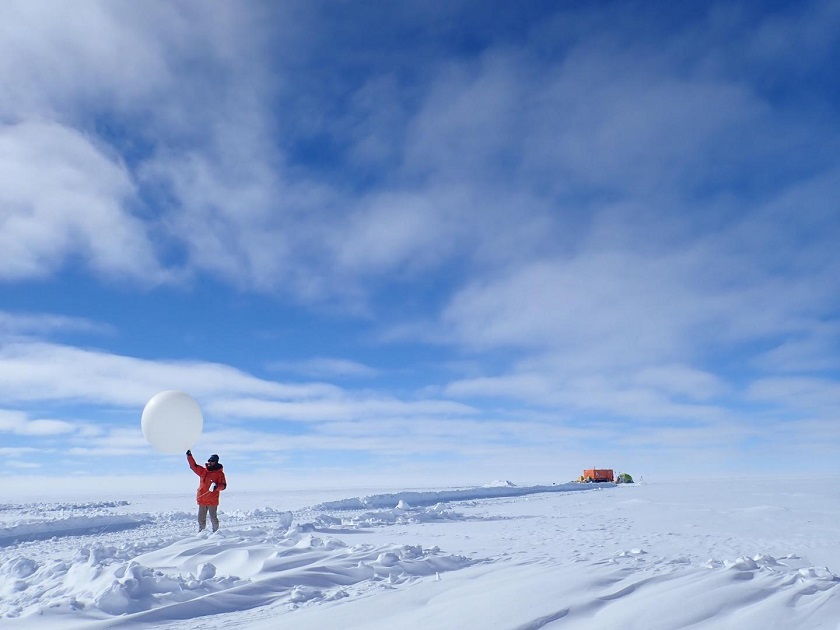
With advancements in satellite technology and supercomputers, the modeling and forecasting of storms is constantly improving. However, accurate forecasts are not based on satellite data alone - they still rely on direct measurements taken at the surface and in the atmosphere. Direct measurements of the atmosphere can be obtained by deploying weather balloons equipped with radiosondes, devices that collect and transmit information about variables such as altitude, temperature, humidity, and wind speed. CAPTION This is a photograph showing radiosonde observation at Dome Fuji Station in Antarctica. The person in the photo is Dr. Konosuke Sugiura, a co-author of the study.  CREDIT Taichi Ito{module In-article}

The research team looked at the importance of weather radiosonde data in predicting severe weather events over Antarctica and the surrounding Southern Ocean. "We investigated the impact of including additional radiosonde observations from both the research vessel Shirase over the Southern Ocean and from the Dome Fuji Station in Antarctica on forecasting using an atmospheric general circulation model," explains lead author Kazutoshi Sato, an assistant professor at the Kitami Institute of Technology, Japan.

The researchers conducted a forecast experiment that focused on an unusually strong Antarctic cyclonic event that occurred from late December 2017 to early January 2018. Two datasets, one that included the additional radiosonde data and one that excluded those data, were used as the initial values. Only the experiment that included the radiosonde observations successfully captured the cyclone's central pressure, wind speed, and moisture transport 2.5 days in advance. These results clearly show that even with operational weather forecast centers, collecting radiosonde observation data is important to improve the forecasting accuracy for Antarctic cyclones.

However, the sparsity of observations in the Antarctic remains a problem. "Even with the assimilation of the additional radiosonde observations," says co-author Jun Inoue, an associate professor of polar science at the National Institute of Polar Research, part of the Inter-University Research Institute Corporation Research Organization of Information and Systems (ROIS) in Tokyo, Japan, "the experiment was unable to forecast the development of the cyclone four days in advance. That leaves a great deal of room for improvement." In a project called the 'Year of Polar Projection', many Antarctic stations have deployed additional radiosondes to provide an opportunity to further investigate the impact of the resulting data on weather forecasting in Antarctica.

To provide more accurate weather forecasts, Inoue noted that new additional observation systems need to be developed in the future. Improving severe weather forecasting in Antarctica will continue to be a priority, as the lives of researchers and other personnel in the region may depend on it.

  1. Woolpert launches STREAM:RASTER to host imagery in the cloud
  2. UM researcher's model of ancient climate suggests future warming could accelerate
  3. Japanese scientists develop framework for 'extremely' energy-efficient circuits

Page 18 of 25

  • 13
  • 14
  • 15
  • 16
  • 17
  • 18
  • 19
  • 20
  • 21
  • 22
POPULAR RIGHT NOW
  • IBM's Historic stock collapse raises questions for the future of enterprise supercomputing
    IBM's Historic stock collapse raises questions for the future of enterprise supercomputing
  • Could a novel dark matter theory simultaneously resolve multiple cosmic enigmas? Supercomputer simulations provide a compelling, albeit currently unverified, potential solution
    Could a novel dark matter theory simultaneously resolve multiple cosmic enigmas? Supercomputer simulations provide a compelling, albeit currently unverified, potential solution
  • Melting icebergs may be reshaping Earth’s greatest ocean current
    Melting icebergs may be reshaping Earth’s greatest ocean current
  • Supercomputers replace ‘bathtub’ flood maps with physics-based digital twins of Britain’s coastline
    Supercomputers replace ‘bathtub’ flood maps with physics-based digital twins of Britain’s coastline
  • Supercomputers push neural quantum simulation beyond previous limits
    Supercomputers push neural quantum simulation beyond previous limits
  • Intel’s AI supercomputing revival: Q2 financial surge signals new era for CPU-powered HPC infrastructure
    Intel’s AI supercomputing revival: Q2 financial surge signals new era for CPU-powered HPC infrastructure
  • AI infrastructure financing fears shake semiconductor sector
    AI infrastructure financing fears shake semiconductor sector
  • AWS supercomputing investment reaches historic scale as Amazon’s AI strategy powers record financial results
    AWS supercomputing investment reaches historic scale as Amazon’s AI strategy powers record financial results
  • Catching the wave of the future: Supercomputers unlock the hidden dynamics of Venus
    Catching the wave of the future: Supercomputers unlock the hidden dynamics of Venus
  • NCAR supercomputers run planet scale climate experiments impossible in the real world
    NCAR supercomputers run planet scale climate experiments impossible in the real world
THIS YEAR'S MOST READ
  • Wall Street wants to trade supercomputing power like oil
    Wall Street wants to trade supercomputing power like oil
  • Beamforming the future: BeammWave's 6G push signals the rise of orbital-terrestrial wireless networks
    Joakim Axmon
    Joakim Axmon
  • Cosmic ambition at scale: UK’s supercomputer unlocks a 2.5 petabytes universe
    Cosmic ambition at scale: UK’s supercomputer unlocks a 2.5 petabytes universe
  • Hidden order, revealed at scale: Supercomputing, electron ptychography uncover the inner workings of relaxor ferroelectrics
    Hidden order, revealed at scale: Supercomputing, electron ptychography uncover the inner workings of relaxor ferroelectrics
  • Intel's Q1 results signal supercomputing surge driving Xeon momentum
    Intel's Q1 results signal supercomputing surge driving Xeon momentum
  • When stars fall apart: Supercomputing reveals the hidden physics of black holes
    When stars fall apart: Supercomputing reveals the hidden physics of black holes
  • MIT develops computational framework to probe dark matter via gravitational waves
    MIT develops computational framework to probe dark matter via gravitational waves
  • Explainable AI moves into the watershed: FAMU-FSU engineers build predictive framework for real-time E. coli forecasting
    FAMU-FSU College of Engineering Assistant Professor Nasrin Alamdari. (Scott Holstein/FAMU-FSU College of Engineering)
    FAMU-FSU College of Engineering Assistant Professor Nasrin Alamdari. (Scott Holstein/FAMU-FSU College of Engineering)
  • Multi-layer simulations reveal the hidden supply chain of solar prominences
    Multi-layer simulations reveal the hidden supply chain of solar prominences
  • Japanese scientists decode dolphin speed with supercomputing: Turbulence, vortices, and the hidden physics of propulsion
    Japanese scientists decode dolphin speed with supercomputing: Turbulence, vortices, and the hidden physics of propulsion
  • FRONTPAGE
  • LATEST
  • POPULAR
  • REGISTER
  • SOCIAL
  • VIDEO
  • SUBSCRIPTION
  • RSS
  • GUIDELINES
  • PRIVACY
  • TOS
  • ABOUT
  • +1 (816) 799-4488
  • editorial@supercomputingonline.com
© 2001 - 2026 SuperComputingOnline.com, LLC. All rights reserved. This material may not be published, broadcast, rewritten or redistributed without permission.
Sign In
  • FRONT PAGE
  • LATEST
    • MEDIA KIT
    • MOST READ
    • RSS FEED
    • ACADEMIA
    • AEROSPACE
    • APPLICATIONS
    • ASTRONOMY
    • AUTOMOTIVE
    • BIG DATA
    • BIOLOGY
    • CHEMISTRY
    • CLIENTS
    • CLOUD
    • DEFENSE
    • DEVELOPER TOOLS
    • EARTH SCIENCES
    • ECONOMICS
    • ENGINEERING
    • ENTERTAINMENT
    • HEALTH
    • INDUSTRY
    • INTERCONNECTS
    • GAMING
    • GOVERNMENT
    • MANUFACTURING
    • MIDDLEWARE
    • MOVIES
    • NETWORKS
    • OIL & GAS
    • PHYSICS
    • PROCESSORS
    • RETAIL
    • SCIENCE
    • STORAGE
    • SYSTEMS
    • VISUALIZATION
  • VIDEOS
    • ADD YOUR VIDEOS
    • MANAGE VIDEOS
  • COMMUNITY
    • TRADE SHOWS
    • SOCIAL NETWORK VIDEOS
    • SURVEYS
    • APPLICATIONS BROWSER
    • CONVERSATION INBOX
    • SOCIAL ADVERTISER
    • GROUPS
    • MARKETPLACE LISTINGS
    • PAGES
    • LEADERBOARD
    • POINTS LISTING
      • BADGES
    • PRIVACY CONFIRM REQUEST
    • PRIVACY CREATE REQUEST

Hey there! We noticed you’re using an ad blocker.