Swiss researchers simulate the defense against asteroid impacts on Earth

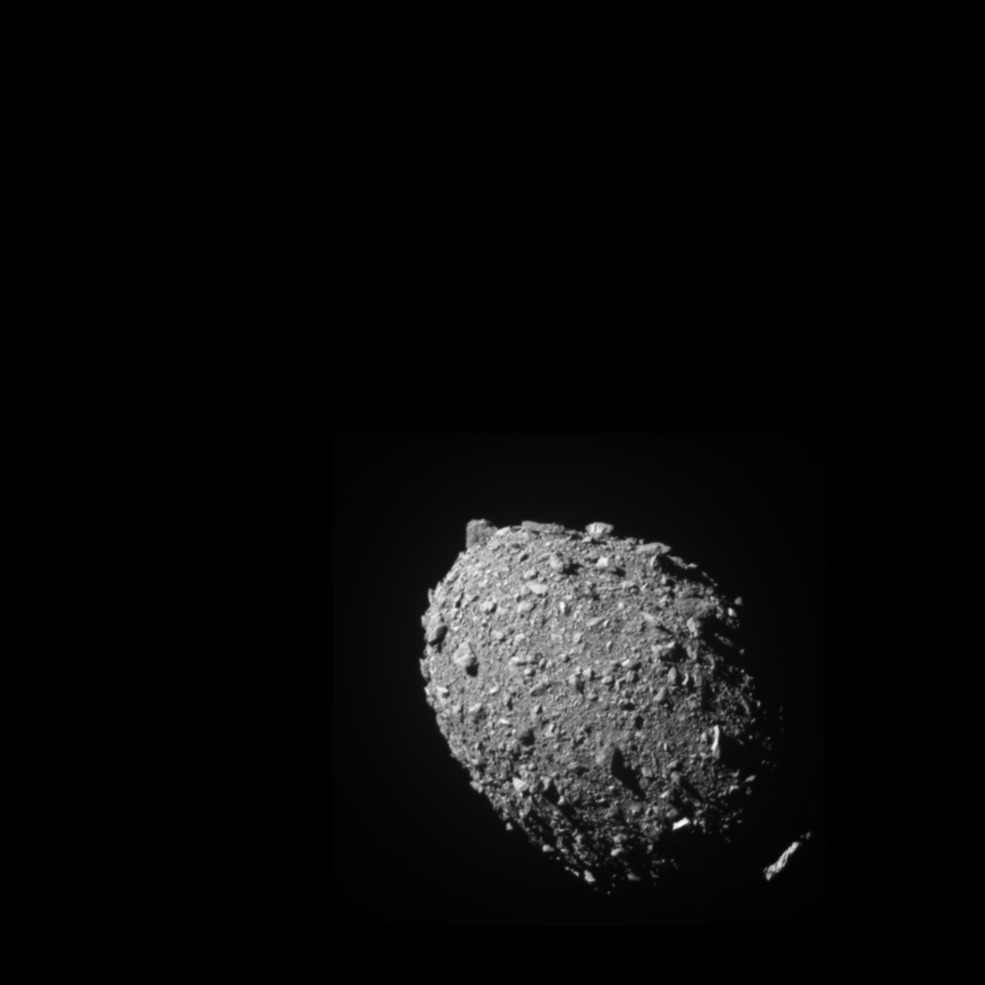
NASA’s Double Asteroid Redirection Test (DART) mission is the world’s first full-scale planetary defense test against potential asteroid impacts on Earth. Researchers of the University of Bern and the National Centre of Competence in Research (NCCR) PlanetS now show that instead of leaving behind a relatively small crater, the impact of the DART spacecraft on its target could leave the asteroid near unrecognizable.

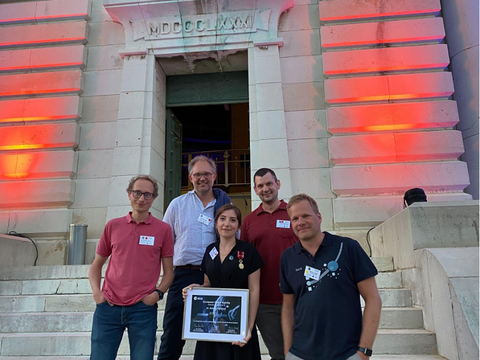
Sabina Raducan (center) and Martin Jutzi (right) with collaborators at the Hera Workshop in Nice, France. © Dr. Toshi Hirabayashi

66 million years ago, a giant asteroid's impact on the Earth likely caused the extinction of the dinosaurs. Currently, no known asteroid poses an immediate threat. But if one day a large asteroid were to be discovered on a collision course with Earth, it might have to be deflected from its trajectory to prevent catastrophic consequences.

Last November, the DART space probe of the US space agency NASA was launched as a first full-scale experiment of such a maneuver: Its mission is to collide with an asteroid and deflect it from its orbit, to provide valuable information for the development of such a planetary defense system.

In a new study published in The Planetary Science Journal, researchers of the University of Bern and the National Centre of Competence in Research (NCCR) PlanetS have simulated this impact with a new method. Their results indicate that it may deform its target far more severely than previously thought. 

Rubble instead of solid rock

"Contrary to what one might imagine when picturing an asteroid, direct evidence from space missions like the Japanese space agency’s (JAXA) Hayabusa2 probe demonstrates that an asteroid can have a very loose internal structure – similar to a pile of rubble – that is held together by gravitational interactions and small cohesive forces", says study lead-author Sabina Raducan from the Institute of Physics and the National Centre of Competence in Research PlanetS at the University of Bern.

Yet, previous simulations of the DART mission impact mostly assumed a much more solid interior of its asteroid target Dimorphos. "This could drastically change the outcome of the collision of DART and Dimorphos, which is scheduled to take place in the coming September", Raducan points out. Instead of leaving a relatively small crater on the 160-meter-wide asteroid, DART’s impact at a speed of 24’000 km/h could completely deform Dimorphos. The asteroid could also be deflected much more strongly and larger amounts of material could be ejected from the impact than the previous estimates predicted.

A prize-winning new approach

“One of the reasons that this scenario of a loose internal structure has so far not been thoroughly studied is that the necessary methods were not available”, study lead-author Sabina Raducan says. “Such impact conditions cannot be recreated in laboratory experiments and the relatively long and complex process of crater formation following such an impact – a matter of hours in the case of DART – made it impossible to realistically simulate these impact processes up to now”, according to the researcher.  

"With our novel modeling approach, which takes into account the propagation of the shock waves, the compaction, and the subsequent flow of material, we were for the first time able to model the entire cratering process resulting from impacts on small, asteroids like Dimorphos” Raducan reports. For this achievement, she was awarded by ESA and by the mayor of Nice at a workshop on the DART follow-up mission HERA. For this achievement, Raducan was awarded by ESA and by the mayor of Nice at a workshop on the DART follow-up mission HERA.

Widen horizon of expectations

In 2024, the European Space Agency ESA will send a space probe to Dimorphos as part of the space mission HERA. The aim is to visually investigate the aftermath of the DART probe impact. "To get the most out of the HERA mission, we need to have a good understanding of potential outcomes of the DART impact", says study co-author Martin Jutzi from the Institute of Physics and the National Centre of Competence in Research PlanetS. "Our work on the impact simulations adds an important potential scenario that requires us to widen our expectations in this regard. This is not only relevant in the context of planetary defense, but also adds an important piece to the puzzle of our understanding of asteroids in general", Jutzi concludes.

Stanford researchers reveal add-on benefits of natural defenses against sea-level rise

Researchers modeled how investing in environmental conservation and protection can help San Mateo County adapt to rising seas. The findings provide incentives for policymakers to prioritize nature-based approaches when planning for sea-level rise.

Investments in the environment are paying off for a California county where projects designed to restore the natural environment are also buffering the impacts of sea-level rise, according to a new study by Stanford researchers. The research, published June 9 in Urban Sustainability, shows that nature-based solutions, such as conserving marshlands and restoring beaches, can be as effective as concrete seawalls at protecting against sea-level rise while providing extra benefits. Those benefits, such as opportunities for recreation, climate change mitigation through carbon storage, and nutrient pollution reduction, provide incentives for policymakers to prioritize nature-based solutions for sea-level rise. Aerial view of a mobile home park in Pacifica, a coastal city in California’s San Mateo County. (Image credit: Getty Images)

“We’re uncovering new benefits of decisions that have already been made about conservation or restoration efforts,” said study lead author Anne Guerry, chief strategy officer and lead scientist at Stanford University’s Natural Capital Project. “Our models show how communities can reap more benefits as they invest more in nature.”

Guerry co-authored a paper last year showing how traditional approaches to combating sea-level rise can create a domino effect of environmental and economic impacts for nearby communities. The new research is the product of a partnership between San Mateo County, the San Francisco Estuary Institute, and Stanford’s Natural Capital Project to develop an actionable, science-driven plan to combat sea-level rise.

Modeling solutions

Using input from stakeholder workshops and scientific explorations of the suitability of stretches of shoreline for restoration of different coastal habitats, the researchers modeled three scenarios for adapting to sea-level rise. The first scenario envisioned the county’s entire San Francisco Bay coastline lined with concrete seawalls, a traditional solution for holding back the sea. The second scenario considered conservation and restoration projects currently underway or in various stages of planning in the county, such as the rehabilitation of salt ponds and the addition of a beach in front of a levee. The third scenario explored additional, feasible nature-based projects, such as protecting marshlands and restoring native seagrasses and oyster beds along the coastline.

The team used InVEST, the Natural Capital Project’s free, open-source software, to model the extra benefits that could flow to people from the county’s sea-level rise adaptation options. They found that conservation and restoration projects would deliver up to eight times the amount of benefits as traditional solutions while providing the same level of flood protection. For example, the results showed that the nature-based solutions that are being implemented today would result in six times more stormwater pollution reduction than the scenario that used traditional concrete seawalls. The third scenario, which proposed additional nature-based projects, would result in eight times more stormwater pollution reduction than traditional approaches, a crucial benefit for keeping Bay waters clean.

The researchers met with residents, community groups, and other government agency staff to co-develop guiding principles for the county’s sea-level rise adaptation planning. Among them: Prioritize nature-based actions; use an inclusive, equitable, and community-based process to make decisions; and rigorously track the process to reduce vulnerability, risks, and impacts.

“Because we engaged with government and other stakeholders, our results will be more helpful to decision-makers throughout the county,” Guerry said. “Regionally, there is a lot of enthusiasm for nature-based solutions. We are hopeful that this work can help build momentum and tailor approaches to places where they will be effective as long-term sea-level rise solutions.”

Paderborn university wins a million euros from the German government for photonic quantum supercomputing research

With its 2020 frame building, the NRW Ministry of Culture and Science (MKW) in Germany is creating scope for developing forward-looking research topics and sustainably boosting the competitiveness of the institutions involved. Around a million euros in annual funding are being provided per project. Building on available strengths, potential areas will be expanded to help further develop the research profile. Paderborn University has now been successful with an application for the photonic quantum supercomputing potential area. Within this, scientists are taking an interdisciplinary approach to creating a photonic quantum supercomputer. In the future, every step will take place at a single site, from fundamental research into new quantum algorithms to modeling large, complex quantum systems to implementing photonic quantum networks for relevant supercomputing applications. The project also seeks to train a new generation of outstanding researchers in the field of quantum supercomputing, with gender equality as an ongoing concern. This profile area should establish Paderborn as an internationally visible center for photonic quantum technologies. An integrated photonic quantum component with direct fibre coupling. Scientists from Paderborn University are using it to study quantum networks.  CREDIT Paderborn University, Besim Mazhiqi

From fundamentals to practical application

The composition and utilization of the “second quantum revolution” is one of the challenges of this digital century. Quantum supercomputing in particular, with its previously unattainable computing power, will inevitably result in fundamental changes to technology and society, project manager Prof. Christine Silberhorn explains. However, in Silberhorn’s view, application-specific quantum supercomputers are still some distance away. Key questions remain open and solutions are often only just beginning to emerge. This is something that scientists are seeking to change: the core of this large-scale project is the parallel, coordinated development of quantum photonic, quantum-information-theory, and mathematical-algorithmic models and technologies that tap the full potential of photonic quantum supercomputers. In terms of prospects, this should result in at least one leading national and international research center in the field of photonic quantum supercomputing. Silberhorn notes: "Firstly, the pressing scientific questions are linked to the scalability aspect of photonic quantum systems, and secondly, algorithmic foundations and practicable applications must be explored using photonic quantum systems."

This speaks for itself: the applications are hugely complex and must, for example, be robust in the face of data loss and environmental influences. "This requires the development of highly integrated systems. Whilst the applications and information-theory technologies of quantum communications are already well understood, this is not the case for quantum computing," Silberhorn continues. Given this, interdisciplinary, transdisciplinary, and international collaborations need to be established that can take a targeted approach to tackle research obstacles that a single discipline would be unable to overcome. In Silberhorn’s view, for the first time ever this will enable the provision of flexible, integrated optical systems for quantum supercomputing that were previously impossible. 

Pooling core competencies in Paderborn

The initiative includes scientists from the Faculty of Computer Science, Engineering, and Mathematics and the Faculty of Science, primarily within the Department of Physics, the Department of Electrical Engineering and Information Technology, and the fields of pure and applied mathematics. The targeted combination of various different core competencies will enable the systematic development of the research field of photonic quantum computing and the creation of new synergies that go far beyond the capacities of the individual disciplines. This establishment of new structures to transfer the topic from fundamental physics research into engineering research activities is virtually unique in the German research landscape. Prof. Birgitt Riegraf is very proud of this: "Pooling various different disciplines produce concentrated agglomerations of research strengths based on the exceptional skill and years of experience offered by outstanding researchers. This success, making Paderborn’s research even more visible on an international stage, is fantastic."

Training highly skilled researchers

Another primary element is training researchers in all aspects of quantum technologies with quantum supercomputing as the core focus. To this end, an interdisciplinary graduate college is to be established that can train a new generation of researchers. Silberhorn: ‘This is an opportunity for us to establish ourselves as the first designated location for quantum photonics engineers, taking particular care to ensure equal opportunities for both male and female researchers in Germany.’ Another goal will also be to establish an interdisciplinary master’s program in Quantum SuperComputing.

Interdisciplinary center for quantum photonics

Critical technologies underlying the development of a photonic quantum supercomputer are already being gradually established in Paderborn. With the funding approved last year for the Photonic Quantum Systems Laboratory (PhoQS Lab) research building, suitable infrastructure has been created to research ground-breaking quantum circuits for quantum photonics applications. Together with the foundation of the Institute for Photonic Quantum Systems (PhoQS), therefore, a unique interdisciplinary center for quantum photonics is in development.

Ten-year plan

Over the next three to five years, the foundations will be laid for developing photonic quantum supercomputing into a practicable hardware platform and a key cornerstone of high-performance supercomputing (HPC). Over the subsequent five to seven years, work will be undertaken to expand the scalability of the relevant systems, integrate quantum computing into traditional computing platforms and HPC systems in particular, and significantly augment algorithmic technologies for photonic quantum computing. Things will be kicking off in November. During the first five years, new application fields will be opened up for non-universal quantum supercomputers, and scalable, integrated optical quantum circuits will be developed that are ideally tailored to the challenges of quantum supercomputing. The foundations will also be laid for the interdisciplinary training of quantum supercomputing specialists in Paderborn.