A black hole in a nearby galaxy is devouring a star similar to our Sun, causing it to lose mass equivalent to three Earths every time it passes by.
The discovery by University of Leicester astronomers is reported today and provides a missing link in our knowledge of black holes disrupting orbiting stars. It suggests a whole menagerie of stars in the process of being consumed that still lie undiscovered. The team was supported by the UK Space Agency and the UK Science and Technology Facilities Council (STFC).
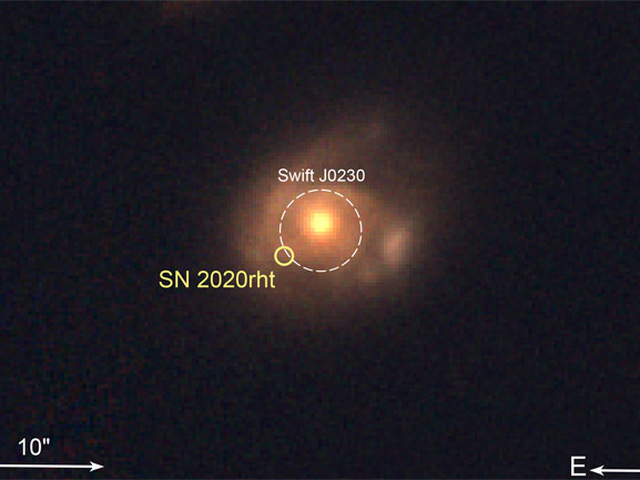
The astronomers were alerted to the star by a bright X-ray flash that seemed to come from the center of the nearby galaxy 2MASX J02301709+2836050, around 500 million light-years away from the Milky Way. Named Swift J0230, it was spotted the moment it happened for the first time using a new tool developed by the scientists for the Neil Gehrels Swift Observatory. They rapidly scheduled further Swift observations of it, finding that instead of decaying away as expected, it would shine brightly for 7-10 days and then abruptly switch off, repeating this process roughly every 25 days. 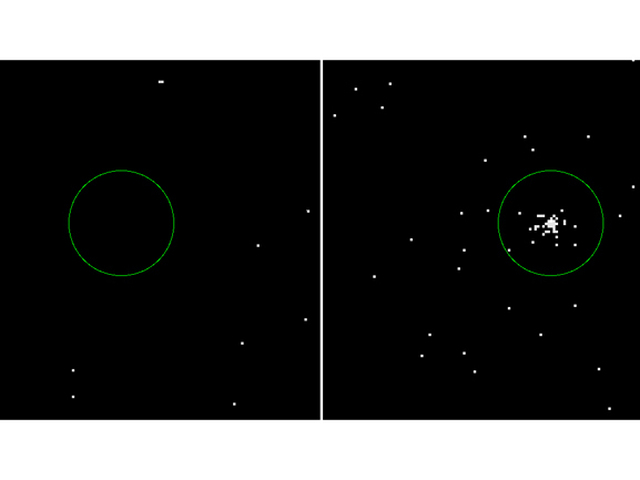
Similar behavior has been observed in what are termed quasi-periodic eruptions and periodic nuclear transients, where a star has material ripped away by a black hole as its orbit takes it close by, but they differ in how often they erupt, and in whether it is in X-rays or optical light that the explosion is predominant. The regularity of Swift J0230’s emissions fell between the two, suggesting that it forms the ‘missing link’ between the two types of outbursts.
Using the models proposed for these two classes of events as a guide, the scientists concluded that the Swift J0230 outburst represents a star of a similar size to our own sun in an elliptical orbit around a low-mass black hole at the center of its galaxy. As the star’s orbit takes it close to the intense gravitational pull of the black hole, material equivalent to the mass of three Earths is wrenched from the atmosphere of the star and heated up as it falls into the black hole. The intense heat, around 2 million degrees Celsius, releases a huge amount of X-rays which were first picked up by the Swift satellite.
Lead author Dr Phil Evans of the University of Leicester School of Physics and Astronomy said: “This is the first time we've seen a star like our Sun being repeatedly shredded and consumed by a low mass black hole. So-called ‘repeated, partial tidal disruption’ events are themselves quite a new discovery and seem to fall into two types: those that outburst every few hours, and those that outburst every year or so. This new system falls right into the gap between these, and when you run the numbers, you find the types of objects involved fall nicely into place too.”
Dr. Rob Eyles-Ferris, who works with Dr. Evans on the Swift satellite, recently completed his Ph.D. at Leicester, which included the study of stars being disrupted by black holes. He explains: “In most of the systems we’ve seen in the past the star is completely destroyed. Swift J0230 is an exciting addition to the class of partially-disrupted stars as it shows us that the two classes of these objects already found are really connected, with our new system giving us the missing link.”
Dr. Kim Page from the University of Leicester, who worked on the data analysis for the study, said: “Given that we found Swift J0230 within a few months of enabling our new transient-hunting tool, we expect that there are a lot more objects like this out there, waiting to be uncovered.”
Dr Chris Nixon is a theoretical astrophysicist who recently moved from the University of Leicester to the University of Leeds. He led the theoretical interpretation of this event. His research is funded by the UK Science and Technology Facilities Council and the Leverhulme Trust.
They estimate that the black hole is around 10,000 to 100,000 times the mass of our sun, which is quite small for the supermassive black holes usually found at the center of galaxies. The black hole at the center of our own galaxy is thought to be 4 million solar masses, while most are in the region of 100 million solar masses.
It is the first discovery to be made using the new transient detector for the Swift satellite, developed by the University of Leicester team and running on their supercomputer. When an extreme event takes place, causing an X-ray burst in a region of the sky where there were previously no X-rays, astronomers call it an astronomical X-ray transient. Despite the extreme events they herald, these events are not easy to find, or at least, not quickly – and so this new tool was developed to look for new types of transients in real-time.
Dr Evans adds: “This type of object was essentially undetectable until we built this new facility, and soon after it found this completely new, never-before-seen event. Swift is nearly 20 years old and it's suddenly finding brand new events that we never knew existed. I think it shows that every single time you find a new way of looking at space, you learn something new and find there's something out there you didn't know about before.”
Dr Caroline Harper, Head of Space Science at the UK Space Agency, said: “This is yet another exciting discovery from the world-leading Swift mission - a low mass black hole taking ‘bites’ from a Sun-like star whenever it orbits close enough.
“The UK Space Agency has been working in partnership with NASA on this mission for many years; the UK led the development of hardware for two of the key science instruments and we provided funding for the Swift Science Data Centre, which we continue to support. We look forward to even more insights from Swift about gamma-ray bursts throughout the cosmos, and the massive events that cause them, in the future.”
The discovery of this ravenous black hole serves as a reminder of the immense power of the universe and the importance of studying it. By understanding the behavior of these objects, we can gain insight into the evolution of galaxies and the formation of stars. This study is a testament to the power of collaboration and the importance of international research efforts. It is a reminder that the universe is full of mysteries and that by working together, we can unlock the secrets of the cosmos.