

A new study sheds light on imaging space debris in high resolution

Litter is not only a problem on Earth. According to NASA, there are currently millions of pieces of space junk in the range of altitudes from 200 to 2,000 kilometers above the Earth’s surface, which is known as low Earth orbit (LEO). Most of the junk is comprised of objects created by humans, like pieces of old spacecraft or defunct satellites. This space debris can reach speeds of up to 18,000 miles per hour, posing a major danger to the 2,612 satellites that currently operate at LEO. Without effective tools for tracking space debris, parts of LEO may even become too hazardous for satellites.

In a paper publishing today in the SIAM Journal on Imaging Sciences, Matan Leibovich (New York University), George Papanicolaou (Stanford University), and Chrysoula Tsogka (University of California, Merced) introduce a new method for taking high-resolution images of fast-moving and rotating objects in space, such as satellites or debris in LEO. They created an imaging process that first utilizes a novel algorithm to estimate the speed and angle at which an object in space is rotating, then applies those estimates to develop a high-resolution picture of the target.

Leibovich, Papanicolaou, and Tsogka used a theoretical model of a space imaging system to construct and test their imaging process. The model depicts a piece of fast-moving debris as a cluster of very small, highly reflective objects that represent the strongly reflective edges of an item in orbit, such as the solar panels on a satellite. The cluster of reflectors all move together with the same speed and direction and rotate about a common center. In the model, multiple sources of radiation on the Earth’s surface—such as the ground control stations of global navigation satellite systems—emit pulses that are reflected by target pieces of space debris. A distributed set of receivers then detects and records the signals that bounce off the targets. 

The model focuses on sources that produce radiation in the X-band, or from frequencies of 8 to 12 gigahertz. “It is well known that resolution can be improved by using higher frequencies, such as the X-band,” Tsogka said. “Higher frequencies, however, also result in distortions to the image due to ambient fluctuations from atmospheric effects.” Signals are distorted by turbulent air as they travel from the target to receivers, which can make the imaging of objects in LEO quite challenging. The first step of the authors’ imaging process was thus to correlate the data taken at different receivers, which can help reduce the effects of these distortions.

The diameter of the area encompassed by the receivers is called the physical aperture of the imaging system — in the model, this is about 200 kilometers. Under normal imaging conditions, the physical aperture’s size determines the resolution of the resulting image; a larger aperture begets a sharper picture. However, the quick movement of the imaging target relative to the receivers can create an inverse synthetic aperture, in which the signals that were detected at multiple receivers as the target moved throughout their field of view are synthesized coherently. This configuration can effectively improve the resolution as if the imaging system had a wider aperture than the physical one.

Objects in LEO can spin on timescales that range from a full rotation every few seconds to every few hundred seconds, which complicates the imaging process. It is thus important to know—or at least be able to estimate—some details about the rotation before developing the image. The authors, therefore, needed to estimate the parameters related to the object’s rotation before synthesizing the data from different receivers. Though simply checking all of the possible parameters to see which ones yield the sharpest image is technically feasible, doing so would require a lot of computational power. Instead of employing this brute force approach, the authors developed a new algorithm that can analyze the imaging data to estimate the object’s rotation speed and the direction of its axis.

After accounting for the rotation, the next step in the authors’ imaging process was to analyze the data to develop a picture of the space debris that would hopefully be as accurate and well-resolved as possible. One method that researchers often employ for this type of imaging of fast-moving objects is the single-point migration of cross-correlations. Though atmospheric fluctuations do not usually significantly impair this technique, it does not have a very high resolution. A different, commonly-used imaging approach called Kirchhoff migration can achieve a high resolution, as it benefits from the inverse synthetic aperture configuration; however, the trade-off is that it is degraded by atmospheric fluctuations. With the goal of creating an imaging scheme that is not too heavily affected by atmospheric fluctuations but still maintains a high resolution, the authors proposed a third approach: an algorithm whose result they call a rank-1 image. “The introduction of the rank-1 image and its resolution analysis for fast-moving and rotating objects is the most novel part of this study,” Leibovich said. 

To compare the performance of the three imaging schemes, the authors gave simulated data of a rotating object in LEO to each one and compared the images that they produced. Excitingly, the rank-1 image was much more accurate and well-resolved than the result of single-point migration. It also had similar qualities to the output of the Kirchhoff migration technique. But this result was not entirely surprising, given the problem’s configuration. “It is important to note that the rank-1 image benefits from the rotation of the object,” Papanicolaou said. Though a rotating object generates more complex data, one can actually incorporate this additional information into the image processing technique to improve its resolution. The rotation at certain angles can also increase the size of the synthetic aperture, which significantly improves the resolution for the Kirchhoff migration and rank-1 images. 

Further simulations revealed that the rank-1 image is not easily muddled by errors in the new algorithm for the estimation of rotation parameters. It is also more robust to atmospheric effects than the Kirchhoff migration image. If receivers capture data for a full rotation of the object, the rank-1 image can even achieve optimal imaging resolution. Due to its good performance, this new imaging method could improve the accuracy of imaging LEO satellites and space debris. “Overall, this study shed light on a new method for imaging fast-moving and rotating objects in space,” Tsogka said. “This is of great importance for ensuring the safety of the LEO band, which is the backbone of global remote sensing.”

Rice's theory could accelerate push for spintronics

Rice University models help ID materials for advanced electronics, computer memories

A new theory by Rice University scientists could boost the growing field of spintronics, devices that depend on the state of an electron as much as the brute electrical force required to push it.

Materials theorist Boris Yakobson and graduate student Sunny Gupta at Rice’s Brown School of Engineering describe the mechanism behind Rashba splitting, an effect seen in crystal compounds that can influence their electrons’ “up” or “down” spin states, analogous to “on” or “off” in common transistors.

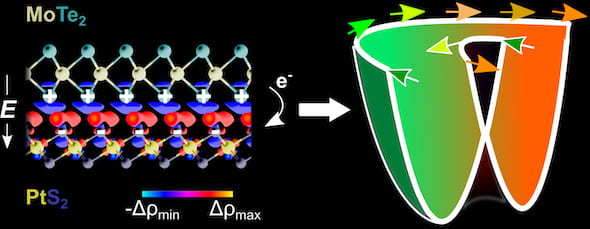
“Spin” is a misnomer, since quantum physics constrains electrons to only two states. But that’s useful because it gives them the potential to become essential bits in next-generation quantum supercomputers, as well as more powerful everyday electronic devices that use far less energy. The image at left shows the crystal structure of a MoTe2|PtS2 heterobilayer with isocharge plots from a model created at Rice University. When the materials are stacked together, mirror symmetry is broken and there is a charge transfer that creates an intrinsic electric field. This field is responsible for Rashba-type spin-splitting shown by the band structure at right, where the spin is perpendicular to momentum. Illustration by Sunny Gupta

However, finding the best materials to read and write these bits is a challenge.

The Rice model characterizes single layers to predict heteropairs — two-dimensional bilayers — that enable large Rashba splitting. These would make it possible to control the spin of enough electrons to make room-temperature spin transistors, a far more advanced version of common transistors that rely on electric current.

“The working principle behind information processing is based on the flow of electrons that can be either off or on,” Gupta said. “But electrons also have a spin degree of freedom that can be used to process information and is the basis behind spintronics. The ability to control electron spin by optimizing the Rashba effect can bring new functionality to electronic devices.

“A cellphone with spin-related memory would be much more powerful and much less energy-consuming than it is now,” he said.

Yakobson and Gupta would like to eliminate the trial and error of finding materials. Their theory, presented in the Journal of the American Chemical Society, aims to do just that.

“Electron spins are tiny magnetic moments that usually require a magnetic field to control,” Gupta said. “However, manipulating such fields on the small scales typical in computing is very difficult. The Rashba effect is the phenomenon that allows us to control the electron spin with an easy-to-apply electric field instead of a magnetic field.”

Yakobson’s group specializes in atom-level computations that predict interactions between materials. In this case, their models helped them understand that calculating the Born effective charge of the individual material components provides a means to predict Rashba splitting in a bilayer.

“Born effective charge characterizes the rate of the bond polarization change under external perturbations of the atoms,” Gupta said. “When two layers are stacked together, it effectively captures the resulting change in lattices and charges, which brings about the overall interlayer polarization and interface field responsible for the Rashba splitting.”

Sunny Gupta

Their models turned up two heterobilayers — lattices of MoTe2|Tl2O or MoTe2|PtS2 — that are good candidates for the manipulation of Rashba spin-orbit coupling, which happens at the interface between two layers held together by the weak van der Waals force. (For the less-chemically inclined, Mo is molybdenum, Te is tellurium, Tl is thallium, O is oxygen, Pt is platinum and S is sulfur.)

Gupta noted the Rashba effect is known to occur in systems with broken inversion symmetry — where the spin of the electron is perpendicular to its momentum — that generates a magnetic field. Its strength can be controlled by an external voltage.

“The difference is that the magnetic field due to the Rashba effect depends on the electron’s momentum, which means the magnetic field experienced by a left-moving and right-moving electron is different,” he said. “Imagine an electron with spin pointing in the z-direction and moving in the x-direction; it will experience a momentum-dependent Rashba magnetic field in the y-direction, which will precess the electron along the y-axis and change its spin orientation.”

Where a traditional field-effect transistor (FET) turns on or off depending on the flow of charge across a barrier with gate voltage, spin transistors control the spin precession length by a gate electric field. If the spin orientation is the same at the transistor’s source and drain, the device is on; if the orientation differs, it’s off. Because a spin transistor does not require the electronic barrier found in FETs, it needs less power.

“That gives spintronic devices an enormous advantage compared to conventional charge-based electronic devices,” Gupta said. “Spin states can be set quickly, which makes transferring data quicker. And spin is nonvolatile. Information sent using spin remains fixed even after a loss of power. Moreover, less energy is needed to change spin than to generate current to maintain electron charges in a device, so spintronics devices use less power.”

“To the chemist in me,” Yakobson said, “the revelation here that spin-splitting strength depends on the Born charge is, in a way, very similar to the bond ionicity versus the electronegativity of the atoms in Pauling’s formula. This parallel is very intriguing and deserves further exploration.”

Softline wins second place in Microsoft E5 Open Hackathon

Microsoft E5 OpenHack is a space that brings together teams of developers and experts to solve several experimental issues that some customers could potentially have, usually caused by cyber-attacks. The E5 Open Hackathon is another competition where Microsoft has dedicated it to cybersecurity solutions. This time, partners in India and the Asia Pacific worked for four days to create best-in-class security solutions using Azure Sentinel and Azure Security Center.

  • Microsoft 365 is the Company’s premium offering to enable customers to create secure, compliant, and collaborative “Modern Workplaces”.
  • Microsoft relies on their trusted Network of Gold Certified Partners to help customers realize the potential of Microsoft 365 under their specific needs and requirements.
  • The “Microsoft E5 Open Hackathon” is a yearly event meant to accelerate the development of skills in their Partner Ecosystem as well as to showcase some of their most strategic partners in the field within India and the Asia Pacific regions.
  • It being one of Softline’s core strengths, the company presented two teams with a member from the Softline India and Vietnam offices who collaborated to create a cybersecurity solution for a large electronics manufacturer with more than 2000 employees.
  • The challenge was to design a transformation program for the customer's information security system by experts on  Microsoft 365 Defender and Azure Defender technologies as per the Zero Trust model.
  • The competition ended with the jury awarding Softline as the second-best winner at the Hackathon

Softline’s team worked remotely with a large electronics manufacturer with over 2,000 employees. Given the context of an ever-changing threat landscape of global cyber-attacks and the lack of knowledge or tools thereof to detect and prevent them, the realized its vulnerability and the need to act and protect its business.

Softline offered the customer to implement a robust cyber-threat transformation program:

  • The first phase included solution areas to strengthen the client's IT infrastructure without any additional investment.
  • The second phase was to deploy an advanced detection and response system that gathers an in-depth analysis of information.
  • The final stage of implementation included an enterprise visualization tool using Azure Sentinel, which in the future will pre-empt and apprise the organization about possible threats and stay ahead of potential attacks.

“We differentiated our proposed solution by demonstrating how Azure Sentinel’s unique features can revolutionize security operations with assured support from Softline. For organizations that use cloud and artificial intelligence solutions, we have provided a clear action plan so that they can react quickly and decisively, using both built-in and customizable dashboards if a cyber threat emerges,” explains Atul Ahuja, Vice President Asia. “The way technology is evolving today is really amazing. What used to be a long time-consuming task, can now be done in minutes and it keeps improving every second. I’m really proud to say that we’ve received the second-best position at the Hackathon, it clearly demonstrates that we are not just only one of the best and most reliable Microsoft partners in Asia but also that we also have built extensive capabilities in some of the cutting edge technologies that keep us ahead.”