Hewlett Packard's supercomputers sales drop 9% in Q1

Hewlett Packard Enterprise has announced financial results for the first quarter, ended January 31, 2021.

Q1 2021 Financial Highlights:

  • Revenue: $6.8 billion exceeded Q1 outlook with stronger than normal sequential seasonality
    • Supercomputers revenue was $762 million, down 9% year over year, with a 5.6% operating profit margin, compared to 7.5% from the prior-year period
    • Intelligent Edge revenue: $806 million, up 11% from the prior-year period when adjusted for currency
    • Annualized revenue run-rate (ARR): $649 million, up 27% from the prior-year period
    • Core businesses delivered strong profitability and cash flow
  • Diluted net earnings per share (“EPS”):
    • GAAP of $0.17, above the previously provided outlook of $0.02 to $0.06 per share
    • Non-GAAP of $0.52, above the previously provided outlook of $0.40 to $0.44 per share
  • Cash flow from operations of approximately $1.0 billion, up $1.0 billion from the prior-year period
  • Generated record free cash flow of $563 million, up $748 million from the prior-year period

Dividend: declared a regular cash dividend of $0.12 per share, payable on April 7, 2021

Outlook:

  • Fiscal 2021 Second quarter: Estimates GAAP diluted net EPS to be in the range of $0.02 to $0.08 and non-GAAP diluted net EPS to be in the range of $0.38 to $0.44
  • Fiscal 2021: Raises GAAP diluted net EPS outlook to $0.48 to $0.66 and non-GAAP diluted net EPS outlook to $1.70 to $1.88
  • Fiscal 2021 free cash flow: Raises free cash flow guidance to $1.1 to $1.4 billion

“We delivered a strong Q1 performance,” said Antonio Neri, president, and CEO of Hewlett Packard Enterprise. “Our revenue exceeded our outlook and we significantly expanded our gross and operating margins to drive strong profitability across most of our businesses. Our non-GAAP EPS exceeded the high-end of our guidance and free cash flow was a record Q1 performance. These results give us the confidence to raise our FY21 outlook.”

“The global pandemic has brought a renewed focus on digital transformation as businesses are rethinking everything from remote work and collaboration to business continuity and data insight,“ he continued. “As the world heads to recovery, our customers are looking for the agility and simplicity of the cloud-native world with the flexibility and control of a hybrid business model – and this is where we have a unique and differentiated value proposition.”

“Our dedicated, passionate and resilient team members are laser-focused on delivering for our customers and executing our strategy to strengthen our core businesses, double down in areas of growth, and accelerate our pivot to as-a-service to drive long-term sustainable, profitable growth,” said Neri.

First Quarter Fiscal Year 2021 Results

Net revenue of $6.8 billion, down 2% from the prior-year period or 3% when adjusted for currency, marked by stronger than normal sequential seasonality.

Annualized revenue run-rate (ARR) of $649 million, up 27% from the prior-year period. Based on strong customer demand and recent wins, we are reiterating our 2019 Securities Analyst Meeting ARR guidance of 30-40% Compounded Annual Growth Rate from fiscal year 2019 to fiscal year 2022.

GAAP gross margins of 33.5%, up 70 basis points from the prior-year period and Non-GAAP gross margins of 33.7%, up 30 basis points from the prior-year period.

GAAP diluted net earnings per share (“EPS”) was $0.17, compared to $0.25 in the prior-year period and above the previously provided outlook of $0.02 to $0.06 per share.

Non-GAAP diluted net EPS was $0.52, compared to $0.50 in the prior-year period and above the previously provided outlook of $0.40 to $0.44 per share. First quarter non-GAAP net earnings and non-GAAP diluted net EPS exclude after-tax adjustments of $456 million and $0.35 per diluted share, respectively, primarily related to transformation costs, stock-based compensation expense and the amortization of intangible assets.

Cash flow from operations of approximately $1.0 billion, up $1.0 billion from the prior-year period.

Free cash flow of $563 million, up $748 million from the prior-year period.

Segment Results

  • Intelligent Edge revenue was $806 million, up 12% year over year or 11% when adjusted for currency, with 18.9% operating profit margin, compared to 12.1% from the prior-year period. Rich software capabilities combined with greater operational productivity helped accelerate revenue and profits. Based on the solid performance, the Company expects to continue to take share in both campus switching and WLAN.
  • High-Performance Compute & Mission Critical Systems (HPC & MCS) revenue was $762 million, down 9% year over year, with a 5.6% operating profit margin, compared to 7.5% from the prior-year period. Despite the inherent uneven nature of the business, the Company remains confident in the near-term and longer-term outlook for this business.
  • Compute revenue was $3.0 billion, down 1% year over year or down 2% when adjusted for currency, with 11.5% operating profit margin, compared to 10.7% from the prior-year period.
  • Storage revenue was $1.2 billion, down 5% year over year or down 6% when adjusted for currency, with 19.7% operating profit margin, compared to 20.0% from the prior-year period. Notable strength in software-defined solutions, including Nimble, up 31% from the prior-year period when adjusted for currency and All-Flash Array Storage, up 5% from the prior-year period, driven by increased adoption of Primera All Flash.
  • Financial Services revenue was $860 million, flat year over year or down 1% when adjusted for currency, with 9.8% operating profit margin, compared to 8.7% from the prior-year period. Net portfolio assets were up 3% year over year or flat when adjusted for currency. The business delivered a return on equity of 16.5%, up 1.3 points from the prior-year period.

Dividend

The Board of Directors has declared a regular cash dividend of $0.12 per share on the company's common stock. This dividend, the second in Hewlett Packard Enterprise's fiscal year 2021, is payable on April 7, 2021, to stockholders of record as of the close of business on March 10, 2021.

Fiscal 2021 second-quarter outlook:

Hewlett Packard Enterprise estimates GAAP diluted net EPS to be in the range of $0.02 to $0.08 and non-GAAP diluted net EPS to be in the range of $0.38 to $0.44. Fiscal 2021 second quarter non-GAAP diluted net EPS estimates exclude after-tax adjustments of approximately $0.36 per diluted share, primarily related to transformation costs, stock-based compensation expense, and the amortization of intangible assets.

Fiscal 2021 outlook:

Hewlett Packard Enterprise raises GAAP diluted net EPS outlook to $0.48 to $0.66 from $0.38 to $0.56 and non-GAAP diluted net EPS outlook to $1.70 to $1.88 from $1.60 to $1.78. Fiscal 2021 non-GAAP diluted net EPS estimates exclude after-tax adjustments of approximately $1.22 per diluted share, primarily related to transformation costs, stock-based compensation expense, and the amortization of intangible assets.

Raises free cash flow guidance range to $1.1 to $1.4 billion from $0.9 to $1.1 billion.

A quantum internet is closer to reality, thanks to Purdue's switch

The new approach could help quantum networks to support more users without losing data

When quantum supercomputers become more powerful and widespread, they will need a robust quantum internet to communicate.

Purdue University engineers have addressed an issue barring the development of quantum networks that are big enough to reliably support more than a handful of users.

The method, demonstrated in a paper published in Optica, could help lay the groundwork for when a large number of quantum computers, quantum sensors, and other quantum technology are ready to go online and communicate with each other. Purdue University researchers have demonstrated a new method for building quantum networks that can support communication between a larger number of quantum computers. (Credit: Pixabay)

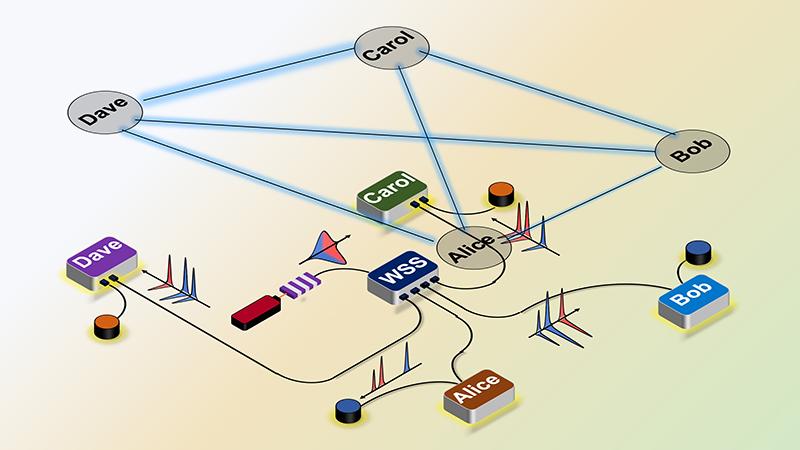
The team deployed a programmable switch to adjust how much data goes to each user by selecting and redirecting wavelengths of light carrying the different data channels, making it possible to increase the number of users without adding to photon loss as the network gets bigger.

If photons are lost, quantum information is lost – a problem that tends to happen the farther photons have to travel through fiber-optic networks.

“We show a way to do wavelength routing with just one piece of equipment – a wavelength-selective switch – to, in principle, build a network of 12 to 20 users, maybe even more,” said Andrew Weiner, Purdue’s Scifres Family Distinguished Professor of Electrical and Computer Engineering. “Previous approaches have required physically interchanging dozens of fixed optical filters tuned to individual wavelengths, which made the ability to adjust connections between users not practically viable and photon loss more likely.”

Instead of needing to add these filters each time that a new user joins the network, engineers could just program the wavelength-selective switch to direct data-carrying wavelengths over to each new user – reducing operational and maintenance costs as well as making a quantum internet more efficient.

The wavelength-selective switch also can be programmed to adjust bandwidth according to a user’s needs, which has not been possible with fixed optical filters. Some users may be using applications that require more bandwidth than others, similarly to how watching shows through a web-based streaming service uses more bandwidth than sending an email.

For a quantum internet, forming connections between users and adjusting bandwidth means distributing entanglement, the ability of photons to maintain a fixed quantum mechanical relationship with one another no matter how far apart they may be to connect users in a network. Entanglement plays a key role in quantum supercomputing and quantum information processing.

“When people talk about a quantum internet, it’s this idea of generating entanglement remotely between two different stations, such as between quantum computers,” said Navin Lingaraju, a Purdue Ph.D. student in electrical and computer engineering. “Our method changes the rate at which entangled photons are shared between different users. These entangled photons might be used as a resource to entangle quantum computers or quantum sensors at the two different stations.” Using a programmable wavelength-selective switch can help increase the number of users in a quantum network without increasing photon loss from the switching device, a new study shows. (Purdue University image/Navin Lingaraju)

Purdue researchers performed the study in collaboration with Joseph Lukens, a research scientist at Oak Ridge National Laboratory. The wavelength-selective switch that the team deployed is based on similar technology used for adjusting bandwidth for today’s classical communication.

The switch also is capable of using a “flex grid,” like classical lightwave communications now uses, to partition bandwidth to users at a variety of wavelengths and locations rather than being restricted to a series of fixed wavelengths, each of which would have a fixed bandwidth or information-carrying capacity at fixed locations.

“For the first time, we are trying to take something sort of inspired by these classical communications concepts using comparable equipment to point out the potential advantages it has for quantum networks,” Weiner said.

Russian scientists develop biomolecule elements for the future electronics

SPbPU researchers are developing thin films, the elements for biomolecular electronics

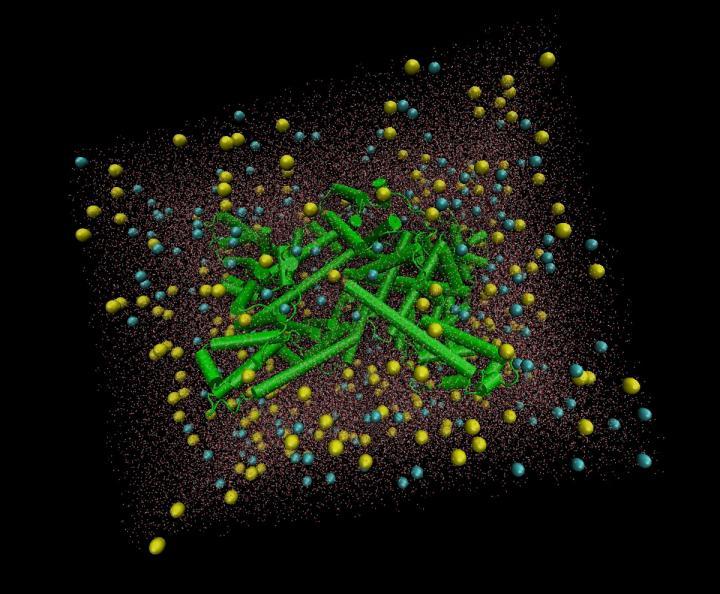
Modern electronics is approaching the limit of its capabilities, which are determined by the fundamental laws of physics. Therefore, the use of classical materials, for example, silicon, is no longer able to meet the requirements for energy efficiency of the devices. Currently, it is necessary to start searching for new materials, new principles of electronic devices' functioning. To solve this problem, researchers of Peter the Great St.Petersburg Polytechnic University (SPbPU) are developing thin films, the elements for biomolecular electronics. Scientists believe that biological macromolecules such as nucleic acids, proteins, amino acids can become a promising material for modern electronics. It obtains several unique properties, for example, the self-organization ability, which is why the molecules can be assembled into certain structures, for example, into biomolecular films. Albumin protein molecule in the water environment.

"Our scientific group is investigating various properties of the thin films based on the albumin protein. In the course of experiments, we dilute the protein in various concentrations and use the method of isothermal dehydration (water evaporation at a certain temperature and pressure) to form the biomolecular films. Depending on the composition of the initial samples and drying parameters, we obtain different structures inside the films, " notes Maxim Baranov, an assistant at the Higher School of Applied Physics and Space Technologies SPbPU.

Using an optical microscope, the scientists fixed the structures inside the dried albumin proteins, and also developed software in Python, which can isolate and analyze images of biomolecular films with a help of the special mathematical apparatus. Molecular modeling for solving this problem is carried out at the facilities of the Supercomputer Center "Polytechnic". The research results were published in the first quartile journal Symmetry by MDPI.

Maxim Baranov adds: "Semiconductor integrated circuits, which are currently used in electronic devices, have a stationary configuration. In turn, the functioning of proteins is based on dynamics, i.e. a biological system can transform in the process of interaction with other objects. Therefore, the molecules can perfectly repeat the required structure, for example as in integrated circuits. However, we expect a lower number of defects in the biomolecular thin films. We can't say that the biomolecular platform will completely replace the classic semiconductor devices. Rather, we are talking about its symbiosis. Our scientific group believes that thin films will be introduced not in the mass market of electronics, but rather in single applications."

According to scientists, various types of proteins can be used for further research, including plant proteins. Perhaps in the future, it will simplify the creation of biomolecular thin films. Currently, it is necessary to create a certain set of mathematical parameters for a more accurate description of the thin films and their properties. A large number of experiments will be carried out before a prototype of the element is created, which could be implemented into the future device.