

Russian scientists develop method for predicting solar radio flux for two years ahead

Scientists at the Skolkovo Institute of Science and Technology (Skoltech) and their colleagues from the University of Graz & the Kanzelhöhe Observatory (Austria) and the ESA European Space Operations Centre developed a method and software called RESONANCE to predict the solar radio flux activity for 1-24 months ahead. RESONANCE will serve to improve the specification of satellite orbits, re-entry services, modeling of space debris evolution, and collision avoidance maneuvers. The research results were published in the Astrophysical Journal Supplement Series.

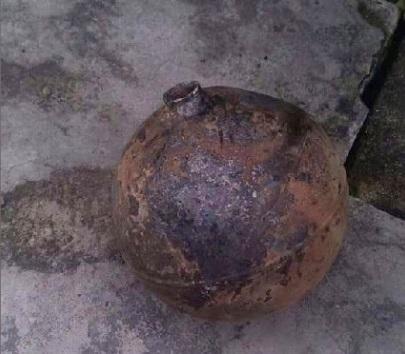
Since the launch of Sputnik, the Earth's first artificial satellite, in 1957, more than 41,500 tons of manmade objects have been placed in orbit around the Sun, the Earth, and other planetary bodies. Since that time, the majority of objects, such as rocket bodies and large pieces of space debris, re-entered the Earth's atmosphere in an uncontrolled way, posing a potential hazard to people and infrastructure. Predicting the re-entry date and time is a challenging task, as one needs to specify the density of the upper Earth atmosphere that strongly depends on solar activity which, in turn, is hard to predict. Earth's atmosphere can become very heated due to solar activity which causes it to expand, and a satellite can decay in its orbit and fall back to the Earth due to the effect known as atmospheric drag. In addition, there is a lot of space debris, much of it very small; if a spacecraft unexpectedly changes its orbit and encounters even a small piece of debris, this would be equivalent to hitting a bomb because of the high speed. A piece of a re-entering space object found in Indonesia. The sphere measures about 50 cm in diameter and weighs 7.4 kg.  CREDIT ESA
An international group of scientists led by Skoltech professor Tatiana Podladchikova developed a new method and software called RESONANCE ("Radio Emissions from the Sun: ONline ANalytical Computer-aided Estimator") which provides predictions of the solar radio flux at F10.7 and F30 cm with a lead time of 1 to 24 months. The F10.7 and F30 indices represent the flux density of solar radio emissions at a wavelength of 10.7 and 30 cm averaged over an hour and serve as a solar proxy of the ultraviolet solar emission which heats the Earth's upper atmosphere. The method combines state-of-art physics-based models and advanced data assimilation methods, where the resulting F10.7 and F30 forecasts are used as solar input in the re-entry prediction tool for further estimation of an object re-entry time.

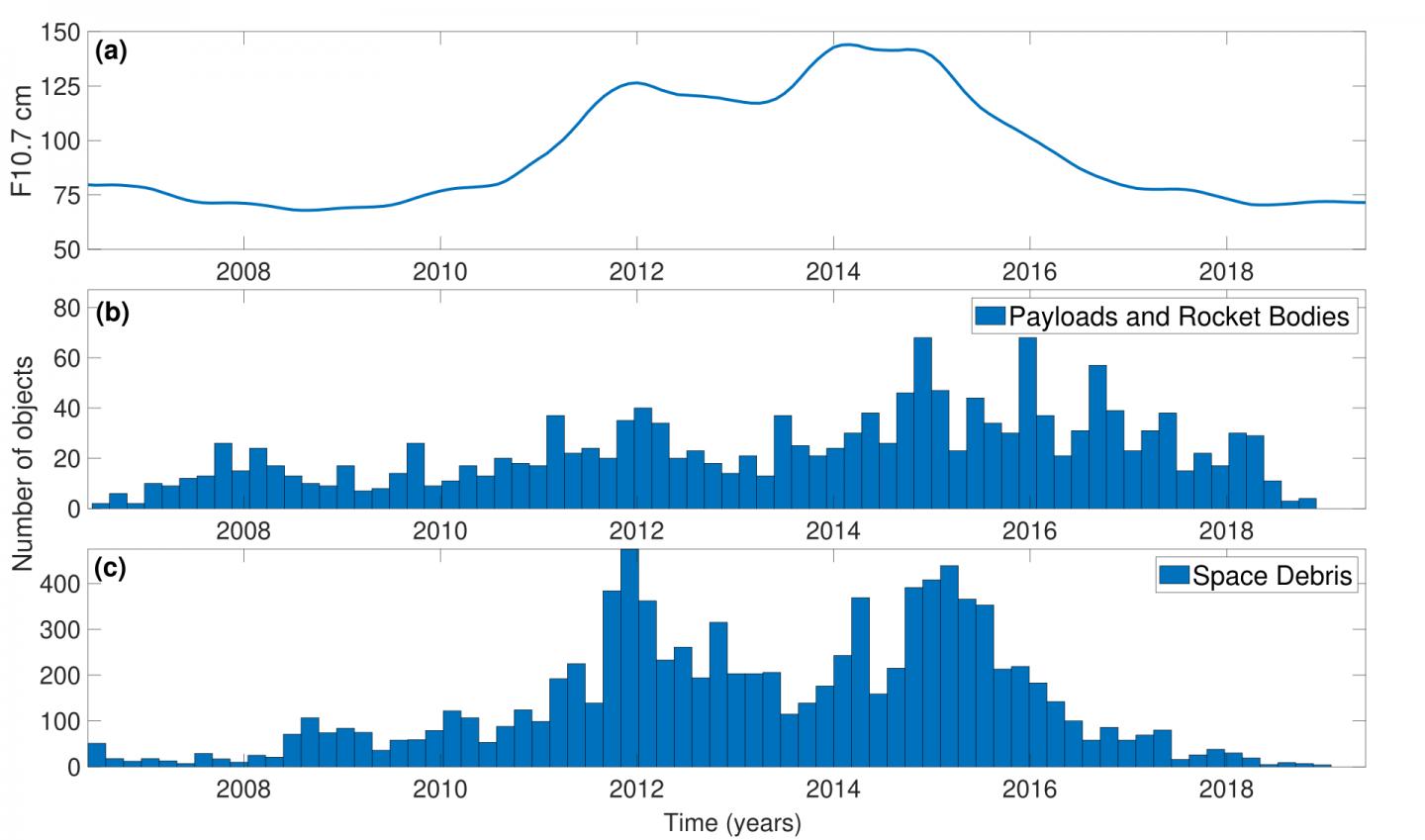
"We systematically evaluated the performance of RESONANCE in providing re-entry predictions on past ESA re-entry campaigns for 602 payloads and rocket bodies as well as 2,344 objects of space debris that re-entered from 2006 to 2019 over the full 11-year solar cycle. The test results demonstrated that the predictions obtained by RESONANCE in general also lead to improvements in the forecasts of re-entry epochs and can thus be recommended as a new operational service for re-entry predictions and other space weather applications," says lead author and Skoltech's MSc graduate Elena Petrova who is currently pursuing her Ph.D. studies at the Centre for Mathematical Plasma Astrophysics, Catholic University of Leuven (KU Leuven).

"The number of re-entered objects is closely related to the solar activity level: the majority of objects return during the maximum solar activity phase within the 11-year cycle. Interestingly, the space debris re-entry time closely follows the evolution of the cycle, reacting immediately to changes in solar activity. At the same time, payloads and rocket bodies also show a large number of re-entries during the declining phase of the cycle, which may be related to the time delay between solar activity and re-entry for large objects", says professor Astrid Veronig, a co-author of the study and director of Kanzelhöhe Observatory at the University of Graz.

{media load=media,id=255,width=350,align=left,display=inline}

"It is very important to monitor and predict solar activity for orbit prediction needs. For example, Skylab which was intended to perform a controlled re-entry in the 1970s dropped on Earth in an uncontrolled way due to inaccurate calculations of the atmospheric drag due to solar activity. Another example is the most recent launch of the Chinese Long March 5B rocket on May 9, 2021: the remnants from its second stage that carried China's first space station module made an uncontrolled re-entry and landed in the Indian Ocean. Thus the development of robust and reliable space weather operational services bringing together the forefront of research with engineering applications is of prime importance for the protection of space and ground-based infrastructures and advancement of space exploration. And whatever storms may rage, we wish everyone good weather in space," says Tatiana Podladchikova, assistant professor at the Skoltech Space Center (SSC) and a research co-author. Frequency of re-entered objects during 11-year solar cycle 24. Top: F10.7 cm radio flux data. Middle: Number of payloads and rocket bodies re-entered. Bottom: Number of objects of space debris re-entered.  CREDIT Petrova et al., 2021
Currently, the team is preparing RESONANCE for operational use as part of a new space weather service for continuous prediction of solar radio flux activity.

CEA, IFP Energies nouvelles renew their collaboration

The CEA and IFP Energies nouvelles (IFPEN) have just signed an agreement extending their collaboration initiated in 2007 on the numerical code framework called Arcane in the field of high-performance computations.

The CEA Military Applications Division launched the Arcane software platform in 2000 within the scope of the Simulation program. It is used to optimize the performance of large parallel-processing supercomputers and to manage complex data for 3D unstructured meshes. Thanks to its sophisticated object-oriented design, Arcane is both flexible and modular in its construction of simulation software, offering different levels of reading. It also gives players involved in the development process (physicists, numerical analysts, and computer scientists) the opportunity to focus on their core activities. This approach simplifies the development of innovative scientific tools in shorter time frames. vignettearcane 2 02b9a

Since 2007, the CEA and IFPEN have been working together to further develop the Arcane platform, sharing technical breakthroughs along the way. IFPEN Ressources Energétiques Carnot Institute has recently been exploiting this platform to develop a new-generation simulator for its research in geosciences.

Since the end of nuclear testing in 1996, the Simulation program has ensured the safety and reliability of nuclear weapons for France. It is based on the modeling of physical phenomena that describe how nuclear weapons work, resolving equations using supercomputers, and experimental validation in large test facilities.

  • Interactive development environments (IDE), with improvements to end-user support, from writing algorithms to debugging in a parallel configuration
  • Performance of computer codes, with adaptations to the platform to accept new architectures combining processors and accelerators
  • Software engineering, including steps to modularise the platform
  • Open-source distribution of the Arcane platform.

The open-source licensing of Arcane represents a key milestone in the platform’s development, enabling its promotion within the scientific community, fast-tracking collaboration with other research organizations and universities (internships, PhDs, and post-doctoral research), simplifying contributions to public-funded projects (ANR, future investments program, etc.), and encouraging the submission of articles in journals and for conferences.

Warwick, EPFL team uses phage to discover new antifreeze proteins

Controlling and mitigating the effects of ice growth is crucial to protect infrastructure, help preserve frozen cells, and enhance frozen foods' texture. An international collaboration of Warwick Scientists working with researchers from Switzerland has used a phage display platform to discover new, small, peptides which function like larger antifreeze proteins. This presents a route to new, easier to synthesize, cryoprotectants.

Ice binding proteins, which include antifreeze proteins, are produced by a large range of species from fish, to insects to plants, to prevent the damage caused by ice. The proteins achieve the remarkable function of recognizing and binding to ice, even in the huge excess of water (which ice is the solid form of). New antifreeze proteins have typically been discovered by isolation from the organisms.

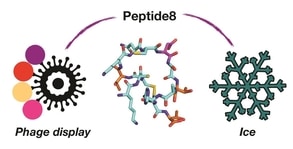
In this work, the team took a very different approach by screening billions of possible peptides to find those which could bind to ice. This was achieved by Phage Display – a technology whereby a virus is used to generate vast numbers of peptides, and those which ‘bind’ to the ice can be isolated.

Using this a cyclic peptide of just 14 amino acids (which is very short compared to a typical protein) was discovered which could bind to ice. The team used supercomputer simulations to understand how the peptide binds to the ice, which is not possible by ‘wet’ experimental techniques alone. The team also showed how this short peptide can help purify other proteins by ace affinity purification. gibson sosso crop 5df26

By identifying these short peptides, it means researchers can now simply make (or buy) modified peptides to understand and probe how these interact with ice and help design new cryoprotectants with simplified structures, and hence lower cost.

In the paper A Minimalistic Cyclic Ice-Binding Peptide from Phage Display, the international team including the University of Warwick and led by EPFL, Switzerland, have demonstrated the use of phage display to discover new minimalistic antifreeze peptides, which could not be achieved by conventional tools, which would not allow the billions of potential structures to be screened.

Dr. Gabriele Sosso, Assistant Professor at the University of Warwick, in the Department of Chemistry commented, “This work highlights that even very small changes within the structure of these peptides can make a huge difference in their ability to control the formation of ice. Our computer simulations allowed us to identify and understand the importance of these structural changes – which is a key step toward the rational design of synthetic cryoprotectants.

“It is such a privilege to be able to leverage both the experimental work of Gibson’s group and the computational resources of the SCRTP. Truly, Warwick is a great place to be if you want to understand how ice forms and what can we do to have a say in this process.”

Professor Matthew Gibson, Professor at the University of Warwick in the Department of Chemistry and Warwick Medical School adds:

“We have been working on developing synthetic tools to understand, and interfere with, ice growth processes to help develop new cryoprotectants. This work was really exciting, as we used biotechnology tools (phage) to discover small, cyclic, peptides that are remarkably potent.

“These peptides are easy to synthesis and modify and will accelerate our research in this field. It also highlights the growing ‘team ice’ collaborative network at Warwick, combining experimental and computation studies. We are also grateful for the support from the IAS at Warwick, which allowed Dr. Stevens to visit us to complete this work, showing the need to support international scientific collaborations.”