

SUPERCOMPUTING NEWS SUPERCOMPUTING NEWS
    • MEDIA KIT
    • MOST READ
    • RSS FEED
    • ACADEMIA
    • AEROSPACE
    • APPLICATIONS
    • ASTRONOMY
    • AUTOMOTIVE
    • BIG DATA
    • BIOLOGY
    • CHEMISTRY
    • CLIENTS
    • CLOUD
    • DEFENSE
    • DEVELOPER TOOLS
    • EARTH SCIENCES
    • ECONOMICS
    • ENGINEERING
    • ENTERTAINMENT
    • GAMING
    • GOVERNMENT
    • HEALTH
    • OIL & GAS
    • INDUSTRY
    • INTERCONNECTS
    • MANUFACTURING
    • MIDDLEWARE
    • MOVIES
    • NETWORKS
    • PHYSICS
    • PROCESSORS
    • RETAIL
    • SCIENCE
    • STORAGE
    • SYSTEMS
    • VISUALIZATION
    • AcyMailing subscription form

    • ADD YOUR VIDEOS
    • MANAGE VIDEOS
    • CONVERSATION INBOX
    • SOCIAL ADVERTISER
    • SOCIAL NETWORK VIDEOS
    • SURVEYS
    • GROUPS
    • PAGES
    • MARKETPLACE LISTINGS
    • APPLICATIONS BROWSER
    • PRIVACY CONFIRM REQUEST
    • PRIVACY CREATE REQUEST
    • LEADERBOARD
    • POINTS LISTING
      • BADGES
    • TRADE SHOWS
Sign In
Tyler O'Neal, Staff Editor HEALTH April 6, 2021, 8:00 am

Kaiserslautern founding team develops software that can revolutionize semiconductor development

A team of engineers from Technische Universität Kaiserslautern (TUK) is developing a software tool to support companies in the semiconductor industry in agile chip design. Through early testing and verification, the solution can help customers provide feedback and correct defects early in the design process. The engineers aim to market their tool under the name "LUBIS EDA". From April 12 to 16, they will present their platform at the digital Hanover Fair at the Rhineland-Palatinate research and innovation stand.

The engineers Tobias Ludwig, Michael Schwarz, and Dr. Max Birtel have joined forces with software developer Tim Burr to bring concepts from the software domain to chip development.

"In terms of hardware design, not much has changed in the industry over the last few decades," Ludwig explains. "The focus has been on making the existing process faster. The idea of completely redesigning this with the help of agile approaches and thus making a big leap forward when it comes to achieving time-to-market has not yet taken off."

The founding team (from left to right): Tim Burr, Tobias Ludwig, Michael Schwarz and Dr. Max Birtel. Credit: Thomas Koziel/TUK
The founding team is now offering the semiconductor industry the right toolbox to unleash this untapped potential. "Our software solution enables companies to transfer proven approaches from agile software development to the world of hardware," says Ludwig. "More customer proximity, faster releases, error minimization in initial design - all of this is also possible in hardware development."

The decisive advantage lies in early and continuous testing because it takes place not at the end, but after each adaptation step. This significantly reduces the total time required to verify the chip. "Based on experience, we can guarantee at least 10 percent time savings, just in testing," says Birtel. "Since the development costs for a chip range from two to as much as six million euros per project, depending on the complexity, it's obvious what savings potential opens."

The new methodology can be introduced easily, as the development tool can be operated in parallel with existing development environments. “Chip manufacturers can use our software to convert abstract specifications into a virtual prototype that provides all the functionality, before producing the hardware," Birtel says.

The agile system can be used to achieve all development goals that are relevant in the semiconductor industry - from the smallest possible chips to the most energy-efficient to the most powerful. "Almost 15 years of development work have gone into our tool. Now we are ready for pilot projects to evaluate our software solution in specific use cases," Birtel says.

The German Federal Ministry for Economic Affairs and Energy and the European Social Fund's development to market maturity was being funded until March 2021 as part of an EXIST research transfer called "Syncopate" (03EFORP026). Also, the start-up office of the TU Kaiserslautern and the Kaiserslautern University of Applied Sciences has advised the engineers.

How it all began: Ludwig further developed existing methods that enable agile hardware development as part of his doctoral thesis at the chair of Electronic Design Automation under Professor Dr. Wolfgang Kunz at TUK. Together with his doctoral colleague Schwarz, he recognized their potential, set his sights on founding the company, and brought on board Birtel, an industrial engineer who complements the technical engineer's perspective with business skills. Most recently, software developer Burr completed the team.

Japanese scientist develops a new 'quantum' approach that helps solve an old problem in materials science

Tyler O'Neal, Staff Editor HEALTH April 5, 2021, 6:00 pm

One of the most important classes of problems that all scientists and mathematicians aspire to solve, due to their relevance in both science and real life, is optimization problems. From esoteric computer science puzzles to the more realistic problems of vehicle routing, investment portfolio design, and digital marketing--at the heart of it all lies an optimization problem that needs to be solved.

An appealing technique often used in solving such problems is the technique of "quantum annealing", a framework that tackles optimization problems by using "quantum tunneling"--a quantum physical phenomenon--to pick an optimum solution out of several candidate solutions. Ironically, it is in quantum mechanical problems where the technique has found rather scarce application! "Chemists and materials scientists, who deal with quantum problems, are mostly unfamiliar with quantum annealing and so do not think to use it. Finding applications of this technique is therefore important for increasing its recognition as a useful method in this domain," says Prof. Ryo Maezono from Japan Advanced Institute of Science and Technology (JAIST), who specializes in applying information science to the field of materials science.

To that end, Prof. Maezono explored, in a recent study published in Scientific Reports, the phenomenon of ionic diffusion in solids, a topic of great interest in both pure and applied materials science, along with his colleagues, Keishu Utimula, a Ph.D. graduate in materials science from JAIST (in 2020) and lead author of the study, Prof. Kenta Hongo, and Prof. Kousuke Nakano, by applying a framework that combined quantum annealing with ab initio calculations, a method that calculates physical properties of materials without relying on experimental data. "While current ab initio techniques can provide information about diffusion path networks of the ions, it is difficult to map that information into useful knowledge of the diffusion coefficient, a practically relevant quantity," explains Prof. Maezono. In this figure, the hopping amplitude and existence of possible pathways for atomic migrations [panel (a)] can be identified at the microscopic level. But it is not easy to count all the chosen pathways using the magnitude of hopping amplitude [(b)]. To understand the properties of a material, it is necessary to be able to count the latter.  CREDIT Ryo Maezono from JAIST

Specifically, the team looked to calculate the "correlation factor", a key quantity in the diffusion process, and realized that this could be done by framing the process as a routing optimization problem, which is precisely what the quantum annealing framework is designed to solve! Accordingly, scientists calculated the correlation factor for a simple two-dimensional tetragonal lattice, for which they already knew the exact result, using quantum annealing and a variety of other computational techniques and compared their outputs.

While the evaluated correlation factors were consistent with the analytical result for all the methods employed, all the approaches suffered from limitations due to unrealistic computational costs for large system sizes. However, scientists noted that the computational expense for quantum annealing grew much more slowly in a linear fashion compared to the other techniques, which showed rapid exponential growth.

Prof. Maezono is excited by the finding and is confident that, with sufficient technological advancement, quantum annealing would present itself as the best possible choice for solving problems in materials science. "The problem of ion diffusion in solids is of central importance in building smaller batteries with higher capacity or improving the strength of steel. Our work shows that quantum annealing is effective in solving this problem and can expand the scope of materials science as a whole," he concludes.
Harvard researcher makes long-lasting molecules for molecule-based quantum supercomputing

Tyler O'Neal, Staff Editor HEALTH April 5, 2021, 12:00 pm

In 2018, Kang-Kuen Ni and her lab earned the cover of Science with an impressive feat: They took two individual atoms, sodium and cesium, and forged them into a single dipolar molecule, sodium cesium.

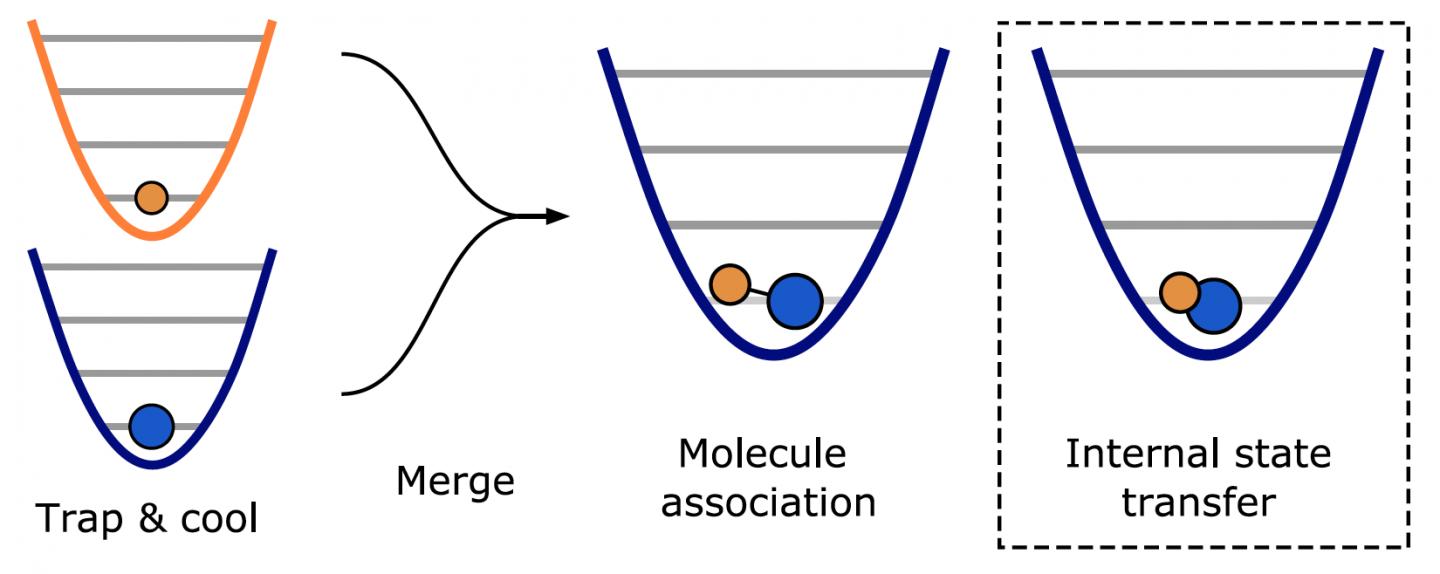
Sodium and cesium normally ignore each other in the wild; but in the Ni lab's carefully calibrated vacuum chamber, she and her team captured each atom using lasers and then forced them to react, a capability that gifted scientists with a new method to study one of the most basic and ubiquitous processes on Earth: the formation of a chemical bond. With Ni's invention, scientists could not only discover more about our chemical underpinnings, but they could also start creating bespoke molecules for novel uses like qubits for quantum supercomputers.

But there was one flaw in their original sodium cesium molecule: "That molecule was lost soon after it's made," said Ni, the Morris Kahn associate professor of chemistry and chemical biology and of physics. Now, in a new study published in Physics Review Letters, Ni and her team report a new feat: They granted their molecule an extended lifetime of up to almost three and a half seconds--a luxury of time in the quantum realm--by controlling all the degrees of freedom (including its motion) of an individual dipolar molecule for the first time. During those precious seconds, the researchers can maintain the full quantum control necessary for stable qubits, the building blocks for a wide variety of exciting quantum applications.

According to the paper, "These long-lived, fully quantum state-controlled individual dipolar molecules provide a key resource for molecule-based quantum simulation and information processing." For example, such molecules could accelerate progress toward the quantum simulation of new phases of matter (faster than any known computer), high-fidelity quantum information processing, precision measurements, and basic research in the field of cold chemistry (one of Ni's specialties). The above diagram shows part of the molecular assembly process from individually trapped atoms to ground state molecule using optical tweezers (lasers).  CREDIT Photo courtesy of the Ni group

And, by forming obedient molecules in their quantum ground states (basically, their simplest, most pliant form), the researchers created more reliable qubits with electric handles, which, like the magnetic handles of a magnet, allow researchers to interact with them in new ways (for example, with microwaves and electric fields).

Next, the team is working on scaling their process: They plan to assemble not just one molecule from two atoms but force larger collections of atoms to interact and form molecules in parallel. In so doing, they can also start to perform long-range entanglement interactions between molecules, the basis for information transfer in quantum computing.

"With the addition of a microwave and electric field control," said Ni, "molecular qubits for quantum computing applications and simulations that further our understanding of quantum phases of matter are within experimental reach."

  1. Physicists at the University of Bonn observe new phase in Bose-Einstein condensate of light particles
  2. Max Planck's MD simulations of SARS-CoV-2 spike protein reveal potential new vaccine targets

Page 11 of 28

  • 6
  • 7
  • 8
  • 9
  • 10
  • 11
  • 12
  • 13
  • 14
  • 15
POPULAR RIGHT NOW
  • Supercomputers replace ‘bathtub’ flood maps with physics-based digital twins of Britain’s coastline
    Supercomputers replace ‘bathtub’ flood maps with physics-based digital twins of Britain’s coastline
  • Supercomputers push neural quantum simulation beyond previous limits
    Supercomputers push neural quantum simulation beyond previous limits
  • Intel’s AI supercomputing revival: Q2 financial surge signals new era for CPU-powered HPC infrastructure
    Intel’s AI supercomputing revival: Q2 financial surge signals new era for CPU-powered HPC infrastructure
  • AWS supercomputing investment reaches historic scale as Amazon’s AI strategy powers record financial results
    AWS supercomputing investment reaches historic scale as Amazon’s AI strategy powers record financial results
  • AI infrastructure financing fears shake semiconductor sector
    AI infrastructure financing fears shake semiconductor sector
  • Catching the wave of the future: Supercomputers unlock the hidden dynamics of Venus
    Catching the wave of the future: Supercomputers unlock the hidden dynamics of Venus
  • NCAR supercomputers run planet scale climate experiments impossible in the real world
    NCAR supercomputers run planet scale climate experiments impossible in the real world
  • AI hunts the cosmos: Machine learning helps astronomers discover the first ‘Wandering’ supermassive black hole caught destroying a star
    AI hunts the cosmos: Machine learning helps astronomers discover the first ‘Wandering’ supermassive black hole caught destroying a star
  • Supercomputing for the masses: Meta's vision of a personal superintelligence for everyone
    Supercomputing for the masses: Meta's vision of a personal superintelligence for everyone
  • NVIDIA helps turn AI compute into a new asset class as Wall Street mobilizes $500 billion
    NVIDIA helps turn AI compute into a new asset class as Wall Street mobilizes $500 billion
THIS YEAR'S MOST READ
  • Wall Street wants to trade supercomputing power like oil
    Wall Street wants to trade supercomputing power like oil
  • Beamforming the future: BeammWave's 6G push signals the rise of orbital-terrestrial wireless networks
    Joakim Axmon
    Joakim Axmon
  • Cosmic ambition at scale: UK’s supercomputer unlocks a 2.5 petabytes universe
    Cosmic ambition at scale: UK’s supercomputer unlocks a 2.5 petabytes universe
  • Hidden order, revealed at scale: Supercomputing, electron ptychography uncover the inner workings of relaxor ferroelectrics
    Hidden order, revealed at scale: Supercomputing, electron ptychography uncover the inner workings of relaxor ferroelectrics
  • Intel's Q1 results signal supercomputing surge driving Xeon momentum
    Intel's Q1 results signal supercomputing surge driving Xeon momentum
  • When stars fall apart: Supercomputing reveals the hidden physics of black holes
    When stars fall apart: Supercomputing reveals the hidden physics of black holes
  • MIT develops computational framework to probe dark matter via gravitational waves
    MIT develops computational framework to probe dark matter via gravitational waves
  • Explainable AI moves into the watershed: FAMU-FSU engineers build predictive framework for real-time E. coli forecasting
    FAMU-FSU College of Engineering Assistant Professor Nasrin Alamdari. (Scott Holstein/FAMU-FSU College of Engineering)
    FAMU-FSU College of Engineering Assistant Professor Nasrin Alamdari. (Scott Holstein/FAMU-FSU College of Engineering)
  • Multi-layer simulations reveal the hidden supply chain of solar prominences
    Multi-layer simulations reveal the hidden supply chain of solar prominences
  • Japanese scientists decode dolphin speed with supercomputing: Turbulence, vortices, and the hidden physics of propulsion
    Japanese scientists decode dolphin speed with supercomputing: Turbulence, vortices, and the hidden physics of propulsion
  • FRONTPAGE
  • LATEST
  • POPULAR
  • REGISTER
  • SOCIAL
  • VIDEO
  • SUBSCRIPTION
  • RSS
  • GUIDELINES
  • PRIVACY
  • TOS
  • ABOUT
  • +1 (816) 799-4488
  • editorial@supercomputingonline.com
© 2001 - 2026 SuperComputingOnline.com, LLC. All rights reserved. This material may not be published, broadcast, rewritten or redistributed without permission.
Sign In
  • FRONT PAGE
  • LATEST
    • MEDIA KIT
    • MOST READ
    • RSS FEED
    • ACADEMIA
    • AEROSPACE
    • APPLICATIONS
    • ASTRONOMY
    • AUTOMOTIVE
    • BIG DATA
    • BIOLOGY
    • CHEMISTRY
    • CLIENTS
    • CLOUD
    • DEFENSE
    • DEVELOPER TOOLS
    • EARTH SCIENCES
    • ECONOMICS
    • ENGINEERING
    • ENTERTAINMENT
    • HEALTH
    • INDUSTRY
    • INTERCONNECTS
    • GAMING
    • GOVERNMENT
    • MANUFACTURING
    • MIDDLEWARE
    • MOVIES
    • NETWORKS
    • OIL & GAS
    • PHYSICS
    • PROCESSORS
    • RETAIL
    • SCIENCE
    • STORAGE
    • SYSTEMS
    • VISUALIZATION
  • VIDEOS
    • ADD YOUR VIDEOS
    • MANAGE VIDEOS
  • COMMUNITY
    • TRADE SHOWS
    • SOCIAL NETWORK VIDEOS
    • SURVEYS
    • APPLICATIONS BROWSER
    • CONVERSATION INBOX
    • SOCIAL ADVERTISER
    • GROUPS
    • MARKETPLACE LISTINGS
    • PAGES
    • LEADERBOARD
    • POINTS LISTING
      • BADGES
    • PRIVACY CONFIRM REQUEST
    • PRIVACY CREATE REQUEST

Hey there! We noticed you’re using an ad blocker.