

SUPERCOMPUTING NEWS SUPERCOMPUTING NEWS
    • MEDIA KIT
    • MOST READ
    • RSS FEED
    • ACADEMIA
    • AEROSPACE
    • APPLICATIONS
    • ASTRONOMY
    • AUTOMOTIVE
    • BIG DATA
    • BIOLOGY
    • CHEMISTRY
    • CLIENTS
    • CLOUD
    • DEFENSE
    • DEVELOPER TOOLS
    • EARTH SCIENCES
    • ECONOMICS
    • ENGINEERING
    • ENTERTAINMENT
    • GAMING
    • GOVERNMENT
    • HEALTH
    • OIL & GAS
    • INDUSTRY
    • INTERCONNECTS
    • MANUFACTURING
    • MIDDLEWARE
    • MOVIES
    • NETWORKS
    • PHYSICS
    • PROCESSORS
    • RETAIL
    • SCIENCE
    • STORAGE
    • SYSTEMS
    • VISUALIZATION
    • AcyMailing subscription form

    • ADD YOUR VIDEOS
    • MANAGE VIDEOS
    • CONVERSATION INBOX
    • SOCIAL ADVERTISER
    • SOCIAL NETWORK VIDEOS
    • SURVEYS
    • GROUPS
    • PAGES
    • MARKETPLACE LISTINGS
    • APPLICATIONS BROWSER
    • PRIVACY CONFIRM REQUEST
    • PRIVACY CREATE REQUEST
    • LEADERBOARD
    • POINTS LISTING
      • BADGES
    • TRADE SHOWS
Sign In
Tyler O'Neal, Staff Editor HEALTH November 4, 2020, 12:04 pm

Europe takes center-stage in global spread of the coronavirus

A collaboration between genome researchers at the UK's University of Huddersfield and Portugal's University of Minho, has led to one of the largest analyses of its kind focussing on thousands of virus genomes sampled from all around the world

University of Huddersfield's Archaeogenetics Research Group has mapped out the dispersal of the SARS-CoV-2 coronavirus, responsible for the current worldwide COVID-19 pandemic, putting Europe center-stage as the main source of the spread.

The group's findings, recently published in a special issue of the peer-reviewed journal Microorganisms, confirm that the virus originated in China and most likely jumped into humans from horseshoe bats. But that it is Europe, not China, which has been the main source for spreading the disease around the world.

The research also suggests that travel restrictions across Britain and Europe seem to have been too little and too late and that the actual spread of the virus to America and other parts of the world was large via Europe, and not directly from China. A collaboration between genome researchers at the University of Huddersfield and geneticists at the University of Minho in Portugal has discovered it is Europe, not China, which has been the main source of spreading the coronavirus disease around the world.{module INSIDE STORY}

The study focused on 27,000 virus genomes, sampled from all around the world. The researchers usually work on tracking ancient human migrations using mitochondrial DNA, and they capitalized on the fact that the virus genome is similar in crucial respects.

Still, the mammoth size of the database, even back in May when the study began, makes this one of the biggest analyses of its kind ever undertaken.

The intensive data analyses were carried out by clinical geneticist Dr. Teresa Rito and evolutionary geneticist Dr. Pedro Soares. Both are based at the University of Minho, in Portugal and have worked closely with the University of Huddersfield's Professor Martin Richards and Dr. Maria Pala, as part of the Archaeogenetics Research Group, on many occasions. The pair called upon the knowledge and expertise of their colleagues in the UK to help make sense of the data and publish their conclusions in double-quick time.

Professor Richards explained how there is a huge ongoing worldwide effort to understand the spread of the coronavirus and that researchers are trying to make their work available to the public as fast as possible.

As the world continues to face a rapidly spreading pathogen, Dr. Pala believes a greater understanding of the virus will better inform and improve upon policies designed to control the spread.

"With thousands of lives still at risk," added Dr. Pala, "the need for scientific research is now more crucial than ever."

Danish students develop Carbontracker to predict the carbon footprint of algorithms

Tyler O'Neal, Staff Editor HEALTH November 3, 2020, 11:26 am

On a daily basis, and perhaps without realizing it, most of us are in close contact with advanced AI methods known as deep learning. Deep learning algorithms churn whenever we use Siri or Alexa, when Netflix suggests movies and tv shows based upon our viewing histories, or when we communicate with a website's customer service chatbot.

However, the rapidly evolving technology, one that has otherwise been expected to serve as an effective weapon against climate change, has a downside that many people are unaware of -- sky-high energy consumption. Artificial intelligence, and particularly the subfield of deep learning, appears likely to become a significant climate culprit should industry trends continue. In only six years -- from 2012 to 2018 -- the compute needed for deep learning has grown 300,000%. However, the energy consumption and carbon footprint associated with developing algorithms are rarely measured, despite numerous studies that clearly demonstrate the growing problem.

In response to the problem, two students at the University of Copenhagen's Department of Computer Science, Lasse F. Wolff Anthony and Benjamin Kanding, together with Assistant Professor Raghavendra Selvan, have developed a software program they call Carbontracker. The program can calculate and predict the energy consumption and CO2 emissions of training deep learning models. Carbontracker 1100x600 9afe5

"Developments in this field are going insanely fast and deep learning models are constantly becoming larger in scale and more advanced. Right now, there is exponential growth. And that means an increasing energy consumption that most people seem not to think about," according to Lasse F. Wolff Anthony. {module INSIDE STORY}

One training session = the annual energy consumption of 126 Danish homes

Deep learning training is the process during which the mathematical model learns to recognize patterns in large datasets. It's an energy-intensive process that takes place on specialized, power-intensive hardware running 24 hours a day.

"As datasets grow larger by the day, the problems that algorithms need to solve become more and more complex," states Benjamin Kanding.

One of the biggest deep learning models developed thus far is the advanced language model known as GPT-3. In a single training session, it is estimated to use the equivalent of a year's energy consumption of 126 Danish homes, and emit the same amount of CO2 as 700,000 kilometers of driving.

"Within a few years, there will probably be several models that are many times larger," says Lasse F. Wolff Anthony.

Room for improvement

"Should the trend continue, artificial intelligence could end up being a significant contributor to climate change. Jamming the brakes on technological development is not the point. These developments offer fantastic opportunities for helping our climate. Instead, it is about becoming aware of the problem and thinking: How might we improve?" explains Benjamin Kanding.

The idea of Carbontracker, which is a free program, is to provide the field with a foundation for reducing the climate impact of models. Among other things, the program gathers information on how much CO2 is used to produce energy in whichever region the deep learning training is taking place. Doing so makes it possible to convert energy consumption into CO2 emission predictions.

Among their recommendations, the two computer science students suggest that deep learning practitioners look at when their model training takes place, as power is not equally green over a 24-hour period, as well as what type of hardware and algorithms they deploy.

"It is possible to reduce climate impact significantly. For example, it is relevant if one opts to train their model in Estonia or Sweden, where the carbon footprint of a model training can be reduced by more than 60 times thanks to greener energy supplies. Algorithms also vary greatly in their energy efficiency. Some require less compute, and thereby less energy, to achieve similar results. If one can tune these types of parameters, things can change considerably," concludes Lasse F. Wolff Anthony.

Ultrapotent COVID-19 vaccine candidate designed via supercomputer

Tyler O'Neal, Staff Editor HEALTH November 2, 2020, 11:06 am

Preclinical data published in Cell show the nanoparticle vaccine spurs extremely high levels of protective antibodies in animal models

An innovative nanoparticle vaccine candidate for the pandemic coronavirus produces virus-neutralizing antibodies in mice at levels ten-times greater than is seen in people who have recovered from COVID-19 infections. Designed by scientists at the University of Washington School of Medicine in Seattle, the vaccine candidate has been transferred to two companies for clinical development.

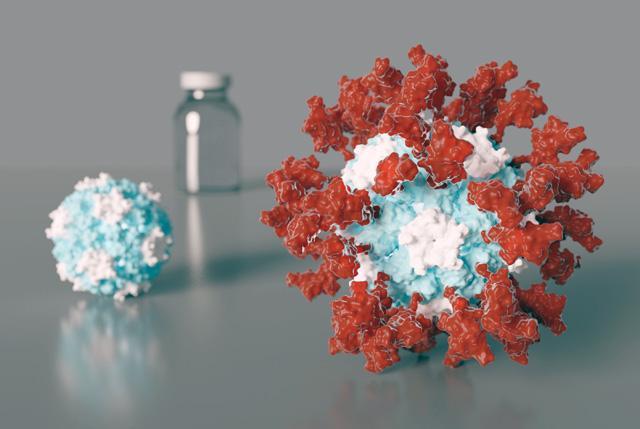
Compared to vaccination with the soluble SARS-CoV-2 Spike protein, which is what many leading COVID-19 vaccine candidates are based on, the new nanoparticle vaccine produced ten times more neutralizing antibodies in mice, even at a six-fold lower vaccine dose. The data also show a strong B-cell response after immunization, which can be critical for immune memory and a durable vaccine effect. When administered to a single nonhuman primate, the nanoparticle vaccine produced neutralizing antibodies targeting multiple different sites on the Spike protein. Researchers say this may ensure protection against mutated strains of the virus, should they arise. The Spike protein is part of the coronavirus infectivity machinery. CAPTION Artist's depiction of an ultrapotent COVID-19 vaccine candidate in which 60 pieces of a coronavirus protein (red) decorate nanoparticles (blue and white). The vaccine candidate was designed using methods developed at the UW Medicine Institute for Protein Design. The molecular structure of the vaccine roughly mimics that of a virus, which may account for its enhanced ability to provoke an immune response.  CREDIT Ian Haydon/ UW Medicine Institute for Protein Design{module INSIDE STORY}

The findings are published in Cell. The lead authors of this paper are Alexandra Walls, a research scientist in the laboratory of David Veesler, who is an associate professor of biochemistry at the UW School of Medicine; and Brooke Fiala, a research scientist in the laboratory of Neil King, who is an assistant professor of biochemistry at the UW School of Medicine.

The vaccine candidate was developed using structure-based vaccine design techniques invented at UW Medicine. It is a self-assembling protein nanoparticle that displays 60 copies of the SARS-CoV-2 Spike protein's receptor-binding domain in a highly immunogenic array. The molecular structure of the vaccine roughly mimics that of a virus, which may account for its enhanced ability to provoke an immune response.

"We hope that our nanoparticle platform may help fight this pandemic that is causing so much damage to our world," said King, inventor of the computational vaccine design technology at the Institute for Protein Design at UW Medicine. "The potency, stability, and manufacturability of this vaccine candidate differentiate it from many others under investigation."

Hundreds of candidate vaccines for COVID-19 are in development around the world. Many require large doses, complex manufacturing, and cold-chain shipping and storage. An ultrapotent vaccine that is safe, effective at low doses, simple to produce, and stable outside of a freezer could enable vaccination against COVID-19 on a global scale.

"I am delighted that our studies of antibody responses to coronaviruses led to the design of this promising vaccine candidate," said Veesler, who spearheaded the concept of a multivalent receptor-binding domain-based vaccine.

  1. Where were Jupiter and Saturn born?
  2. UD's Pinki Mondal offers recommendations on using remote sensing to quantify forest health

Page 25 of 28

  • 19
  • 20
  • 21
  • 22
  • 23
  • 24
  • 25
  • 26
  • 27
  • 28
POPULAR RIGHT NOW
  • Supercomputers replace ‘bathtub’ flood maps with physics-based digital twins of Britain’s coastline
    Supercomputers replace ‘bathtub’ flood maps with physics-based digital twins of Britain’s coastline
  • Supercomputers push neural quantum simulation beyond previous limits
    Supercomputers push neural quantum simulation beyond previous limits
  • Intel’s AI supercomputing revival: Q2 financial surge signals new era for CPU-powered HPC infrastructure
    Intel’s AI supercomputing revival: Q2 financial surge signals new era for CPU-powered HPC infrastructure
  • AWS supercomputing investment reaches historic scale as Amazon’s AI strategy powers record financial results
    AWS supercomputing investment reaches historic scale as Amazon’s AI strategy powers record financial results
  • AI infrastructure financing fears shake semiconductor sector
    AI infrastructure financing fears shake semiconductor sector
  • Catching the wave of the future: Supercomputers unlock the hidden dynamics of Venus
    Catching the wave of the future: Supercomputers unlock the hidden dynamics of Venus
  • NCAR supercomputers run planet scale climate experiments impossible in the real world
    NCAR supercomputers run planet scale climate experiments impossible in the real world
  • AI hunts the cosmos: Machine learning helps astronomers discover the first ‘Wandering’ supermassive black hole caught destroying a star
    AI hunts the cosmos: Machine learning helps astronomers discover the first ‘Wandering’ supermassive black hole caught destroying a star
  • Supercomputing for the masses: Meta's vision of a personal superintelligence for everyone
    Supercomputing for the masses: Meta's vision of a personal superintelligence for everyone
  • NVIDIA helps turn AI compute into a new asset class as Wall Street mobilizes $500 billion
    NVIDIA helps turn AI compute into a new asset class as Wall Street mobilizes $500 billion
THIS YEAR'S MOST READ
  • Wall Street wants to trade supercomputing power like oil
    Wall Street wants to trade supercomputing power like oil
  • Beamforming the future: BeammWave's 6G push signals the rise of orbital-terrestrial wireless networks
    Joakim Axmon
    Joakim Axmon
  • Cosmic ambition at scale: UK’s supercomputer unlocks a 2.5 petabytes universe
    Cosmic ambition at scale: UK’s supercomputer unlocks a 2.5 petabytes universe
  • Hidden order, revealed at scale: Supercomputing, electron ptychography uncover the inner workings of relaxor ferroelectrics
    Hidden order, revealed at scale: Supercomputing, electron ptychography uncover the inner workings of relaxor ferroelectrics
  • Intel's Q1 results signal supercomputing surge driving Xeon momentum
    Intel's Q1 results signal supercomputing surge driving Xeon momentum
  • When stars fall apart: Supercomputing reveals the hidden physics of black holes
    When stars fall apart: Supercomputing reveals the hidden physics of black holes
  • MIT develops computational framework to probe dark matter via gravitational waves
    MIT develops computational framework to probe dark matter via gravitational waves
  • Explainable AI moves into the watershed: FAMU-FSU engineers build predictive framework for real-time E. coli forecasting
    FAMU-FSU College of Engineering Assistant Professor Nasrin Alamdari. (Scott Holstein/FAMU-FSU College of Engineering)
    FAMU-FSU College of Engineering Assistant Professor Nasrin Alamdari. (Scott Holstein/FAMU-FSU College of Engineering)
  • Multi-layer simulations reveal the hidden supply chain of solar prominences
    Multi-layer simulations reveal the hidden supply chain of solar prominences
  • Japanese scientists decode dolphin speed with supercomputing: Turbulence, vortices, and the hidden physics of propulsion
    Japanese scientists decode dolphin speed with supercomputing: Turbulence, vortices, and the hidden physics of propulsion
  • FRONTPAGE
  • LATEST
  • POPULAR
  • REGISTER
  • SOCIAL
  • VIDEO
  • SUBSCRIPTION
  • RSS
  • GUIDELINES
  • PRIVACY
  • TOS
  • ABOUT
  • +1 (816) 799-4488
  • editorial@supercomputingonline.com
© 2001 - 2026 SuperComputingOnline.com, LLC. All rights reserved. This material may not be published, broadcast, rewritten or redistributed without permission.
Sign In
  • FRONT PAGE
  • LATEST
    • MEDIA KIT
    • MOST READ
    • RSS FEED
    • ACADEMIA
    • AEROSPACE
    • APPLICATIONS
    • ASTRONOMY
    • AUTOMOTIVE
    • BIG DATA
    • BIOLOGY
    • CHEMISTRY
    • CLIENTS
    • CLOUD
    • DEFENSE
    • DEVELOPER TOOLS
    • EARTH SCIENCES
    • ECONOMICS
    • ENGINEERING
    • ENTERTAINMENT
    • HEALTH
    • INDUSTRY
    • INTERCONNECTS
    • GAMING
    • GOVERNMENT
    • MANUFACTURING
    • MIDDLEWARE
    • MOVIES
    • NETWORKS
    • OIL & GAS
    • PHYSICS
    • PROCESSORS
    • RETAIL
    • SCIENCE
    • STORAGE
    • SYSTEMS
    • VISUALIZATION
  • VIDEOS
    • ADD YOUR VIDEOS
    • MANAGE VIDEOS
  • COMMUNITY
    • TRADE SHOWS
    • SOCIAL NETWORK VIDEOS
    • SURVEYS
    • APPLICATIONS BROWSER
    • CONVERSATION INBOX
    • SOCIAL ADVERTISER
    • GROUPS
    • MARKETPLACE LISTINGS
    • PAGES
    • LEADERBOARD
    • POINTS LISTING
      • BADGES
    • PRIVACY CONFIRM REQUEST
    • PRIVACY CREATE REQUEST

Hey there! We noticed you’re using an ad blocker.