MIT uses AI to solve the challenges of robotic pizza-making

A new technique could enable a robot to manipulate squishy objects like pizza dough or soft materials like clothing.

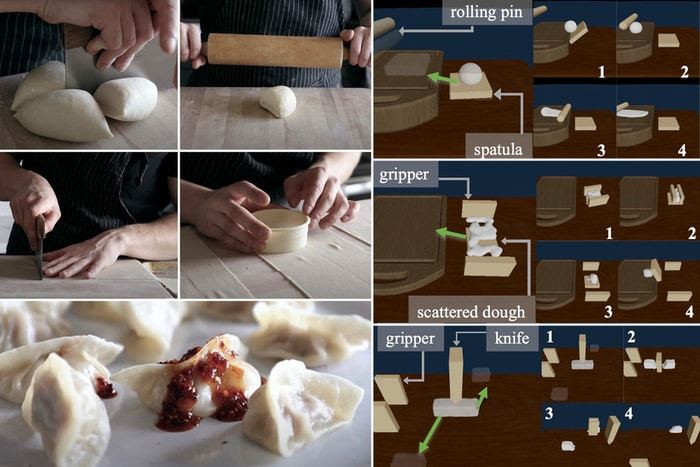
Imagine a pizza maker working with a ball of dough. She might use a spatula to lift the dough onto a cutting board and then use a rolling pin to flatten it into a circle. Easy, right? Not if this pizza maker is a robot. Researchers from MIT and elsewhere have created a framework that could enable a robot to effectively complete complex manipulation tasks with deformable objects, like dough or cloth, that require many tools and take a long time to complete.  CREDIT Image courtesy of Yunzhu Li, Chuang Gan, et al.
For a robot, working with a deformable object like dough is tricky because the shape of dough can change in many ways, which are difficult to represent with an equation. Plus, creating a new shape out of that dough requires multiple steps and the use of different tools. It is especially difficult for a robot to learn a manipulation task with a long sequence of steps — where there are many possible choices — since learning often occurs through trial and error.

Researchers at MIT, Carnegie Mellon University, and the University of California at San Diego, have come up with a better way. They created a framework for a robotic manipulation system that uses a two-stage learning process, which could enable a robot to perform complex dough-manipulation tasks over a long timeframe. A “teacher” algorithm solves each step the robot must take to complete the task. Then, it trains a “student” machine-learning model that learns abstract ideas about when and how to execute each skill it needs during the task, like using a rolling pin. With this knowledge, the system reasons how to execute the skills to complete the entire task.

The researchers show that this method, which they call DiffSkill, can perform complex manipulation tasks in simulations, like cutting and spreading dough, or gathering pieces of dough from around a cutting board, while outperforming other machine-learning methods.

Beyond pizza-making, this method could be applied in other settings where a robot needs to manipulate deformable objects, such as a caregiving robot that feeds, bathes, or dresses someone elderly or with motor impairments.

“This method is closer to how we as humans plan our actions. When a human does a long-horizon task, we are not writing down all the details. We have a higher-level planner that roughly tells us what the stages are and some of the intermediate goals we need to achieve along the way, and then we execute them,” says Yunzhu Li, a graduate student in the Computer Science and Artificial Intelligence Laboratory (CSAIL), and author of a paper presenting DiffSkill.

Li’s co-authors include lead author Xingyu Lin, a graduate student at Carnegie Mellon University (CMU); Zhiao Huang, a graduate student at the University of California at San Diego; Joshua B. Tenenbaum, the Paul E. Newton Career Development Professor of Cognitive Science and Computation in the Department of Brain and Cognitive Sciences at MIT and a member of CSAIL; David Held, an assistant professor at CMU; and senior author Chuang Gan, a research scientist at the MIT-IBM Watson AI Lab. The research will be presented at the International Conference on Learning Representations.

Student and teacher

The “teacher” in the DiffSkill framework is a trajectory optimization algorithm that can solve short-horizon tasks, where an object’s initial state and target location are close together. The trajectory optimizer works in a simulator that models the physics of the real world (known as a differentiable physics simulator, which puts the “Diff” in “DiffSkill”). The “teacher” algorithm uses the information in the simulator to learn how the dough must move at each stage, one at a time, and then outputs those trajectories.

Then the “student”neural network learns to imitate the actions of the teacher. As inputs, it uses two camera images, one showing the dough in its current state and another showing the dough at the end of the task. The neural network generates a high-level plan to determine how to link different skills to reach the goal. It then generates specific, short-horizon trajectories for each skill and sends commands directly to the tools.

The researchers used this technique to experiment with three different simulated dough-manipulation tasks. In one task, the robot uses a spatula to lift the dough onto a cutting board and then uses a rolling pin to flatten it. In another, the robot uses a gripper to gather the dough from all over the counter, places it on a spatula, and transfers it to a cutting board. In the third task, the robot cuts a pile of dough in half using a knife and then uses a gripper to transport each piece to different locations.

A cut above the rest

DiffSkill was able to outperform popular techniques that rely on reinforcement learning, where a robot learns a task through trial and error. DiffSkill was the only method that was able to complete all three dough manipulation tasks. Interestingly, the researchers found that the “student” neural network was even able to outperform the “teacher” algorithm, Lin says.

“Our framework provides a novel way for robots to acquire new skills. These skills can then be chained to solve more complex tasks which are beyond the capability of previous robot systems,” says Lin.

Because their method focuses on controlling the tools (spatula, knife, rolling pin, etc.) it could be applied to different robots, but only if they use the specific tools the researchers defined. In the future, they plan to integrate the shape of a tool into the reasoning of the “student” network so it could be applied to other equipment.

The researchers intend to improve the performance of DiffSkill by using 3D data as inputs, instead of images that can be difficult to transfer from simulation to the real world. They also want to make the neural network planning process more efficient and collect more diverse training data to enhance DiffSkill’s ability to generalize to new situations. In the long run, they hope to apply DiffSkill to more diverse tasks, including cloth manipulation.

This work is supported, in part, by the National Science Foundation, LG Electronics, the MIT-IBM Watson AI Lab, the Office of Naval Research, and the Defense Advanced Research Projects Agency Machine Common Sense program.
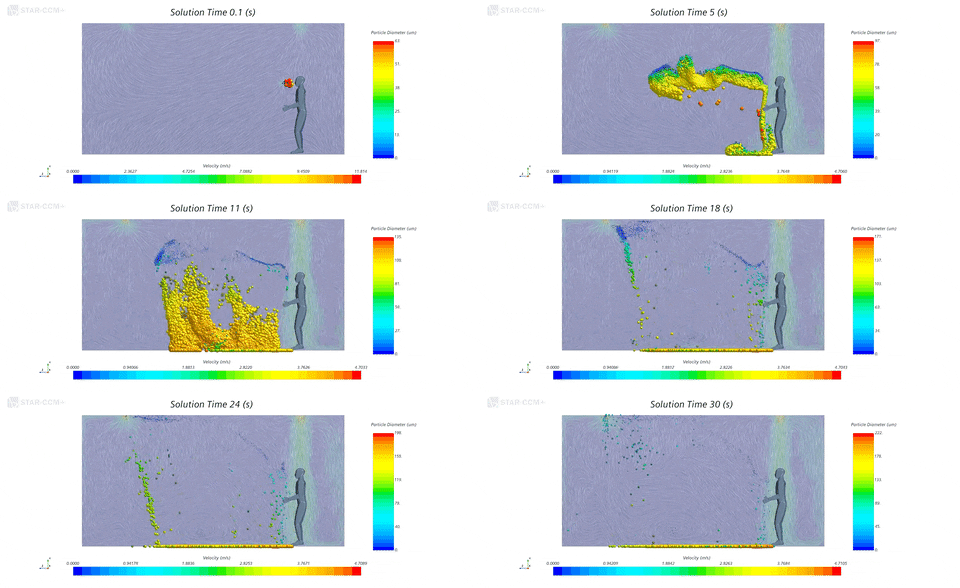
CFD simulations track the spread of coughs, safe physical distancing indoors

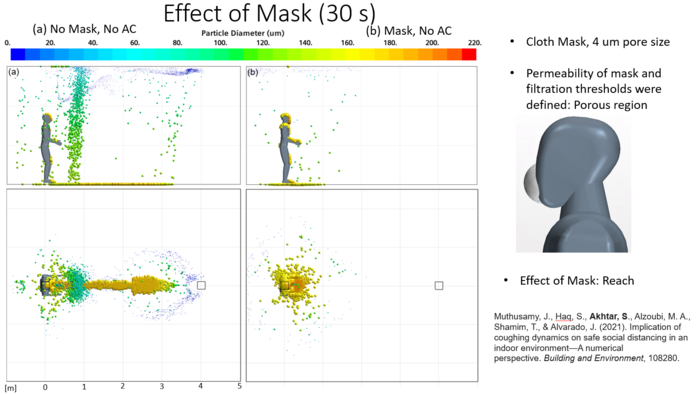
To prevent the spread of COVID-19 indoors, the two meters physical distancing guideline is not enough without masks, according to researchers from Quebec, Illinois, and Texas. However, wearing a mask indoors can reduce the contamination range of airborne particles by about 67 percent. Computational Fluid Dynamics has been performed to model complex physics such as turbulent buoyant cloud, particle–air interaction, particle collision/breakup, and droplet evaporation. Implication of coughing dynamics on safe social distancing in an indoor environment.  CREDIT Muthusamy, J., Haq, S., Akhtar, S., Alzoubi, M. A., Shamim, T., & Alvarado, J. (2021). Implication of coughing dynamics on safe social distancing in an indoor environment—A numerical perspective. Building and Environment, 108280.

“Mask mandates and good ventilation are critically important to curb the spread of more contagious strains of COVID-19, especially during the flu season and winter months as more people socialize indoors,” says Saad Akhtar, a former doctoral student under the supervision of Professor Agus Sasmito at McGill University.

While most public health guidelines recommend physical distancing of two meters for people from different households, the researchers say distancing alone is not enough to prevent the spread of COVID-19. In a study published in Building and Environment, the researchers found that when people are unmasked, more than 70 percent of airborne particles pass the two meters threshold within 30 seconds. By contrast, less than 1 percent of particles cross the two-meter mark if masks are worn.

Simulating coughing dynamics

Building on models used by scientists to study the flow of liquids and gasses, the team from McGill University, Université de Sherbrooke, Texas A&M University, and Northern Illinois University, developed their own program to accurately simulate coughing dynamics in indoor spaces. giphy af3e8

While ventilation, a person’s posture, and mask-wearing impacted the spread of the bio-contaminants significantly, the impact of age and gender was marginal, the researchers found.

Coughing is one of the main sources of the spread of airborne viruses from symptomatic individuals. “This study advances the understanding of how infectious particles can spread from a source to its surroundings and can help policymakers and governments make informed decisions about guidelines for masks and distancing in indoor settings,” says Akhtar.

Japanese researchers build an all-nitride superconducting qubit on a silicon substrate for quantum supercomputing hardware

A new material platform for large-scale integration of superconducting qubits

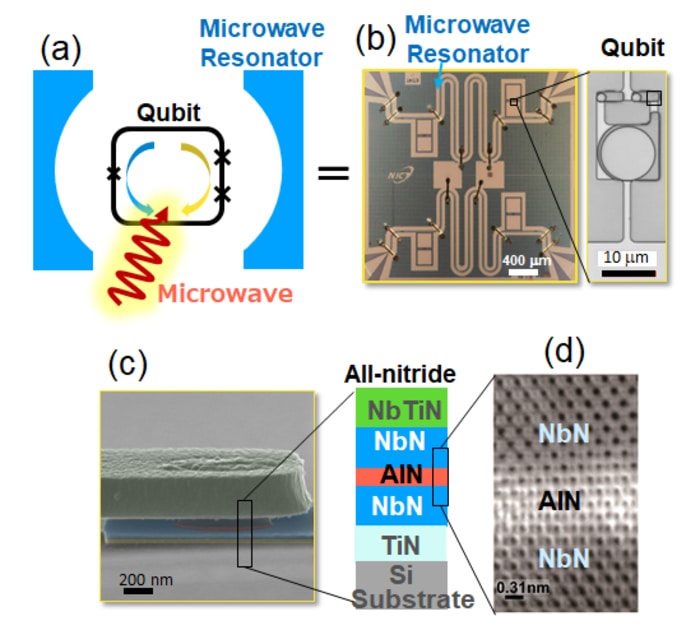
Researchers at the National Institute of Information and Communications Technology (NICT, President: TOKUDA Hideyuki, Ph.D.), in collaboration with researchers at the National Institute of Advanced Industrial Science and Technology (AIST, President: Dr. ISHIMURA Kazuhiko) and the Tokai National Higher Education and Research System Nagoya University (President: Dr. MATSUO Seiichi) have succeeded in developing an all-nitride superconducting qubit using epitaxial growth on a silicon substrate that does not use aluminum as the conductive material. This qubit uses niobium nitride (NbN) with a superconducting transition temperature of 16 K (-257 °C) as the electrode material, and aluminum nitride (AlN) for the insulating layer of the Josephson junction. It is a new type of qubit made of all-nitride materials grown epitaxially on a silicon substrate and free of any amorphous oxides, which are a major noise source. By realizing this new material qubit on a silicon substrate, long coherence times have been obtained: an energy relaxation time (T1) of 16 microseconds and a phase relaxation time (T2) of 22 microseconds as the mean values. This is about 32 times T1 and about 44 times T2 of nitride superconducting qubits grown on a conventional magnesium oxide substrate. (a) Conceptual diagram of microwave cavity and qubit (b) Optical micrograph of nitride superconducting qubit circuit (c) Electron micrograph of nitride superconducting qubit (part) and cross-sectional view of the device (d) Transmission electron micrograph of epitaxially grown nitride Josephson junction

By using niobium nitride as a superconductor, it is possible to construct a superconducting quantum circuit that operates more stably, and it is expected to contribute to the development of quantum computers and quantum nodes as basic elements of quantum computation. We will continue to work on optimizing the circuit structure and fabrication process, and we will proceed with research and development to further extend the coherence time and realize large-scale integration.

These results were published in the British academic journal "Communications Materials" on September 20 2021 at 18:00 (Japan standard time).

Toward the coming Society 5.0, there are limits to the performance improvement of semiconductor circuits that have supported the information society so far, and expectations for quantum computers are rising as a new information processing paradigm that breaks through such limits. However, the quantum superposition state, which is indispensable for the operation of a quantum computer, is easily destroyed by various disturbances (noise), and it is necessary to properly eliminate these effects.

Since superconducting qubits are solid-state elements, they have excellent design flexibility, integration, and scalability, but they are easily affected by various disturbances in their surrounding environment. The challenge is how to extend the coherence time, which is the lifetime of quantum superposition states. Various efforts are being made by research institutes around the world to overcome this problem, and most of them use aluminum (Al) and aluminum oxide film (AlOx) as superconducting qubit materials. However, amorphous aluminum oxide, which is often used as an insulating layer, is a concern as a noise source, and it was essential to study materials that could solve this problem.

As an alternative to aluminum and amorphous aluminum oxide with a superconducting transition temperature TC of 1 K (-272 °C), epitaxially grown niobium nitride (NbN) with a TC of 16 K (-257 °C), NICT has been developing superconducting qubits using NbN / AlN / NbN all-nitride junctions, focusing on aluminum nitride (AlN) as an insulating layer.

To realize an NbN / AlN / NbN Josephson junction (epitaxial junction) in which the crystal orientation is aligned up to the upper electrode, it was necessary to use a magnesium oxide (MgO) substrate whose crystal lattice constants are relatively close to those of NbN. However, MgO has a large dielectric loss, and the coherence time of the superconducting quantum bit using the NbN / AlN / NbN junction on the MgO substrate was only about 0.5 microseconds.

NICT has succeeded in realizing NbN / AlN / NbN epitaxial Josephson junctions using titanium nitride (TiN) as a buffer layer on a silicon (Si) substrate with a smaller dielectric loss. This time, using this junction fabrication technology, we designed, fabricated, and evaluated a superconducting qubit (see Figure 1) that uses NbN as the electrode material and AlN as the insulating layer of the Josephson junction.

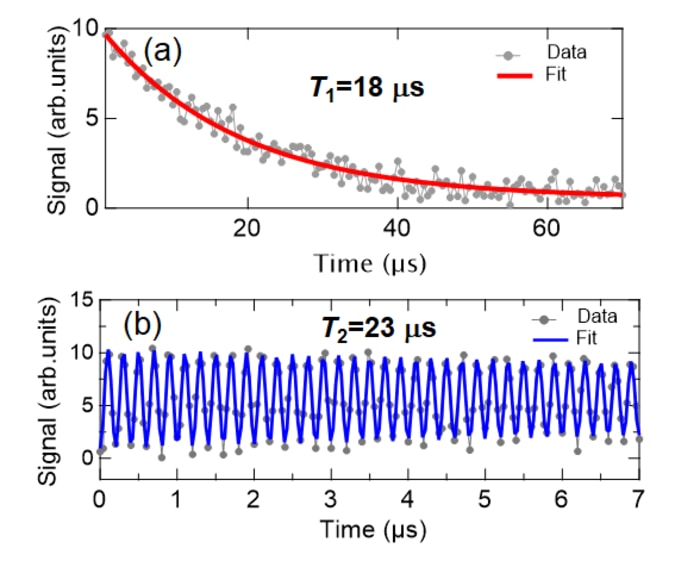
As schematically shown in Figure 1(a), the quantum circuit is fabricated on a silicon substrate so that the microwave cavity and the qubit can be coupled and interact with each other as shown in Figure 1(b). From the transmission measurement of the microwave characteristics of the resonator weakly coupled to the qubit under small thermal fluctuation at the extremely low temperature of 10 mK, we achieved an energy relaxation time (T1) of 18 microseconds and a phase relaxation time (T2) of 23 microseconds. The mean values for 100 measurements are T1=16 microseconds and T2= 22 microseconds. This is an improvement of about 32 times for T1 and about 44 times for T2 compared to the case of superconducting qubits on MgO substrates. (a) Energy relaxation time T1=18 microseconds (b) Phase relaxation time T2=23 microseconds

For this result, they did not use conventional aluminum and aluminum oxide for the Josephson junction, which is the heart of superconducting qubits. They have succeeded in developing a nitride superconducting qubit that has a high superconducting critical temperature TC and excellent crystallinity due to epitaxial growth. These two points have great significance. In particular, it is the first time that anyone in the world has succeeded in observing coherence times in the tens of microseconds from nitride superconducting qubits by reducing dielectric loss by epitaxially growing them on a Si substrate. The superconducting qubit of this nitride is still in the early stages of development, and we believe that it is possible to further improve the coherence time by optimizing the design and fabrication process of the qubit.

Using this new material platform that may replace conventional aluminum, they will accelerate research and development of quantum information processing, which will contribute to the realization of more power-saving information processing and the realization of quantum nodes necessary for the construction of safe and secure quantum networks.

They plan to work on optimizing the circuit structure and fabrication process to further extend the coherence time and improve the uniformity of device characteristics in anticipation of future large-scale integration. In this way, they aim to build a new platform for quantum hardware that surpasses the performance of conventional aluminum-based qubits.