

Researchers at University of Limerick, Ireland help create ‘brain-inspired computing architecture’

An international team of scientists including researchers at the University of Limerick in Ireland has discovered a new molecule that could further increase ultra-fast decision-making in computers.

The energy-saving discovery, creating a new type of computing architecture, could have major implications in areas spanning from financial decision-making to bioinformatics.

The team at UL’s Bernal Institute discovered that a simple molecule made from just 77 atoms provides a new fundamental electronic circuit element in which complex logic is encoded in nanoscale material properties.

The new type of brain-inspired computing architecture was created by optimizing the electrical properties of soft crystals grown from the molecules.

The finding has just been reported in the academic journal Nature.

Damien Thompson, Professor in Physics at UL who leads a research team in predictive materials design at the Bernal Institute, made the discovery using state-of-the-art computer simulations performed on the Irish Centre for High-End Computing supercomputer. Damien Thompson, Professor in Physics at UL who leads a research team in predictive materials design at the Bernal Institute, made the discovery using state of the art computer simulations performed on the Irish Centre for High-End Computing supercomputer  CREDIT Picture: Alan Place
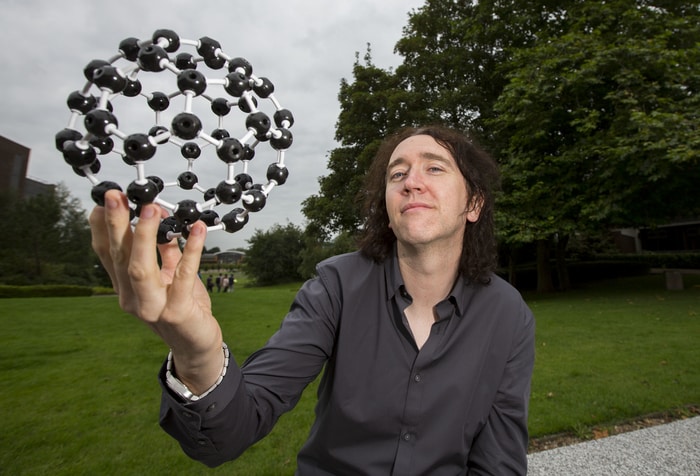
He showed that the molecule uses natural asymmetry in its metal-organic bonds to cleanly switch between different states, which allows it to perform ultra-fast decision-making.

“In the new device, everything is done in one place, so there is no need to keep reading or moving information around,” explained the Science Foundation Ireland-supported scientist.

“This removes the ‘von Neumann bottleneck, a problem that has plagued computing from the very beginning and still hampers technology development. The new molecular circuitry means the computer-processing unit no longer has to fetch data for every operation it performs, and this saves enormously on time and energy costs.

“We are excited about the possibilities because the devices show all the hallmarks of brain computing. First, a huge number of tiny, identical molecular processors are networked together and work in parallel. More importantly, they show both redundancy and reconfigurability, which means the device can solve problems even if the individual components do not all work perfectly all the time or in the same way every time.

“The new circuit elements could provide computers that are smaller, faster, and more energy-efficient, exactly what is needed for edge computing, internet of things, and artificial intelligence applications,” Professor Thompson added.

The metal-organic molecules were synthesized by collaborators at the Indian Association for the Cultivation of Science (IACS) in Kolkata, made into films at the National University of Singapore, and tested as circuit elements in Singapore, at Hewlett Packard’s AI Research Lab in Colorado, and Texas A&M University.

Professor Luuk van der Wielen, Director of Bernal Institute and Bernal Professor of Biosystems Engineering and Design, expressed his delight at the breakthrough involving the UL scientists.

“This high-impact research reinforces the ambition of the Bernal Institute at UL to impact the world based on top science in an increasingly international context. This is a continuation of Bernal scientists’ world-leading contribution to the field of predictive materials modeling,” he explained.

Professor Seán Arkins, Dean of Science and Engineering at UL, said: “The researchers in UL’s Department of Physics continue to pioneer the exploitation of organic materials for electrical applications, and this work places them at the forefront of molecular nanotechnology.”
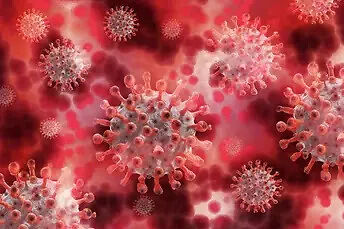
Model of SARS-CoV-2 dynamics reveals opportunity to prevent COVID-19 transmission

A structural model of the SARS-CoV-2 spike protein as the virus fuses with host human cells reveals an opportunity to disrupt dynamics and halt transmission.

Scientists have simulated the transition of the SARS-CoV-2 spike protein structure from when it recognizes the host cell to when it gains entry, according to a study published today in eLife.

The research shows that a structure enabled by sugar molecules on the spike protein could be essential for cell entry and that disrupting this structure could be a strategy to halt virus transmission.

An essential aspect of SARS-CoV-2’s lifecycle is its ability to attach to host cells and transfer its genetic material. It achieves this through its spike protein, which is made up of three separate components – a transmembrane bundle that anchors the spike to the virus, and two S subunits (S1 and S2) on the exterior of the virus. To infect a human cell, the S1 subunit binds to a molecule on the surface of human cells called ACE2, and the S2 subunit detaches and fuses the viral and human cell membranes. Although this process is known, the exact order in which it occurs is as yet undiscovered. Yet, understanding the microsecond-scale and atomic-level movements of these protein structures could reveal potential targets for COVID-19 treatment. SARS-CoV-2. Image credit: Public domain

“Most of the current SARS-CoV-2 treatments and vaccines have focused on the ACE2 recognition step of virus invasion, but an alternative strategy is to target the structural change that allows the virus to fuse with the human host cell,” explains study co-author José N. Onuchic, Harry C & Olga K Wiess Professor of Physics at Rice University, Houston, US, and Co-Director of the Center for Theoretical Biological Physics. “But probing these intermediate, transient structures experimentally is extremely difficult, and so we used a computer simulation sufficiently simplified to investigate this large system but that maintains sufficient physical details to capture the dynamics of the S2 subunit as it transitions between pre-fusion and post-fusion shapes.”

The team was particularly interested in the role of sugar molecules on the spike protein which is called glycans. To see whether the number, type, and position of glycans play a role in the membrane fusion stage of viral cell entry by mediating these intermediate spike formations, they performed thousands of simulations using an all-atom structure-based model. Such models allow you to predict the trajectory of atoms over time taking into account steric forces – that is, how neighboring atoms affect the movement of others.

The supercomputer simulations revealed that glycans form a ‘cage’ that traps the ‘head’ of the S2 subunit causing it to pause in an intermediate form between when it detaches from the S1 subunit and when the viral and cell membranes are fused. When the glycans were not there, the S2 subunit spent much less time in this conformation.

The supercomputer simulations also suggest that holding the S2 head in a particular position helps the S2 subunit recruit human host cells and fuse with their membranes, by allowing the extension of short proteins called fusion peptides from the virus. Indeed, glycosylation of S2 significantly increased the likelihood that a fusion peptide would extend to the host cell membrane, whereas when glycans were absent, there was only a marginal possibility that this would occur.

“Our simulations indicate that glycans can induce a pause during the spike protein transition. This provides a critical opportunity for the fusion peptides to capture the host cell,” concludes co-author Paul C. Whitford, Associate Professor at the Center for Theoretical Biological Physics and Department of Physics, Northeastern University, Boston, US. “In the absence of glycans, the viral particle would likely fail to enter the host. Our study reveals how sugars can control infectivity, and it provides a foundation for experimentally investigating factors that influence the dynamics of this pervasive and deadly pathogen.”

Germany's climate simulations show that cooling periods cause evolutionary surges

Temperatures on Earth have had a significant influence on the course of evolution. A particularly high number of new species of marine animals emerged after geologically short cooling periods that had already been preceded by a much longer cooling period. This is the conclusion reached by researchers from the Universities of Bayreuth and Erlangen-Nuremberg in a new study that has now been published in the journal PNAS. By combining empirical data and supercomputer simulations, they have found that the influence of rapid climate change on biodiversity is significantly influenced by longer-lasting climate trends in previous periods of the Earth’s history.

Based on a wealth of geological data, it is been established that there have been several long-lasting glacial and warm periods in the course of the Earth's history. Researchers in Bayreuth and Erlangen have now divided these periods into long-term and short-term trends to investigate the effect of geological temperature fluctuations on the formation of species. The short-term trends each had a duration of around six million years and can be described as climate change on a geological time scale.

The results of the research show that the influence of the respective climate change on the emergence of species only becomes apparent when the long-term temperature trends before climate change are included. For example, the probability of species emergence increases by almost 28 percent if a long-lasting cooling is followed by a short ice age. However, if a short ice age occurs after a long-lasting warming period, this probability does not increase.

The calculations based on supercomputer simulations are confirmed by fossil finds and palaeoclimatic data. Thus, in the history of the Earth, there has always been an unusually large increase in new species of marine animals when an ice age occurred after a period of long-term cooling. The authors of the study explain this hype of evolution by the fact that the consequences of the ice-age cooling are amplified by the after-effects of the preceding long cooling period. "The combination of the rectified climate developments caused an increased lowering of sea levels. Particularly off mainland coasts and near islands, the seas became so shallow that many of the marine animals living there could not, or could only rarely, swim out into the open sea. Their mobility was considerably restricted. As a result, widespread populations belonging to the same genus or species were cut off from each other and isolated for many millions of years. This allowed them to evolve and differentiate independently of each other. Coastal marine areas with shallow water depths thus became hotspots of evolution", explains Gregor Mathes M.Sc., lead author of the new study.

The new research results exemplify that the influence of short-term climate change on biodiversity can only be realistically assessed if longer periods of geological history are also taken into account. "Our calculations have shown that short cooling periods following a long temperature rise result in a significantly weaker evolutionary response," says Mathes. In January 2021, the team from Bayreuth and Erlangen already proved in another study that the extent to which short temperature rises affect the extinction risk of species depends not least on the context of geological and climatic history.

The research team from Bayreuth and Erlangen is part of the research group TERSANE ("temperature-related Stresses as a Unifying Principle in Ancient Extinctions"), in which scientists from all over Germany are investigating connections between biodiversity and climate-historical processes.