German researchers use a hydro-SMILE modeling approach in a study that helps to improve flood forecasts

  • The international research team sheds light on links between heavy rainfall and flooding
  • Two different types of extreme precipitation events pose different flood risks - both of which are affected differently by climate change
  • In Bavaria, heavy rainfall will most likely occur two to four times more frequently in the future than it does today.

Climate change will lead to more and stronger floods, mainly due to the increase of more intense heavy rainfall. To assess how exactly flood risks and the severity of floods will change over time, it is particularly helpful to consider two different types of such extreme precipitation events: weaker and stronger ones. An international group of scientists led by Dr. Manuela Brunner from the Institute of Earth and Environmental Sciences at the University of Freiburg and Prof. Dr. Ralf Ludwig from the Ludwig-Maximilians-Universität München (LMU) has now shed light on this aspect, which has been little researched to date. They found that the weaker and at the same time more frequent extreme precipitation events (on average every 2 to 10 years) are increasing in frequency and quantity, but do not necessarily lead to flooding. In some places, climate change may even reduce the risk of flooding due to drier soils. Similarly, more severe and at the same timeless frequent extreme precipitation events (on average less frequent than 50 years and as occurred in the Eifel in July 2021) are increasing in frequency and quantity, but they also generally lead to more frequent flooding. 

In some places, climate change leads to lower flood risk

“During stronger and at the same time rarer extreme precipitation events, such large amounts of rainfall hit the ground that its current condition has little influence on whether flooding will occur,” explains Manuela Brunner. “Its capacity to absorb water is exhausted relatively quickly, and from then on the rain runs off over the surface, thus flooding the landscape. It’s a different story for the weaker and more frequent extreme precipitation events,” says Brunner. “Here, the current soil conditions are crucial. If the soil is dry, it can absorb a lot of water and the risk of flooding is low. However, if there is already high soil moisture, flooding can occur here as well.” So, as climate change causes many soils to become drier, the flood risk there may decrease for the weaker, more frequent extreme precipitation events – but not for the rare, even more, severe ones.

Heavy rainfall will generally increase in Bavaria

In the specific example of Bavaria, the scientists also predict how the different extreme precipitation events there will become more numerous. Weaker precipitation events, which occurred on average every 50 years from 1961 to 2000, will occur twice as often in the period from 2060 to 2099. Stronger ones, which occurred on average about every 200 years from 1961 to 2000, will occur up to four times more frequently in the future.

“Previous studies have proven that precipitation will increase due to climate change, but the correlation between flood intensities and heavier precipitation events has not yet been sufficiently investigated. That's where we started,” explains Manuela Brunner. Ralf Ludwig adds, “With the help of our unique dataset, this study provides an important building block for an urgently needed, better understanding of the very complex relationship between heavy precipitation and runoff extremes.” This could also help to improve flood forecasts.

78 areas investigated

In its analysis, the team identified so-called frequency thresholds in the relationship between future precipitation increase and flood rise for the majority of the 78 headwater catchments studied in the region around the Inn, Danube, and Main rivers. These site-specific values describe which extreme precipitation events, classified by their occurring frequency, are also likely to lead to devastating floods, such as the one in July in the Eifel region.

For its study, the research team generated a large ensemble of data by coupling hydrological simulations for Bavaria with a large ensemble of simulations with a climate model for the first time. The model chain was applied to historical (1961-2000) and warmer future (2060-2099) climate conditions for 78 river basins. “The region around the headwater catchments of the Inn, Danube, and Main rivers is an area with pronounced hydrological heterogeneity. As a result, we consider a wide variety of hydroclimate, soil types, land uses, and runoff pathways in our study,” says Brunner.

In addition to Brunner and Ludwig, other researchers from the LMU, the U.S. National Center for Atmospheric Research, and the University of California in Los Angeles, USA, collaborated on the project. The research work was funded by the Bavarian State Ministry for the Environment and Consumer Protection, the German Federal Ministry of Education and Research, and the Swiss National Science Foundation, among others.
Highest resolution global warming simulation conducted to date reveals possible end of El Niño/ La Niña temperature cycle

The cycling between warm El Niño and cold La Niña conditions in the eastern Pacific (commonly referred to as the El Niño-Southern Oscillation, ENSO) has persisted without major interruptions for at least the last 11,000 years. This may change in the future according to a new study by a team of scientists from the IBS Center for Climate Physics (ICCP) at Pusan National University in South Korea, the Max Planck Institute of Meteorology, Hamburg, Germany, and the University of Hawaiʻi at Mānoa, USA.

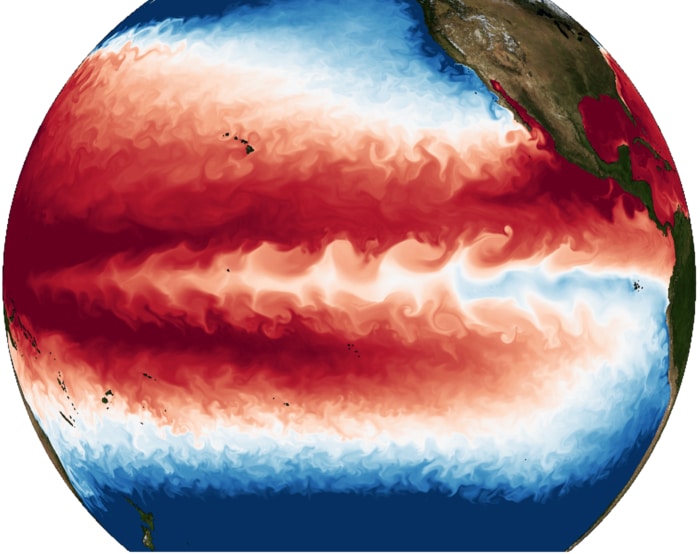
The team conducted a series of global climate model simulations with an unprecedented spatial resolution of 10 km in the ocean and 25 km in the atmosphere. Boosted by the power of one of South Korea’s fastest supercomputers (Aleph), the new ultra-high-resolution climate model simulations can now realistically simulate tropical cyclones in the atmosphere and tropical instability waves in the equatorial Pacific Ocean (see Fig.1), which both play fundamental roles in the generation and termination of El Niño and La Niña events. “Our supercomputer ran non-stop for over one year to complete a series of century-long simulations covering present-day climate and two different global warming levels. The model generated 2 quadrillion bytes of data; enough to fill up about 2,000 hard disks”, says Dr. Sun-Seon Lee who conducted the experiments. Surface ocean temperatures simulated at unprecedented resolution using a coupled atmosphere-ocean model. The extensive wavy cold structure in the equatorial Pacific corresponds to a tropical instability wave. Simulations were conducted on the IBS/ICCP supercomputer Aleph.

Analyzing this enormous dataset, the team focused on a long-standing problem: how will ENSO change in response to increasing greenhouse gas concentrations. “Two generations of climate scientists have looked at this issue using climate models of varying complexity. Some models simulated weaker; others predicted larger eastern Pacific temperature swings in a future warmer climate. The jury was still out.” says Prof. Axel Timmermann, co-corresponding author and Director of the ICCP. He adds “What is common to these models is that their simulated temperatures in the equatorial Pacific, west of Galapagos, were always too cold compared to the observations. This prevented them from properly representing the delicate balance between positive and negative feedback processes that are important in the ENSO cycle.”

By capturing small-scale climatic processes at the highest computationally possible resolution, the ICCP team was able to alleviate these ocean temperature biases, leading to substantial improvements in the representations of ENSO and its response to Global Warming. “The result from our computer simulations is clear: Increasing CO2 concentrations will weaken the intensity of the ENSO temperature cycle,” says Dr. Christian Wengel, first author of the study and former postdoctoral researcher at the ICCP, now at the Max Planck Institute of Meteorology in Hamburg in Germany.

By tracing the movement of heat in the coupled atmosphere/ocean system the scientists identified the main culprit of the collapse of the ENSO system: Future El Niño events will lose heat to the atmosphere more quickly due to the evaporation of water vapor, which tends to cool the ocean. In addition, the reduced future temperature difference between the eastern and western tropical Pacific will also inhibit the development of temperature extremes during the ENSO cycle. However, these two factors are partly offset by a projected future weakening of tropical instability waves (Fig. 1). Normally these oceanic waves, which can encompass up to 30% of the earth’s entire circumference, develop during La Niña conditions. They replace colder equatorial waters with warmer off-equatorial water, thereby accelerating the demise of a La Niña event. The new computer simulations, which resolve the detailed structure of these waves, demonstrate that the associated negative feedback for ENSO will weaken in the future.

“There is a tug-of-war between positive and negative feedbacks in the ENSO system, which tips over to the negative side in a warmer climate. This means future El Niño and La Niña events cannot develop their full amplitude anymore” comments ICCP alumni Prof. Malte Stuecker, co-author of the study and now assistant professor at the Department of Oceanography and the International Pacific Research Center at the University of Hawaiʻi at Mānoa.

Even though the year-to-year fluctuations in eastern equatorial Pacific temperatures are likely to weaken with human-induced warming according to this new study, the corresponding changes in El Niño and La Niña-related rainfall extremes will continue to increase due to an intensified hydrological cycle in a warmer climate, as shown in recent studies by scientists from the ICCP and their international collaborators.

“Our research documents that unabated warming is likely to silence the world’s most powerful natural climate swing which has been operating for thousands of years. We don’t yet know the ecological consequences of this potential no-analog situation“ says Axel Timmermann, “but we are eager to find out.”

BAS IceNet AI system helps to predict Arctic sea ice loss

A new AI (artificial intelligence) tool is set to enable scientists to more accurately forecast Arctic sea ice conditions months into the future. The improved predictions could underpin new early-warning systems that protect Arctic wildlife and coastal communities from the impacts of sea ice loss.

An international team of researchers led by the British Antarctic Survey (BAS) and The Alan Turing Institute describe how the AI system, IceNet, addresses the challenge of producing accurate Arctic sea ice forecasts for the season ahead – something that has eluded scientists for decades.

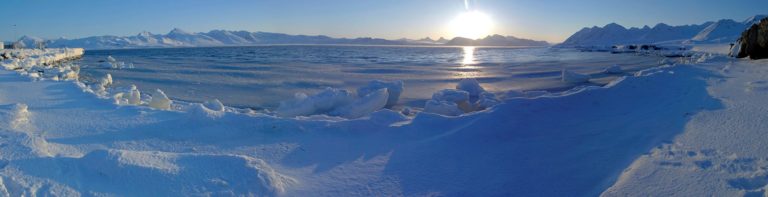
Sea ice, a vast layer of frozen seawater that appears at the North and South poles, is notoriously difficult to forecast because of its complex relationship with the atmosphere above and the ocean below. The sensitivity of sea ice to increasing temperatures has caused the summer Arctic sea ice area to halve over the past four decades, equivalent to the loss of an area around 25 times the size of Great Britain. These accelerating changes have dramatic consequences for our climate, Arctic ecosystems, and Indigenous and local communities whose livelihoods are tied to the seasonal sea ice cycle. From Svalbard archipelago in the Arctic.

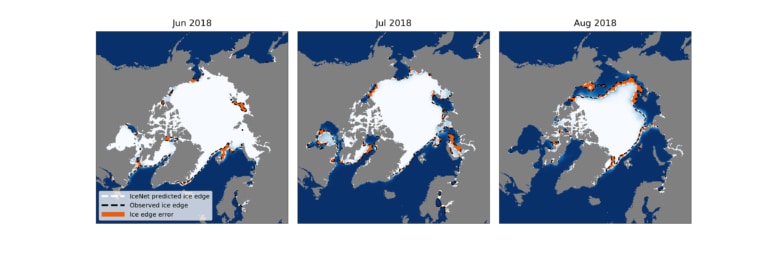
IceNet, the AI predictive tool, is almost 95% accurate in predicting whether sea ice will be present two months ahead – better than the leading physics-based model.

Lead author Tom Andersson, Data Scientist at the BAS AI Lab and funded by The Alan Turing Institute, explains: “The Arctic is a region on the frontline of climate change and has seen substantial warming over the last 40 years. IceNet has the potential to fill an urgent gap in forecasting sea ice for Arctic sustainability efforts and runs thousands of times faster than traditional methods.”

Dr. Scott Hosking, Principal Investigator, Co-leader of the BAS AI Lab, and Senior Research Fellow at The Alan Turing Institute, says: “I’m excited to see how AI is making us rethink how we undertake environmental research. Our new sea ice forecasting framework fuses data from satellite sensors with the output of climate models in ways traditional systems simply couldn’t achieve.” IceNet test. Figure 3, in Seasonal Arctic sea ice forecasting with probabilistic deep learning by Tom Andersson et al. (2021)

Unlike conventional forecasting systems that attempt to model the laws of physics directly, the authors designed IceNet based on a concept called deep learning. Through this approach, the model ‘learns’ how sea ice changes from thousands of years of climate simulation data, along with decades of observational data to predict the extent of Arctic sea ice months into the future.

Tom Andersson concludes: “Now we’ve demonstrated that AI can accurately forecast sea ice, our next goal is to develop a daily version of the model and have it running publicly in real-time, just like weather forecasts. This could operate as an early warning system for risks associated with rapid sea ice loss.”