NC State prof calculates partition function zeros as a shortcut to thermodynamic calculations on quantum supercomputers

A study led by researchers at North Carolina State University developed a new method that enables quantum supercomputers to measure the thermodynamic properties of systems by calculating the zeros of the partition function.

“We’ve illustrated a new way to get at thermodynamic properties of a system, such as free energy, entropy, and other properties that are too complex to currently being measured via traditional or quantum computing,” says Lex Kemper, associate professor of physics at NC State and corresponding author of a paper describing the work. “By calculating partition function zeros we are on the way to solving the problem of scaling to larger numbers of qubits when trying to calculate free energies and entropies in a given system.” 

Quantum supercomputers are often used to study complicated systems due to their ability to handle large computations beyond the reach of conventional computers. However, some problems, such as measuring the thermodynamics or free energy in a system (which involves calculating its entropy), are still too big for even these computers to handle efficiently. 

A partition function describes the statistical properties of a system in thermodynamic equilibrium. The total energy, free energy, entropy, or pressure of a system can be expressed mathematically in terms of the partition function or its derivatives.

Kemper and his colleagues used a quantum computer to measure the partition function zeros, rather than the entropy, of a spin model as it is tuned across a phase transition.

“Our method skips the part where we calculate the entropy in favor of looking at the partition function,” Kemper says. “That’s because the partition function is a generating function – a function that you can perform operations on to get at other thermodynamic information such as the internal energy and the entropy.

“We measure the partition function by determining where it is zero. Once you know all the zeros of a function, you know the whole function. Since the zeros lie in the complex plane, we used a mapping between having a complex magnetic field and time evolution to find them.”

The researchers calculated the partition function on both a standard and a trapped ion quantum computer in the laboratory of Norbert Linke at the University of Maryland. The results from both were compared favorably.

“This is a way to use a quantum computer to get at all the thermodynamic properties of a system without necessitating huge numbers of quantum computations,” Kemper says.

Florida State supercomputing improves the estimate of the amount of carbon in Earth’s outer core

New research from Florida State University and Rice University is providing a better estimate of the amount of carbon in the Earth’s outer core, and the work suggests the core could be the planet’s largest reservoir of that element.

The research, published in the journal Communications Earth & Environment, estimates that 0.3 to 2.0 percent of the Earth’s outer core is carbon.

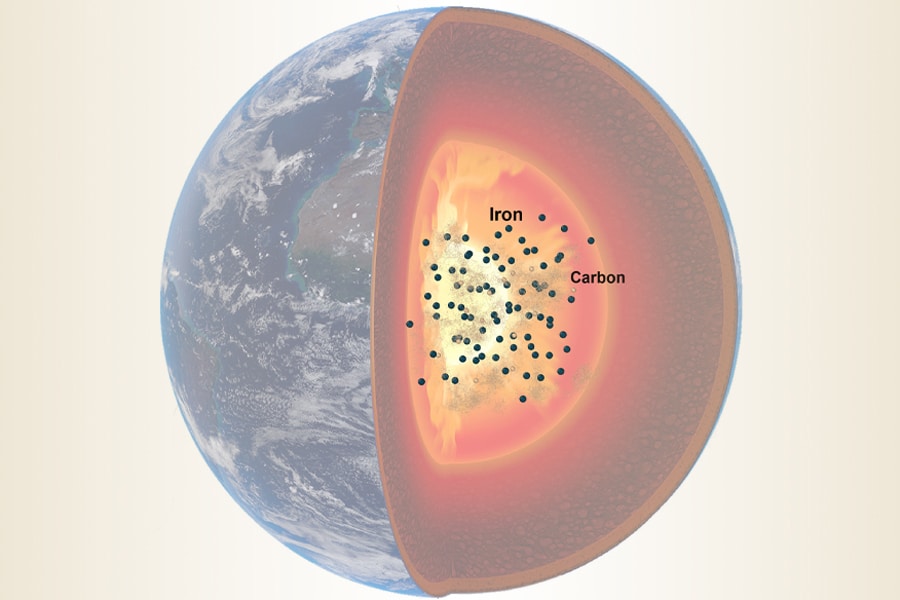
Though the percentage of carbon there is low, it’s still an enormous amount because the outer core is so large. The researchers estimated that the outer core contains between 5.5 and 36.8 × 10^24 grams of carbon — an immense number. An image of the interior of the Earth illustrating a simulation by Florida State University and Rice University researchers to investigate the composition of the planet's outer core. Dark circles in the core represent iron and tan circles represent carbon atoms. The paths taken by carbon atoms during the simulation are shown by the tan lines. (Illustration by Suraj Bajgain)

“Understanding the composition of the Earth’s core is one of the key problems in the solid-earth sciences,” said co-author Mainak Mookherjee, an associate professor of geology in the Department of Earth, Ocean, and Atmospheric Science. “We know the planet’s core is largely iron, but the density of iron is greater than that of the core. There must be lighter elements in the core that reduce its density. Carbon is one consideration, and we are providing better constraints as to how much might be there.”Mainak Mookherjee, an associate professor of geology in the Department of Earth, Ocean and Atmospheric Science

Previous research has estimated the total amount of carbon on the planet. This work refines the estimates for the carbon content of Earth to a range between about 990 parts per million and more than 6,400 parts per million. That would mean the core of the Earth — which includes both the outer core and the inner core — could contain 93 to 95 percent of the planet’s carbon.

Because humans can’t access the Earth’s core, they have to use indirect methods to analyze it. The research team compared the known speed of compressional sound waves traveling through the Earth to supercomputer models that simulated different compositions of iron, carbon, and other light elements at the pressure and temperature conditions of the Earth’s outer core.

“When the velocity of the sound waves in our simulations matched the observed velocity of sound waves traveling through the Earth, we knew the simulations were matching the actual chemical composition of the outer core,” said lead author and postdoctoral researcher Suraj Bajgain.

Scientists have attempted to give a range of the amount of carbon in the outer core before. This research narrows that possible range by including other light elements — namely oxygen, sulfur, silicon, hydrogen, and nitrogen — in the models estimating the outer core’s composition.

Just like hydrogen and oxygen and other elements, carbon is a life-essential element. It’s part of what makes life possible on Earth.

“It’s a natural question to ask where did this carbon that we are all made of coming from and how much carbon was originally supplied when the Earth formed,” Mookherjee said. “Where is the bulk of the carbon residing now? How has it been residing and how has it transferred between different reservoirs? Understanding the total inventory of carbon is what this study gives us insight to.” Suraj Bajgain, a postdoctoral researcher in the Department of Earth, Ocean and Atmospheric Science

Knowing how much carbon exists on Earth will help scientists improve their understanding of the composition of both our planet and rocky planets elsewhere in the universe.

“There have been a lot of activities over the last decade to determine the carbon budget of the Earth’s core using cosmochemical and geochemical models,” said study co-author Rajdeep Dasgupta, the Maurice Ewing Professor of Earth, Environmental and Planetary Sciences at Rice University. “However, it remained an open question because of a lot of uncertain parameters on the accretion process and the building blocks of rocky planets. What is neat about this study is that it provides a direct estimate of the Earth’s outer core’s present-day carbon budget. Therefore, this will, in turn, help the community bracket the possible planetary ingredients and the early processes better.”

SANKEN, Osaka University researchers measure the high-spin state of up to four electrons confined on a quantum dot using the quantum Hall effect

Scientists from SANKEN at Osaka University have demonstrated the readout of spin-polarized multielectron states composed of three or four electrons on a semiconductor quantum dot. By making use of the spin filtering caused by the quantum Hall effect, the researchers were able to improve upon previous methods that could only easily resolve two electrons. This work may lead to quantum computers based on the multielectron high-spin states.

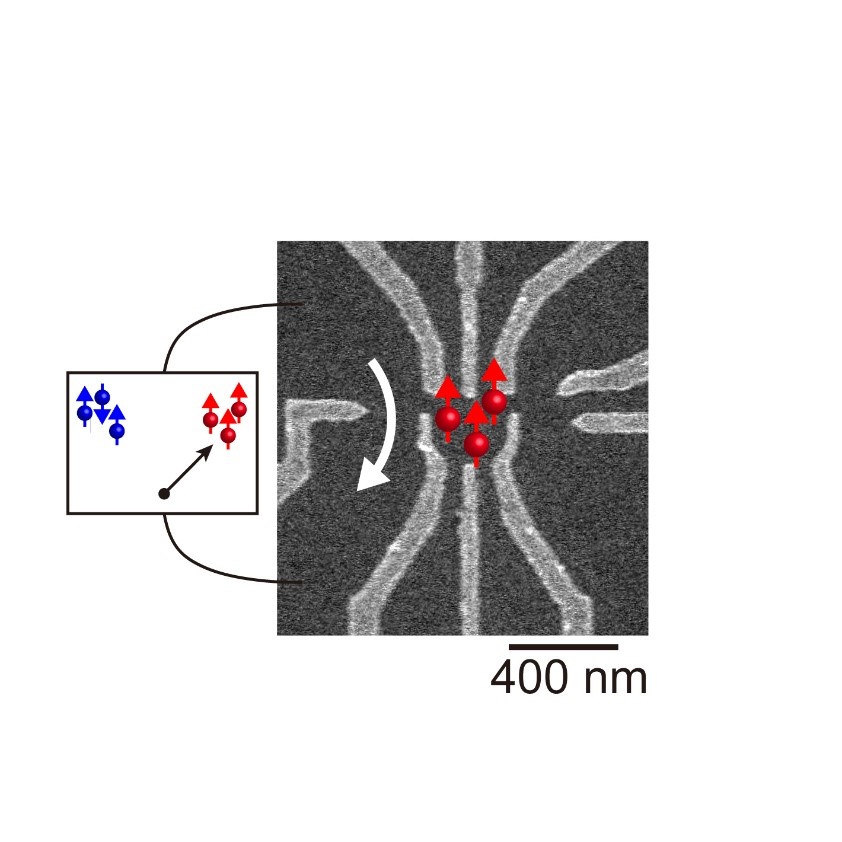
Despite the almost unimaginable increase in the power of computers over the last 75 years, even the fastest machines available today run on the same basic principle as the original room-sized collection of vacuum tubes: information is still processed by herding electrons through circuits based on their electric charge. However, computer manufacturers are rapidly reaching the limit of how much they can readily achieve with charge alone, and new methods, such as quantum supercomputing, is not ready yet to take their place. One promising approach is to utilize the intrinsic magnetic moment of electrons, called “spin,” but controlling and measuring these values has proven to be very challenging. Fig.1 Three-electron high-spin state in a semiconductor quantum dot and its readout. (credit: Osaka University)

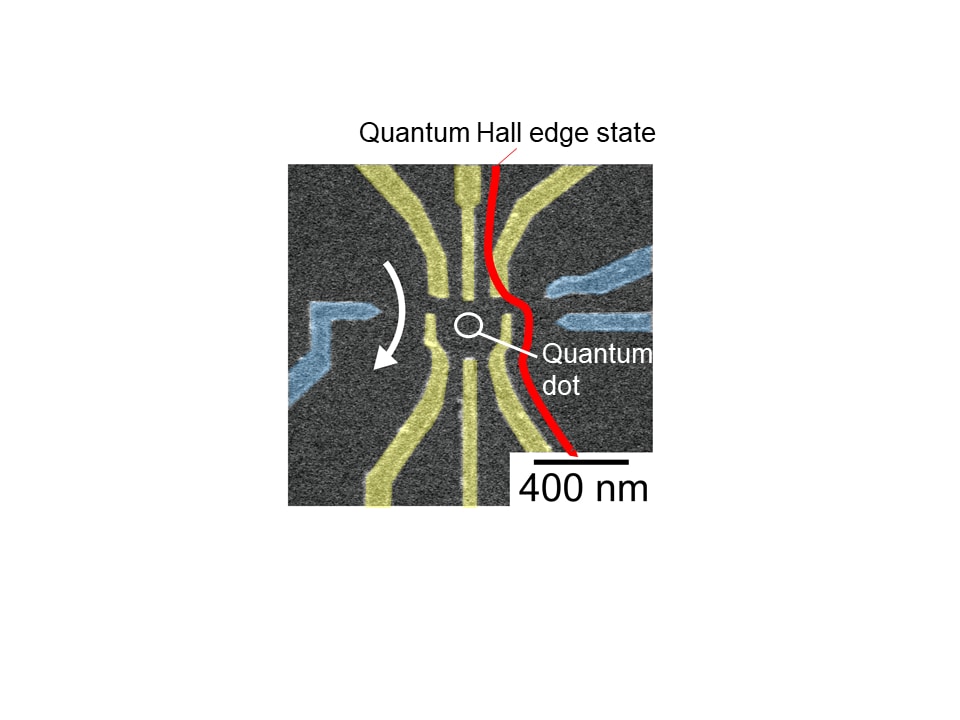
Now, a team of researchers led by Osaka University showed how to read out the spin state of multiple electrons confined to a tiny quantum dot fabricated from gallium and arsenic. Quantum dots act like artificial atoms with properties that can be tuned by scientists by changing their size or composition. However, the gaps in energy levels generally become smaller and harder to resolve as the number of trapped electrons increases.
Fig.2 Scanning electron micrograph of the quantum dot device used in this work. (credit: Osaka University)
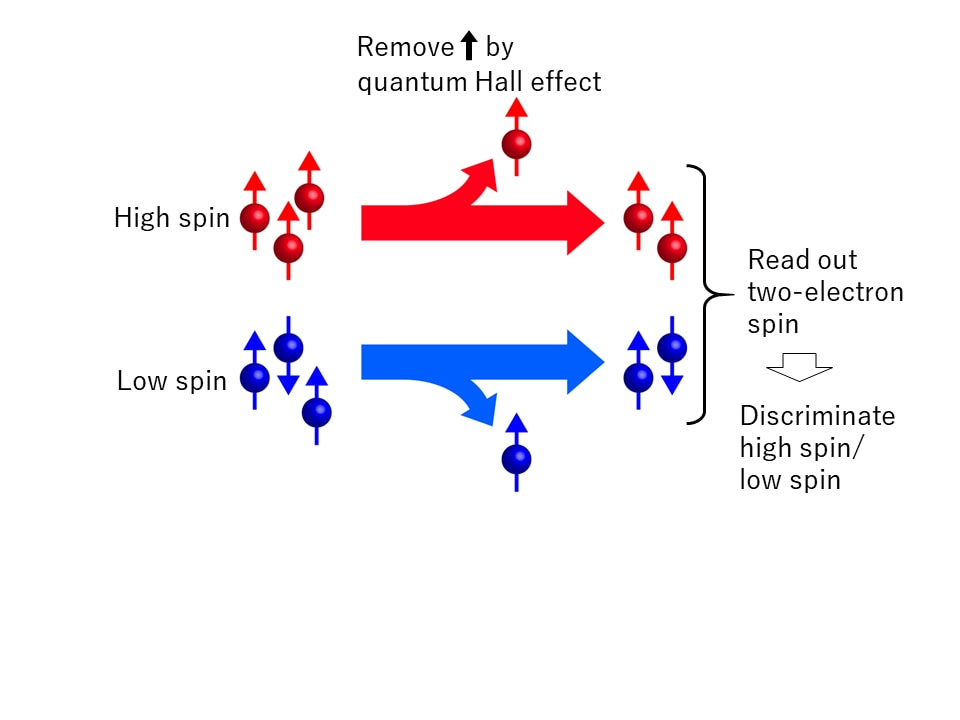
To overcome this, the team took advantage of a phenomenon called the quantum Hall effect. When electrons are confined to two dimensions and subjected to a strong magnetic field, their states become quantized, so their energy levels can only take on certain specific values. “Previous spin readout methods could only handle one or two electrons, but using the quantum Hall effect, we were able to resolve up to four spin-polarized electrons,” first author Haruki Kiyama says. To prevent disturbances from thermal fluctuations, the experiments were performed at extremely low temperatures, around 80 millikelvins. “This readout technique may pave the way toward faster and higher-capacity spin-based quantum information processing devices with multielectron spin states,” senior author Akira Oiwa says.

Fig.3 Concept of the high-spin readout. (credit: Osaka University)